The Long-Term Investor's Reference Manual — Volume 8
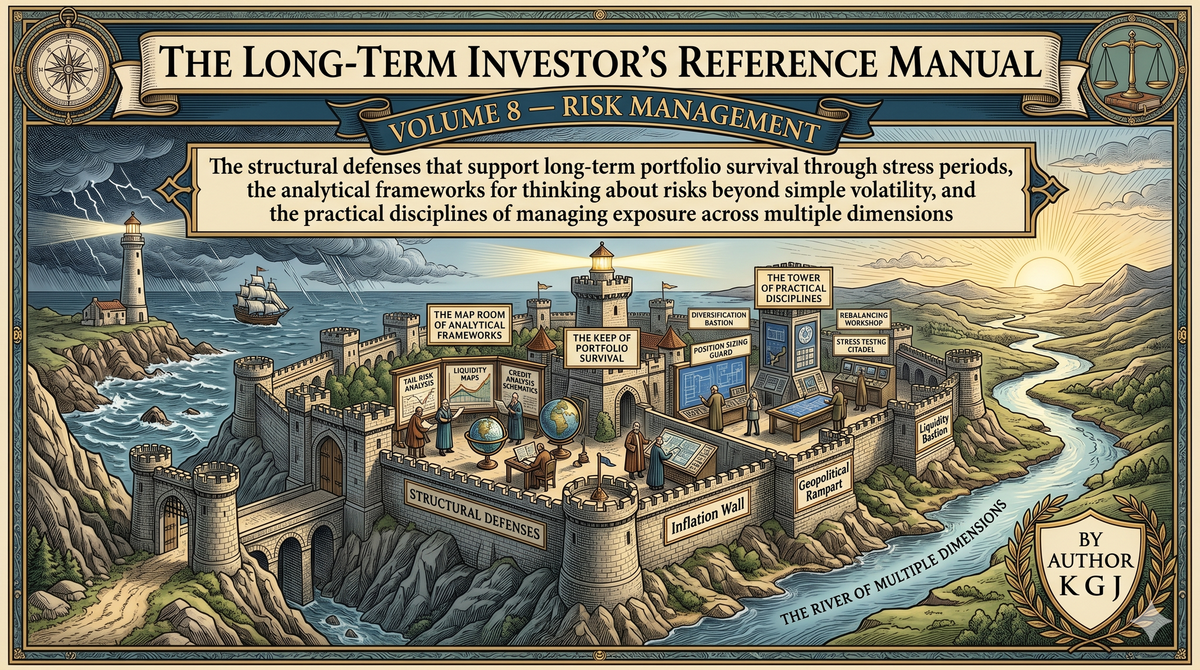
Risk Management The structural defences that support long-term portfolio survival through stress periods, the analytical frameworks for thinking about risks beyond simple volatility, and the practical disciplines of managing exposure across multiple dimensions

Preface to Volume 8
The previous volume covered portfolio construction — the integration of asset classes into coherent structures designed to meet investor objectives. This volume covers risk management — the structural defences that support those portfolios through stress periods and the analytical frameworks for understanding and managing the various risks that affect investment outcomes.
Risk management is sometimes treated as an extension of portfolio construction, sometimes as a separate discipline. The distinction matters less than the integration of both. A portfolio that's mathematically optimal but cannot be sustained through major drawdowns produces poor outcomes; a portfolio that survives stress but produces inadequate returns also produces poor outcomes. Both portfolio construction and risk management contribute to the goal of long-term wealth accumulation through whatever environments occur.
The conceptual challenge of risk management is that risk has many dimensions. Volatility is one dimension — measurable through standard deviation of returns and reasonably well-handled by traditional portfolio theory. But volatility doesn't capture everything that matters. Drawdowns can be larger and more damaging than volatility statistics suggest. Tail events — outcomes outside the normal distribution range — can devastate portfolios designed for normal conditions. Liquidity risk — the inability to transact at expected prices when needed — is essentially absent from most theoretical frameworks but matters substantially in practice. Currency risk affects international holdings in ways that aren't captured by domestic-currency return statistics. Inflation risk erodes real wealth even when nominal returns appear adequate. Sequence-of-returns risk specifically affects retirees taking withdrawals during early retirement market declines.
This volume addresses these multiple dimensions of risk with both analytical frameworks and practical disciplines. The combination of theoretical understanding and practical application is necessary because risk management requires both — the frameworks help identify and measure risks; the disciplines help implement appropriate responses.
The volume is organised into twelve sections. Sections 1 through 3 establish the analytical foundations — what risk actually means beyond volatility, the specific framework for understanding drawdowns and tail risk, and the discipline of position sizing as the primary risk control. Section 4 covers concentration risk, which extends position sizing to broader portfolio concentrations across sectors, geographies, and economic exposures. Section 5 addresses liquidity risk, which becomes acute during stress periods and requires specific structural management. Section 6 covers currency risk for investors with international exposure, including the hedging decision and its implications. Section 7 addresses inflation risk and the structural defences against erosion of real wealth. Section 8 develops sequence-of-returns risk specifically for retirees and pre-retirees managing the transition to drawdown phase. Section 9 covers the broader category of behavioural risks — the ways that investor psychology can damage portfolio outcomes through poor execution. Section 10 addresses systemic risk and the limits of diversification during severe market stress. Section 11 introduces the discipline of stress testing portfolios to identify hidden vulnerabilities. Section 12 synthesises the framework.
A note on the relationship to portfolio theory. Modern portfolio theory addresses risk primarily through variance and covariance — useful but incomplete frameworks. This volume takes a broader view that incorporates dimensions of risk that variance-based frameworks miss. The goal is not to abandon variance-based thinking but to supplement it with additional frameworks for risks that variance doesn't fully capture.
A note on practical orientation. Risk management can become academic when divorced from practical application. This volume emphasises practical disciplines — specific actions investors should take, specific structures that provide protection, specific signs that warrant attention. The frameworks support better decision-making; the disciplines implement that decision-making in practice.
A note on Australian context. Australian investors face specific risk considerations — currency exposure interacting with commodity cycles, concentration risk in property and Australian equities, the franking credit framework affecting after-tax outcomes, the unusual property concentration in household balance sheets. These specific considerations receive attention throughout the volume.
A note on Berkshire's approach. Buffett has emphasised throughout his career that "the first rule of investing is don't lose money; the second rule is don't forget the first rule." This isn't quite literally true — risky investments can be appropriate when expected returns justify the risk. But the spirit captures Berkshire's emphasis on capital preservation as foundation for long-term compounding. Multiple sections in this volume reference Berkshire's specific approaches to various risk dimensions.
Section 1 — What Risk Actually Means
The starting point for risk management is clarity about what risk actually means. The everyday usage conflates several distinct concepts, and the standard finance definitions don't always match what investors actually care about. This section develops a richer framework.
1.1 The various meanings of risk
In ordinary usage, "risk" carries several connotations:
Probability of loss. The chance that an investment will produce negative returns. This intuitive definition focuses on the asymmetric concern most investors actually have — they care more about losses than about volatility around a positive mean.
Magnitude of potential loss. How bad can it get? An investment that might lose 5% in the worst case is fundamentally different from one that might lose 80%, even if the probability of loss is similar.
Variability of returns. How much do returns fluctuate around their mean? This is the standard finance definition, captured by standard deviation or variance.
Uncertainty about outcomes. How well can we predict what will happen? Investments with well-understood return distributions have less uncertainty than investments with substantial unknown unknowns.
Failure to meet objectives. Will the investment meet the specific goals it's intended to meet? An investment may have low variance but still fail if it doesn't grow enough to fund retirement, education, or other specific needs.
Permanent capital impairment. Will I get my money back? Some declines are temporary (recoverable through patience); others represent permanent loss of capital that can never be recovered regardless of patience.
Behavioural risk. Will I capitulate during stress and convert temporary declines into permanent ones? The risk that the investor's response to volatility will damage outcomes more than the volatility itself.
These different meanings are related but distinct. A focus on volatility (standard deviation) captures one dimension but misses others. A comprehensive risk framework addresses multiple dimensions simultaneously.
1.2 Volatility versus risk
The standard finance definition of risk as volatility (standard deviation of returns) has several limitations:
Symmetric treatment of upside and downside. Volatility treats positive and negative deviations equally, but investors don't experience them equally. A portfolio that goes up 30% and down 20% has the same volatility statistics as one that goes up 20% and down 30%, but the experience and outcomes are very different.
Assumes normal distribution. Standard deviation fully describes a normal distribution but inadequately describes distributions with fat tails, skewness, or other non-normal features. Most actual return distributions deviate substantially from normal.
Ignores correlation with needs. Volatility in isolation doesn't capture whether the investment's bad outcomes coincide with the investor's bad times. An investment with high volatility but uncorrelated with investor's spending needs may be less concerning than a low-volatility investment that happens to lose value when needed for spending.
Time-frame dependence. Daily volatility, monthly volatility, and annual volatility produce different numbers. An investment with high daily volatility but stable annual returns may behave very differently than one with low daily volatility but unstable annual returns.
Doesn't capture maximum drawdown. Two investments with similar volatility statistics can have very different maximum drawdowns. Maximum drawdown is the metric retirees care about most, but it isn't directly captured by volatility.
Doesn't capture tail risk. The probability of extreme outcomes (3+ standard deviation events) is much higher in actual markets than normal-distribution models suggest. Volatility statistics calibrated to normal-period data understate tail probabilities.
These limitations don't make volatility useless — it's still a meaningful risk measure. But it should be supplemented with other measures that capture dimensions volatility misses.
1.3 The risks that actually matter
For most investors, the risks that actually matter are:
Permanent capital loss. Any investment that produces permanent loss (rather than temporary decline followed by recovery) is fundamentally damaging. Permanent capital loss includes:
- Bankruptcies of held companies
- Defaults on bonds (without recovery)
- Frauds and scams
- Currency confiscations or capital controls
- Regulatory actions destroying value
- Companies acquired at low prices preventing future recovery
Failure to meet goals. The risk that the portfolio doesn't grow enough to fund intended objectives. This depends on:
- Inflation eroding real returns
- Insufficient nominal returns
- Spending exceeding sustainable withdrawal rates
- Sequence of returns affecting drawdown sustainability
Substantial drawdowns at wrong times. Major declines that:
- Force capitulation at bottoms
- Coincide with spending needs
- Damage psychological capacity to maintain investment
- Produce divorces, lawsuits, or other complications
Inflation erosion. The slow but cumulative loss of purchasing power that affects nominal-currency holdings. Over decades, modest inflation can devastate real wealth even when nominal returns appear adequate.
Currency-related risks. For investors with international exposure or with retirement plans in different currencies than their assets:
- Adverse currency movements affecting realised returns
- Hedging costs reducing returns
- Mismatches between liabilities and assets
Liquidity unavailability when needed. The inability to access funds at appropriate prices when spending needs arise:
- Forced sales at bad prices
- Inability to access locked-up alternatives
- Mismatch between asset liquidity and liability timing
Tail events outside normal distributions. Events that variance-based models don't predict:
- Major financial crises
- Geopolitical disruptions
- Pandemics
- Natural disasters
- Technological disruptions
Behavioural failures during stress. The risk that the investor's own actions damage outcomes:
- Capitulation at market bottoms
- Performance chasing at tops
- Abandonment of strategic discipline
- Emotional decision-making during volatility
For investment decision-making, these "real risks" matter more than volatility statistics. The risk management framework should address these dimensions, not just optimise variance.
1.4 Risk capacity versus risk tolerance
Two related but distinct concepts:
Risk capacity is the financial ability to absorb losses without compromising essential goals. Investors with substantial wealth relative to spending needs have higher risk capacity than those barely meeting goals. Risk capacity is objective — it can be calculated from balance sheets and spending requirements.
Risk tolerance is the emotional ability to absorb losses without making damaging behavioural decisions. Risk tolerance is subjective — it depends on individual psychology, prior experience, and circumstances. Risk tolerance is often overstated by investors before they experience actual stress.
Both dimensions matter:
- High capacity + high tolerance: aggressive allocation appropriate
- High capacity + low tolerance: capacity argues for more risk; tolerance constrains; typical resolution is moderate allocation
- Low capacity + high tolerance: capacity should dominate; aggressive allocation creates fragility
- Low capacity + low tolerance: conservative allocation appropriate
Common mistakes:
- Investors with high capacity but moderate tolerance holding portfolios more aggressive than they'll maintain through stress
- Investors with low capacity but high tolerance holding aggressive portfolios that may fail to meet essential goals during downturns
- Mismatches between stated tolerance and demonstrated tolerance
The discipline is to assess both honestly and let the more conservative dimension constrain the allocation. An investor whose mathematical optimum is 80% equity but who would capitulate at 30% should hold less equity. An investor whose mathematical optimum is 80% but whose financial capacity can absorb only 30% loss should hold less equity.
1.5 Known and unknown risks
A useful distinction is between:
Known knowns: Risks we know about and can quantify. Equity volatility, bond duration risk, credit risk on rated bonds, currency exposure on foreign holdings.
Known unknowns: Risks we know exist but cannot quantify precisely. Major recession risks, geopolitical events, regulatory changes. We know these can happen but can't predict timing or magnitude reliably.
Unknown unknowns: Risks we don't even know exist until they manifest. Black swan events outside historical experience.
The framework was popularised by Nassim Taleb's "Black Swan" thinking but reflects long-standing risk management understanding.
For investors:
Known knowns can be managed through standard frameworks — diversification, position sizing, hedging, etc.
Known unknowns require structural defences that work even when specific events can't be predicted — adequate liquidity reserves, broad diversification, conservative leverage, avoidance of excessive concentration.
Unknown unknowns require humility and structural robustness — building portfolios that can survive unexpected events even when specific risks aren't anticipated. This argues for:
- Modest leverage (so unexpected stress doesn't trigger forced selling)
- Adequate liquidity (so spending continues during disruptions)
- Diversification across multiple dimensions (so single events don't devastate)
- Conservative assumptions (so reality unexpectedly bad doesn't cause failure)
The Buffett quote about "swimming naked when the tide goes out" captures this — leverage and concentration that work fine in normal conditions can fail catastrophically when conditions change unexpectedly. Risk management should focus on robustness across conditions rather than optimisation for current conditions.
1.6 The asymmetry of compounding
A specific feature of investment risk that warrants attention is the asymmetry of compound returns:
To recover from a 10% decline requires an 11.1% gain. To recover from a 25% decline requires a 33.3% gain. To recover from a 50% decline requires a 100% gain. To recover from a 75% decline requires a 300% gain. To recover from a 90% decline requires a 900% gain.
The asymmetry means that large losses are disproportionately damaging compared to large gains. A portfolio that earns +50% one year and -50% the next year is down 25% over the two years, despite arithmetic average return of 0%.
For long-term investors, this asymmetry has important implications:
Avoiding large losses matters more than capturing all gains. A portfolio that captures 80% of the upside but avoids 80% of the downside often outperforms portfolios that capture 100% of both.
Sequence matters. Losing 50% then gaining 50% is much worse than gaining 50% then losing 50% — the latter ends back at the starting point; the former ends down 25%.
Recovery time depends on compounding. After a 50% decline, even reasonable annual returns (8%) take 9 years to fully recover. The opportunity cost of those 9 years is substantial.
Permanent loss is worst. If the 50% decline becomes 100% loss (bankruptcy, fraud, etc.), no recovery is possible regardless of subsequent returns.
The asymmetry argues for risk management focus on avoiding catastrophic outcomes rather than optimising for normal conditions. A small probability of total loss can be more damaging to long-run outcomes than substantial probability of moderate underperformance.
1.7 The path-dependency of investment outcomes
Related to the asymmetry of compounding is the path-dependency of investment outcomes. The order of returns matters, not just the average:
Consider two investors with $1M starting portfolios, both withdrawing $50K annually for 30 years, both experiencing average annual returns of 7%:
Investor A experiences strong early returns and weak later returns:
- Years 1-15: average 12% return
- Years 16-30: average 2% return
Investor B experiences weak early returns and strong later returns:
- Years 1-15: average 2% return
- Years 16-30: average 12% return
Despite identical average returns and identical withdrawals, the outcomes differ dramatically:
Investor A maintains substantial portfolio value throughout because early strong returns build the base. By year 15, the portfolio has grown despite withdrawals, providing buffer against subsequent weak returns. The path produces success.
Investor B depletes the portfolio rapidly because weak early returns combined with withdrawals reduce the base. By the time strong returns arrive, the remaining capital is too small to benefit substantially. The path produces failure.
This is sequence-of-returns risk in its starkest form. The same average return produces vastly different outcomes depending on when the gains and losses arrive.
For accumulators, path-dependency matters less because no withdrawals occur. The order of returns doesn't matter much; only the cumulative result matters. But for retirees taking withdrawals, path-dependency can be the difference between sustainable lifestyle and bankruptcy.
The implications for risk management:
Risk profile should match life stage. Accumulators can absorb sequence variation; retirees cannot.
Bucket strategies address path-dependency. By separating near-term spending from long-term growth assets, retirees can avoid forced sales during weak periods.
Spending flexibility provides protection. Retirees who can reduce spending during weak markets fare much better than those locked into high spending levels.
Withdrawal rates need conservative buffers. Standard 4% rules require buffers that account for sequence risk, not just average return assumptions.
1.8 Risk as opportunity cost
A frequently overlooked perspective: risk also includes the cost of being too conservative.
Investors who hold all cash (or near-cash) avoid most short-term volatility but accept:
Inflation erosion. Cash returns typically don't keep pace with inflation, particularly after taxes. Real wealth slowly erodes.
Lost compounding. Decades of cash holdings forfeit the equity premium that long-term investors expect. The opportunity cost compounds substantially.
Goal failure risk. Conservative allocations may not generate enough growth to meet retirement, education, or other long-term goals.
Insufficient income in retirement. A retiree with all cash faces declining real income through retirement as prices rise. This can be more damaging than equity volatility risks.
The "safe" choice of conservative allocation is only safe relative to specific risks — short-term volatility, capital preservation in nominal terms. It introduces other risks — inflation, opportunity cost, goal failure. Comprehensive risk management addresses both dimensions rather than focusing exclusively on one.
For long-term investors, the genuinely riskiest portfolios are often very conservative ones held for decades during inflationary periods. The cumulative damage from inflation and lost compounding can exceed the worst equity drawdowns over time.
The discipline is to take appropriate risk for the time horizon and circumstances — not zero risk (which has its own costs), not maximum risk (which has obvious costs), but the level of risk that balances multiple concerns over the relevant time frame.
1.9 The concept of robustness
A useful synthesising concept is "robustness" — the ability of a portfolio to perform reasonably across different conditions rather than optimally for specific conditions.
Robust portfolios:
Survive unexpected events. Portfolios designed only for "normal" conditions can fail catastrophically when conditions change. Robust portfolios maintain functionality across a range of conditions.
Don't depend on specific assumptions. Portfolios that require specific economic conditions, specific correlations, or specific market behaviours to perform are fragile. Robust portfolios don't depend on specific assumptions.
Maintain optionality. Portfolios that maintain liquidity and flexibility can respond to new information and opportunities. Portfolios fully committed to specific strategies cannot adjust.
Avoid catastrophic outcomes. Even at the cost of slightly lower expected returns, avoiding outcomes that would devastate wealth supports better long-term results through asymmetric compounding.
Allow continued execution. Portfolios that produce psychological capitulation can't be sustained. Robust portfolios can be maintained through different conditions because investors can stay with them.
The robustness perspective shifts emphasis from optimisation (best for current conditions) to durability (works across conditions). This reframing matches how risk management should think about portfolio construction.
Buffett's portfolio approach exemplifies robustness:
- Concentrated in genuinely understood positions
- Conservative leverage (Berkshire historically operated with very low debt)
- Substantial cash reserves
- Long-term holding orientation (allows working through cycles)
- Diversified across business types (not just market exposure)
- Low-cost structure
- Avoidance of complex instruments with hidden risks
These choices may not produce optimal results in any specific period, but they support the multi-decade compounding that has built Berkshire's wealth. The robustness emphasis is consistent with most successful long-term investment approaches.
Section 2 — Drawdowns and Tail Risk
Drawdowns — peak-to-trough portfolio declines — are perhaps the most important risk metric for long-term investors. Tail risk — the possibility of outcomes outside what normal-distribution thinking predicts — has been responsible for some of the worst investment outcomes in history. This section covers both concepts in detail.
2.1 What drawdowns are and why they matter
A drawdown measures the percentage decline from a peak to a subsequent trough. Several specific drawdown metrics:
Maximum drawdown is the largest peak-to-trough decline experienced over a specified period. For a portfolio with peak value of $1.2M and trough of $700K, the maximum drawdown is 41.7%.
Time underwater measures how long the portfolio remained below the previous peak. A portfolio that took 5 years to recover from its drawdown was underwater for 5 years.
Average drawdown considers the average drawdown across a period rather than just the maximum.
Pain index combines drawdown depth and duration into a single metric, capturing both how bad and how long.
Conditional drawdown at risk (CDaR) measures the expected drawdown given that the drawdown exceeds a specified threshold.
Why drawdowns matter beyond what volatility captures:
They reflect actual experience. The investor who watched their $1M portfolio decline to $500K experienced 50% drawdown regardless of what statistical measures suggest. The lived experience of watching wealth decline is what produces psychological challenges.
They constrain spending and decision-making. Investors in drawdown can't spend or rebalance the same way as those at peak values. The constraint affects life decisions beyond the portfolio itself.
They produce capitulation risk. Substantial drawdowns produce the strongest temptation to abandon strategy. Many investors who could have absorbed 30% drawdowns capitulated during 50% drawdowns.
They affect retirees differently. Drawdowns matter most for retirees taking withdrawals — early-retirement drawdowns can permanently impair portfolio sustainability.
They limit optionality. During substantial drawdowns, the ability to take advantage of opportunities (new investments, value purchases) is constrained by reduced wealth.
Historical drawdowns illustrate the magnitude that can occur:
US equity major drawdowns:
- 1929-1932: -83% (Great Depression)
- 1973-1974: -45% (oil crisis, stagflation)
- 2000-2002: -49% (dot-com bust)
- 2007-2009: -55% (financial crisis)
- 2020 (March): -34% (COVID, brief)
- 2022: -25% (inflation/rates)
These are S&P 500 declines; individual stocks and sectors had much larger declines in these episodes.
Australian equity major drawdowns:
- 2007-2009: -54% (financial crisis)
- 1987 (October): -42% (Black Monday)
- 2020 (March): -36% (COVID)
- 2022: -15% (more moderate than US)
Bond drawdowns (typically smaller but real):
- 2022: -13% (worst year since 1842 for long Treasuries)
- Various inflation periods
Real estate drawdowns:
- US residential 2007-2010: -25-50% (varies by market)
- Various commercial real estate cycles: -30-60%
These historical drawdowns provide context for what investors should plan to absorb without panic. A portfolio designed for normal conditions only is inadequately prepared for the drawdowns that have occurred historically and will likely occur again.
2.2 The relationship between volatility and drawdowns
Mathematical relationship: drawdowns and volatility are related but not identical.
For a normally distributed return process, expected maximum drawdown over a period scales with volatility and time:
Expected maximum drawdown ≈ Volatility × √(2 × Time × ln(Time))
This rough relationship suggests:
- Higher volatility produces larger expected drawdowns
- Longer time periods produce larger expected maximum drawdowns
- The relationship is non-linear
For specific examples:
- 15% annual volatility over 30 years: expected maximum drawdown approximately 50%
- 10% annual volatility over 30 years: expected maximum drawdown approximately 35%
- 20% annual volatility over 30 years: expected maximum drawdown approximately 65%
These are approximate calculations based on normal distribution assumptions. Actual drawdowns are often larger than these calculations suggest because:
- Returns are not normally distributed (fat tails)
- Volatility itself varies (high during stress periods)
- Drawdowns are path-dependent (sequences of losses compound)
For practical planning, investors should expect drawdowns substantially larger than what simple volatility calculations suggest. A "100-year storm" is far more frequent than once per century.
2.3 Tail risk: distributions beyond normal
Tail risk refers to the probability of extreme outcomes — events in the "tails" of the return distribution that produce severe losses.
The conceptual issue: most financial models assume normally distributed returns. Under normal distribution:
- 1 standard deviation events occur approximately 32% of years
- 2 standard deviation events occur approximately 5% of years
- 3 standard deviation events occur approximately 0.3% of years
- 4 standard deviation events occur approximately 0.006% of years (once in 16,000 years)
- 5 standard deviation events occur approximately 0.00006% of years
But empirically, financial markets produce extreme events much more frequently than normal distribution predicts:
Black Monday October 1987: approximately 22% one-day decline in US equities. Under normal distribution assumptions, this would be approximately a 20+ standard deviation event — essentially impossible. Yet it happened.
2008 financial crisis: weekly and monthly returns produced multiple events that should be vanishingly rare under normal distribution.
March 2020 COVID crash: 34% decline in 5 weeks, with several days of >5% decline.
The reasons for this excess of extreme events:
Fat tails. Financial return distributions have "fatter tails" than normal distributions — extreme outcomes are more common than normal models suggest.
Skewness. Many financial return distributions are negatively skewed — large negative outcomes are more common than large positive outcomes of similar magnitude.
Volatility clustering. Volatility isn't constant — periods of low volatility alternate with periods of high volatility. Extreme moves often come in clusters during high-volatility periods.
Correlation breakdowns. During severe stress, normally diversified portfolios can experience correlated losses across asset classes that would be impossible under normal correlation structures.
Liquidity dynamics. During stress, liquidity disappears faster than gradual selling, producing larger price moves than fundamental analysis would suggest.
The implications for risk management:
Don't rely on normal-distribution risk measures alone. Standard deviation, Value at Risk (VaR), and similar measures based on normal assumptions understate tail risk substantially.
Plan for outcomes beyond historical experience. The worst event in your lifetime may not yet have occurred. Risk management should include scenarios beyond what historical data shows.
Maintain structural robustness. Specific defences against tail events include conservative leverage, adequate liquidity, broad diversification, and avoidance of catastrophic concentrations.
Understand the limitations of models. Risk models that worked in normal periods can fail catastrophically in stress. The 2008 crisis revealed many institutional risk models that completely failed during the actual stress event.
2.4 Value at Risk and its limitations
Value at Risk (VaR) is a widely used risk measure that estimates the maximum expected loss over a specified period at a specified confidence level.
For example, "1-month 99% VaR of $100,000" means there's a 99% probability that monthly losses won't exceed $100,000 (and a 1% probability they will).
The mechanics:
Historical VaR uses historical return data to identify the loss level corresponding to the specified percentile.
Parametric VaR assumes a specific distribution (typically normal) and calculates VaR analytically from variance estimates.
Monte Carlo VaR simulates thousands of return scenarios based on assumed distributions to estimate VaR.
VaR has been widely adopted by financial institutions and regulators. The Basel framework for bank capital requirements relies heavily on VaR concepts.
Limitations of VaR:
Doesn't tell you about the magnitude of losses beyond the threshold. A 99% VaR of $100,000 doesn't distinguish between cases where the 1% loss is $150,000 versus $5,000,000. In the financial crisis, many institutions found their VaR-based models predicted losses well below what actually occurred.
Sensitivity to distribution assumptions. Parametric VaR depends on assumed distributions; if those assumptions are wrong (typically because of fat tails), VaR substantially understates risk.
Encourages concentrated positions that look safe. Strategies can be designed to look safe under VaR while concealing substantial tail risk. The classic "picking up dimes in front of a steamroller" strategies — frequent small gains punctuated by occasional catastrophic losses — can have low VaR but be genuinely risky.
Doesn't capture liquidity risk. VaR assumes that positions can be liquidated at expected prices. In stress, this assumption fails dramatically.
Procyclical. Short-window VaR calculations make positions appear safer in calm periods (low recent volatility) and riskier in stressed periods (high recent volatility). This can encourage taking risk at peaks and reducing risk at bottoms — exactly wrong.
Doesn't account for behavioural responses. The VaR doesn't consider what other market participants will do during stress. Correlated forced selling can produce moves much larger than individual position VaR suggests.
The limitations led to development of alternative measures:
Expected Shortfall (ES) or Conditional VaR (CVaR): The expected loss given that the loss exceeds VaR. CVaR captures the magnitude of tail losses, not just whether they exceed a threshold.
Stress testing: Specific scenarios applied to portfolios to identify vulnerabilities. Covered in Section 11.
Scenario analysis: Range of plausible scenarios with probability weightings.
For retail investors, VaR is rarely directly relevant. The takeaway is that simple risk metrics can be deeply misleading and that comprehensive risk thinking requires multiple frameworks.
2.5 Specific historical tail events
Several historical episodes illustrate how tail risk manifests in practice.
1987 Black Monday:
- October 19, 1987: S&P 500 declined 20.5% in one day
- Cumulative decline from August peak to October trough: 33%
- No specific obvious trigger; suggested combination of program trading, portfolio insurance dynamics, and confidence shock
- Recovery: surprisingly fast. S&P 500 reached new highs within 2 years.
- Lessons: market structure dynamics can produce moves that fundamentals don't justify; recovery can be faster than feared
1998 Long-Term Capital Management:
- Highly leveraged hedge fund with Nobel laureate principals
- Strategies based on "convergence" of related security spreads
- Russia default in August 1998 produced flight-to-quality and spread divergence
- LTCM's $4.7 billion equity supported $129 billion in positions, with $1+ trillion in derivatives notional
- Federal Reserve organised industry rescue to prevent systemic collapse
- Lessons: leverage and concentration can produce catastrophic losses from events models don't anticipate; "convergence" strategies can fail when correlations break
2008 Financial Crisis:
- Triggered by housing market decline and subprime mortgage defaults
- Lehman Brothers bankruptcy September 15, 2008 produced systemic stress
- AIG required massive Fed support
- Major bank failures and forced consolidations
- S&P 500 declined 49% from October 2007 peak to March 2009 trough
- Bonds with "AAA" ratings produced losses unprecedented for that rating
- Lessons: ratings and risk models can fail systemically; correlations rise dramatically in stress; liquidity disappears faster than expected
2010 Flash Crash:
- May 6, 2010: Dow Jones declined nearly 1,000 points in minutes, then recovered
- High-frequency trading dynamics produced cascade of selling
- Recovery within an hour, but illustrated market structure vulnerabilities
- Various individual stocks traded at penny prices momentarily
- Lessons: market microstructure produces vulnerabilities not visible during normal conditions
2020 March COVID Crash:
- February 19 to March 23: S&P 500 declined 34% in approximately 5 weeks
- Some days produced 10%+ declines
- Bond markets had liquidity dysfunctions despite Treasuries supposedly being most liquid market
- Substantial Fed intervention restored market function
- Recovery began rapidly with stimulus and intervention
- Lessons: even Treasury market can have liquidity stress; central bank intervention has been remarkably effective at restoring function
2022 Bond Crash:
- Rising inflation produced aggressive Fed rate increases
- 30-year Treasury bonds declined approximately 35% from peak
- Long bond ETFs (TLT) lost approximately 30%
- Aggregate bond ETFs lost approximately 13%
- Stocks and bonds declined together, eliminating typical diversification
- Lessons: bonds aren't always safe haven; long-duration assets vulnerable to inflation; diversification benefits can disappear
These episodes share several patterns:
- Triggered by events that seem obvious in retrospect but were unanticipated
- Rapid declines once stress begins
- Liquidity disappears faster than expected
- Recovery often faster than feared but slower than hoped
- Investors who maintained discipline generally fared better than those who capitulated
2.6 Designing for drawdown survival
Practical implications for portfolio construction:
Match equity allocation to drawdown tolerance. The maximum drawdown an investor can sustain emotionally and financially constrains the appropriate equity allocation. Investors who can tolerate 25% drawdown should hold less equity than those who can tolerate 50%.
Bond allocation provides drawdown buffer. Adding fixed income to portfolios reduces maximum expected drawdowns. Even small fixed income allocations can meaningfully reduce drawdown depth (though the 2022 episode showed bonds aren't always reliable buffer).
Real assets add drawdown protection during inflation. Gold, REITs, and commodities can provide protection during specific scenarios that crush stocks and bonds simultaneously.
Cash reserves preserve optionality. Substantial cash holdings reduce drawdown depth and provide "dry powder" to invest during stress.
Avoid leverage. Personal portfolio leverage amplifies drawdowns and can produce forced selling at the worst times.
Consider explicit hedging in some cases. Tail-risk hedging through put options or similar strategies can reduce maximum drawdowns at the cost of ongoing premium expenses.
Plan for drawdown-period spending. Retirees should structure portfolios so that spending can continue during drawdowns without forcing sales of risk assets at depressed prices.
Match drawdown tolerance to life stage. Pre-retirement and early-retirement drawdowns are particularly damaging due to sequence-of-returns risk.
For most retail investors, the practical approach involves:
- Asset allocation matched to drawdown tolerance
- Adequate cash reserves
- Diversification across asset classes
- Avoidance of leverage
- Behavioural commitment devices to maintain discipline through stress
These structural defences address most drawdown concerns without complex hedging strategies.
2.7 Drawdown management for retirees
Retirees face specific drawdown challenges:
Sequence-of-returns risk (covered in Section 8 in detail) means that early-retirement drawdowns can permanently impair portfolio sustainability.
Limited recovery capacity. Younger investors have decades to recover from drawdowns; retirees may not live to see recovery. The behavioural challenge is more acute.
Spending continues during drawdowns. Retirees must continue to spend regardless of market conditions. This creates structural pressure to sell holdings at potentially depressed prices.
Healthcare and other inflexible costs. Some retirement spending categories (healthcare, basic living) cannot easily be reduced during stress periods.
Specific strategies for retiree drawdown management:
Bucket structure as covered in Volume 7: separate buckets for near-term spending, intermediate needs, and long-term growth allows spending to continue during drawdowns from low-volatility components without selling growth assets at depressed prices.
Cash reserves of 1-3 years of spending. This reserve absorbs the initial impact of any market decline, allowing time for recovery.
Variable spending strategies. Reducing spending during weak market periods (and increasing during strong periods) reduces sequence-of-returns risk. Various academic studies have shown variable spending can dramatically improve portfolio sustainability.
Tax-aware withdrawal sequencing. Drawing from different account types based on market conditions can preserve growth assets during stress.
Inflation hedging. Real assets, TIPS, and equity exposure (in modest amounts) can support real income during inflationary stress.
Annuity considerations. Single premium immediate annuities (SPIAs) can convert portfolio assets into guaranteed income, transferring sequence risk to insurance company. The math is complex but worth considering for some retirees.
2.8 The behavioural challenge of drawdowns
Beyond the mathematical aspects, drawdowns create severe behavioural challenges:
Loss aversion is acute. Watching wealth decline produces psychological pain disproportionate to the financial significance. Even drawdowns that don't threaten goals produce substantial distress.
News consumption amplifies stress. Constant market commentary during stress periods reinforces fear and pressure to act.
Anchoring on peak values. The drawdown is measured from peak, anchoring perception on values that may not be sustainable. This produces feeling of "loss" rather than recognition that peaks were temporary.
Disposition effect. Tendency to sell winners and hold losers can be amplified during drawdowns.
Family pressure. Spouses, advisors, and others may pressure for action during drawdowns.
Capitulation timing tends to be wrong. Investors who finally capitulate after extended decline typically sell near the bottom, locking in losses just before recovery.
The disciplines that help:
Pre-commitment to plans. Written investment policy statements provide guidance that's harder to abandon.
Limited monitoring during stress. Reducing portfolio checking during volatility reduces emotional intensity.
Long-term framing. Reminding yourself that drawdowns are normal, recoveries occur, and the relevant horizon is decades.
Working with advisors. External accountability helps maintain discipline.
Automated rebalancing. Systematic rebalancing can capture opportunities created by drawdowns without emotional decision-making.
Cash buffers reduce pressure. Knowing 2-3 years of spending is in cash makes drawdowns less existential.
For investors who find drawdowns genuinely intolerable, the appropriate response is more conservative allocation rather than attempting to hold aggressive allocations through stress. Better to underperform with maintained allocation than to capitulate from aggressive allocation.
Section 3 — Position Sizing as Primary Risk Control
Position sizing — the decision about how much capital to allocate to each individual investment — is the primary risk control mechanism in portfolio construction. Even excellent investments can devastate portfolios if sized too aggressively; even mediocre investments can be tolerated if sized appropriately. This section develops the framework.
3.1 The conceptual basis
Position sizing addresses several specific risks:
Idiosyncratic risk. Any single investment can fail catastrophically. Bankruptcies, frauds, regulatory actions, and various other events can produce 100% loss on individual holdings. Position sizing limits the damage from any single failure.
Concentration risk. Even when individual holdings don't fail, concentration in similar exposures (industry, geography, factor) can produce correlated losses. Position sizing addresses concentration through limits on individual positions and through aggregate concentration controls.
Recovery limits. The asymmetry of compounding means that large position losses are particularly difficult to recover from. A portfolio that suffers 50% loss on a 20% position has lost 10% of total wealth — recoverable through normal returns. A 50% loss on a 60% position has lost 30% — much harder to recover.
Behavioural challenges. Concentrated positions produce stronger emotional responses to volatility than diversified positions. The portfolio with one $200K position behaves emotionally differently than one with twenty $10K positions even when total wealth is identical.
The principles governing position sizing:
Match position size to confidence. Higher conviction positions can be larger than lower conviction positions. But "conviction" must be honestly assessed — overconfidence is the most common bias affecting position sizing.
Limit any single position's potential damage. Even highest-conviction positions should not be sized so large that catastrophic loss in that single position would devastate the portfolio.
Consider correlation, not just individual position. Multiple positions with correlated exposures produce concentrated risk even when individual position sizes are modest.
Adjust for liquidity. Less liquid positions warrant smaller sizing because exit during stress may not be available at expected prices.
Reflect time horizon. Short-term positions can be sized differently than long-term positions; sizing should match the timeframe over which thesis plays out.
3.2 Quantitative position sizing frameworks
Several quantitative frameworks help structure position sizing decisions.
Equal-weighting. The simplest approach: divide capital equally across all positions. A portfolio of 20 stocks at equal weights has 5% in each position.
The advantages:
- Simple to implement
- Provides natural diversification
- Removes the need for relative conviction judgments
- Empirically often performs better than market-cap weighting (small-cap and value tilt embedded)
The disadvantages:
- Doesn't reflect differences in conviction or expected return
- May produce suboptimal sizing relative to opportunity sets
- Requires regular rebalancing as positions diverge
Market-cap weighting allocates based on market capitalisation of holdings. For 20 stocks, the largest by market cap might be 30% and smallest 1%. This is the implicit approach of cap-weighted index funds.
The advantages:
- Reflects market consensus on relative importance
- Lower turnover than equal-weighting (positions move with their market caps)
- Tax-efficient
The disadvantages:
- Concentration in largest positions
- Past success drives current weights (bigger because they performed better historically)
- May overweight expensive companies
Volatility-adjusted weighting scales position sizes inversely to volatility. Lower-volatility positions get larger weights; higher-volatility positions get smaller weights. The goal is approximately equal risk contribution across positions.
For a portfolio of two stocks:
- Stock A: 15% volatility
- Stock B: 30% volatility (twice as volatile)
- Equal risk weighting: $200 in A, $100 in B (twice as much in lower-vol stock)
This approach creates more balanced risk exposure than equal-dollar weighting.
Kelly criterion provides theoretical optimal sizing for repeated bets:
Optimal fraction = (Probability of win × Win size - Probability of loss × Loss size) / Win size
The formula maximises long-run growth rate of wealth. For a 60% probability of 2x gain and 40% probability of 50% loss:
Optimal fraction = (0.6 × 2 - 0.4 × 0.5) / 2 = (1.2 - 0.2) / 2 = 0.5
So 50% of capital should go to this position. This is much larger than typical position sizes!
The Kelly criterion has limitations:
- Requires accurate probability and outcome estimates
- Assumes infinite repeated bets
- Doesn't account for path dependency or behavioural challenges
- Most practitioners use "fractional Kelly" (typically 0.25x to 0.5x Kelly) to reduce volatility
Risk parity allocates so that each position contributes equally to portfolio risk. For multi-asset portfolios:
- Bonds (lower volatility): larger allocation
- Equity (medium volatility): moderate allocation
- Commodities (high volatility): smaller allocation
The approach equalises risk contribution rather than capital weight.
Maximum position limits simply cap individual positions at specified percentages. Common limits:
- 5% maximum any single stock
- 10% maximum any single sector (above index weight)
- 20% maximum any single asset class above strategic target
These limits provide simple risk control without elaborate optimisation.
For most retail investors, formal optimisation isn't practical. Simple disciplines (equal-weighting within categories, maximum position limits, allocation discipline at category level) provide most of the available benefit without requiring complex calculations.
3.3 The Buffett-Munger concentrated approach
A counterpoint to broad diversification: concentrated positions in genuinely understood high-conviction investments.
Charlie Munger's well-known view: "Diversification is for people who don't know what they're doing." More precisely, Munger argues that excessive diversification dilutes the impact of best ideas without proportionately reducing risk.
Berkshire's approach historically:
- Top 5 equity positions typically representing 60-75% of equity portfolio value
- Concentrated bets on businesses with deep understanding and high conviction
- Long holding periods (often decades) once convinced
- Substantial positions like $50+ billion in Apple, $30+ billion in Bank of America
- Willingness to allocate substantial capital to single ideas
The reasoning:
Quality concentration produces better outcomes than quality dilution. If you've identified a truly exceptional investment, holding it as 1% of portfolio dilutes its impact. If your conviction is justified, larger position produces better outcomes.
Most investors don't have enough exceptional ideas to fill diversified portfolios. Munger argues that requiring diversification across many positions forces inclusion of mediocre ideas alongside excellent ones, reducing average quality.
Deep understanding limits available investments. Genuinely understanding investments (rather than holding because they're in an index) limits the portfolio to a small number of holdings.
Concentrated positions allow concentrated effort. Following 5 businesses deeply produces better understanding than following 50 superficially.
The challenges with concentrated approaches:
Requires genuinely above-average analytical ability. Most investors who attempt concentrated portfolios don't have the analytical capacity Buffett and Munger have. Average investors with concentrated portfolios typically underperform.
Idiosyncratic risk is enormous. Even well-understood businesses can fail (Berkshire has had positions in eventually-failed companies, and even more positions that performed poorly relative to expectations). The concentration amplifies impact of any individual position failure.
Behavioural challenges intense. Watching individual concentrated position decline 50% is much harder than watching 5% position decline.
Information disadvantages versus institutional investors. Most retail investors don't have the information access that allows Buffett to identify exceptional opportunities.
Not appropriate for most retail investors. Buffett himself has been clear that his approach isn't appropriate for most investors, who should use index funds.
For most retail investors, the Buffett-Munger concentrated approach is theoretical inspiration rather than practical guide. The principles are useful (concentrate where understanding is genuine; avoid dilution of best ideas) but the literal implementation is appropriate only for sophisticated investors with genuine analytical edge.
3.4 Position sizing across asset classes
Position sizing principles apply differently across asset classes:
Within equity holdings:
- Individual stocks: typically 1-5% maximum for retail investors using index funds; 5-15% for concentrated investors with conviction
- Sectors: typically 5-15% maximum unless intentional sector tilt
- Geographies: typically 5-30% range with home country bias considerations
- Single ETF holdings: can be 30-60% of equity allocation if covering broad markets
Within fixed income:
- Individual bonds: position sizing depends on credit quality and concentration framework
- Government bonds: can be substantial portion of fixed income (no credit risk)
- Corporate bonds: typically diversified through funds rather than individual positions
- High yield: typically smaller portion (5-15% of fixed income) due to higher default risk
Within alternatives:
- Single private equity fund: typically 5-15% of alternatives allocation
- Real estate: typically substantial portion of alternatives
- Gold/commodities: typically modest portion (10-30% of alternatives)
- Cryptocurrency: very modest if included (1-5% of total portfolio)
Across asset classes:
- Equity: 30-90% depending on lifecycle and risk tolerance
- Fixed income: 10-60% complementary to equity
- Real assets: 5-15% diversifying both
- Cash: 2-15% for liquidity and opportunity
The aggregate framework recognises that position sizing operates at multiple levels — individual positions, within asset classes, and across asset classes. Each level requires consideration.
3.5 Position sizing through accumulation and concentration over time
A specific challenge: how to handle positions that grow large through appreciation:
The success problem. A 5% position that doubles becomes a 10% position. If it doubles again, it becomes a 20% position. Successful concentrated positions can come to dominate portfolios.
Examples:
- Microsoft holders from 1990s saw individual position grow to dominate portfolios as Microsoft became one of largest companies
- Apple holders from 2008-2010 saw similar dynamics
- Bitcoin holders from various entry points
- Tesla holders 2019-2021
The decision: trim back to original target, or let winner ride?
The arguments for trimming:
- Maintains intended diversification
- Captures gains
- Reduces idiosyncratic risk
- Disciplined approach removes emotion
The arguments for letting winners ride:
- Best businesses often continue compounding
- Tax cost of selling appreciated positions
- The rebalancing impulse often sells too early
- Concentrated exposure to highest-conviction ideas
Empirical evidence is mixed. Some studies suggest disciplined rebalancing produces better risk-adjusted returns; others suggest letting winners run produces better total returns.
For most investors, a middle ground works:
- Don't aggressively trim winners back to original targets
- Set "concentration limits" beyond which trimming is required (e.g., no single stock above 10-15% of portfolio)
- Take partial profits at major appreciation milestones (e.g., trim by 20-30% when position doubles)
- In tax-advantaged accounts, more flexibility to rebalance without tax cost
- In taxable accounts, weight tax cost against rebalancing benefit
The discipline depends on circumstances. A 5% position becoming 8% probably doesn't warrant action. A 5% position becoming 25% generally does — both for risk management and because the original allocation rationale has been substantially exceeded.
3.6 Concentrated employer stock
A common position sizing challenge: investors with substantial employer stock through compensation, vesting, or stock purchase plans.
The issue:
- Employer stock represents both human capital concentration and financial capital concentration in the same company
- A single corporate failure could simultaneously eliminate employment income and major investment value
- The 2001 Enron collapse and 2008 financial crisis produced examples of employees losing both jobs and substantial portions of retirement savings simultaneously
The framework for managing employer stock:
Recognise the dual concentration. Working at company X means your income depends on company X. Holding company X stock means your wealth depends on company X. The combined concentration is much more risky than either alone.
Default to diversification. As employer stock vests or becomes available for sale, diversifying out is typically appropriate. The behavioural challenges (familiarity bias, tax considerations, signalling concerns) often delay this, but the financial logic is clear.
Set explicit limits. Many investors set explicit limits on total employer stock exposure (e.g., maximum 10-15% of total wealth) and systematically diversify when limits are exceeded.
Tax considerations matter but shouldn't dominate. Tax-efficient diversification strategies (tax-loss harvesting, donor-advised funds for charitable giving, exchange funds for some sophisticated investors) can help, but the diversification benefit typically exceeds tax costs of delay.
Time the diversification thoughtfully. Diversifying after major appreciation captures gains; diversifying before company-specific bad news avoids losses (though future news is rarely predictable).
Communicate with employer. Major executives may have specific share holding requirements that constrain diversification. Understanding these requirements is part of the planning.
For most retail investors with employer stock through 401(k) match or stock purchase plans, periodic diversification (perhaps annually or as positions vest) maintains reasonable concentration. The behavioural difficulty of selling employer stock can be substantial but the discipline is important.
3.7 The position sizing framework for a typical investor
Synthesising the considerations into practical guidance:
For a typical retail investor using index ETFs:
- Individual ETF positions can be 10-50% of portfolio (covering broad asset categories)
- Effective diversification provided through underlying ETF holdings
- Position sizing decisions occur at asset class and sub-category level
- Maximum any single asset class typically 50-80% (matched to strategic allocation)
For a typical retail investor with some individual stocks:
- Individual stocks typically 1-5% of portfolio
- Aggregate individual stocks typically 10-30% of portfolio
- Remainder in diversified ETFs
- Maximum any single stock typically 5-10%
For an investor with employer stock:
- Total employer stock typically capped at 10-15% of wealth
- Systematic diversification as positions vest
- Recognition of human capital concentration in same company
For a more concentrated investor with conviction:
- Higher individual position sizes (up to 10-20% in highest-conviction positions)
- Smaller total number of holdings
- Requires substantially more analytical work
- Higher behavioural demands during volatility
For an investor with substantial wealth and sophisticated capacity:
- Possible direct property holdings sized appropriately
- Possible private market exposure with appropriate sizing (5-15% in alternatives)
- More complex tax-aware structuring across positions
- Maintained position size discipline despite complexity
In all cases, the principle: no single position should be sized so large that its catastrophic loss would devastate the portfolio. Even highest-conviction positions should be sized within limits that allow survival of unexpected adverse outcomes.
3.8 Common position sizing errors
Several recurring errors deserve attention:
Size based on recent performance. Adding to positions that have appreciated, reducing positions that have declined. The pattern is performance-chasing rather than disciplined sizing.
Insufficient sizing of best ideas. Holding 1% positions in highest-conviction investments dilutes the impact of analytical work.
Excessive sizing without conviction. Holding 15% positions because they performed well rather than because of genuine conviction.
Ignoring correlation. Multiple 5% positions in the same sector or factor produce concentration that 5% sizing alone doesn't suggest.
Anchoring on cost basis. Treating purchase prices as relevant to current sizing decisions. The relevant question is whether to hold the position at current price, not whether you originally purchased at a profit or loss.
Failing to trim winners. Allowing successful positions to grow to dominate portfolios without explicit decision to maintain that concentration.
Aggressive sizing in unfamiliar areas. Concentrated positions in areas where understanding is limited create risk without proportionate expected return.
Tax considerations dominating. Refusing to rebalance or trim because of tax costs even when the concentration risk justifies action.
For retail investors, awareness of these errors plus simple disciplines (equal weighting, maximum position limits, periodic review) provides protection against most common mistakes.
3.9 Position sizing as expression of conviction
A useful conceptual frame: position sizing is the primary way to express conviction in portfolio construction. Investors with multiple positions express varying conviction through varying position sizes.
The implications:
Be honest about conviction. Most investors overestimate their conviction in specific investments. The discipline is to genuinely assess what you know versus what you guess.
Don't size based on hope. Hopes and "stories" don't justify large positions. Genuine analytical conviction does.
Reconsider conviction periodically. Initial conviction may not survive new information or analysis. Position sizes should reflect current conviction, not historical conviction.
Match conviction to time horizon. Long-term high-conviction positions can be larger than short-term opportunistic positions.
Distinguish luck from skill. Successful past positions may have been skill or luck. Don't size new positions based on past success that may have been luck.
For most retail investors, the appropriate conviction level for individual stocks is modest. The complexity of modern markets, the substantial information advantages of professional investors, and the empirical history of retail underperformance all suggest that high-conviction concentrated positions are typically misplaced confidence.
The use of index ETFs effectively expresses appropriate humility about individual security selection while maintaining full equity market exposure. This is typically the appropriate approach for the substantial majority of retail investors.
For investors who want to take individual stock positions, smaller sizing (1-3% individual positions) with limited total individual stock exposure (10-25% of portfolio) typically captures the engagement and learning benefits without exposing the portfolio to substantial idiosyncratic risk.
Section 4 — Concentration Risk
Concentration risk extends position sizing concerns to broader portfolio dimensions. A portfolio with many individual positions can still be concentrated in specific sectors, geographies, factors, or economic exposures. This section develops the framework for identifying and managing concentration across multiple dimensions.
4.1 The dimensions of concentration
Concentration can occur across multiple dimensions simultaneously:
Individual security concentration: Specific positions too large relative to portfolio. Section 3 covered this dimension.
Sector concentration: Heavy exposure to specific industry sectors. A portfolio of 30 technology stocks has 30 different positions but extreme sector concentration.
Geographic concentration: Heavy exposure to specific countries or regions. Australian equity-only portfolios are heavily concentrated geographically.
Currency concentration: All wealth denominated in single currency, even when underlying exposures are diversified.
Factor concentration: Concentration in specific style factors (value, growth, quality, size). Factor-tilted portfolios have factor concentration even when individual security selection is broad.
Economic concentration: Concentration in specific economic exposures even across nominally diversified holdings. Examples:
- Real estate exposure across home, REIT, infrastructure, banks, and construction stocks
- Commodity exposure across energy stocks, materials stocks, AUD currency, and Australian economic exposure
- Interest rate exposure across bonds, REITs, infrastructure, and rate-sensitive equity
Counterparty concentration: All assets at single broker, single bank, or with single fund manager. Operational risks through single points of failure.
Time concentration: All capital invested at similar times (lump sum at market peak). Dollar-cost averaging spreads time concentration risk.
A portfolio can be diversified by some metrics while concentrated by others. A portfolio of 100 individual stocks looks diversified at security level but might be concentrated in:
- Technology sector (50% of holdings)
- US geography (90%)
- Growth factor (heavy growth stock concentration)
- USD currency (90%)
- Interest rate sensitive holdings (high duration exposure)
The combined concentration produces risk that security-level diversification doesn't capture.
4.2 Sector concentration
Sector concentration deserves specific attention because of the historical pattern of sector-specific stress periods.
Major sectoral stress episodes:
Technology 2000-2002: Tech-heavy portfolios declined 70-80% as the dot-com bubble burst. Investors with substantial individual tech stock holdings or tech-focused funds had drawdowns far exceeding broad market drawdowns.
Financials 2007-2009: Financial sector declined approximately 80% as the financial crisis unfolded. Investors with substantial financial exposure (banks, insurance, real estate, financial advisors) faced concentrated stress simultaneously with market-wide stress.
Energy 2014-2016 and 2020: Energy sector declined 50%+ during oil price collapses. Energy-concentrated portfolios experienced devastating losses.
Real estate 2007-2010: Real estate-related sectors (REITs, homebuilders, construction, mortgage finance) all declined together.
Pharmaceuticals/biotech various periods: Specific drug failures, regulatory actions, or patent expirations have produced concentrated stress in sub-sectors.
Cryptocurrency 2022: The "crypto sector" (cryptocurrencies plus crypto-related stocks like Coinbase, MicroStrategy) declined 70%+.
These episodes demonstrate that sector concentration can produce concentrated losses even in nominally diversified portfolios. An investor with 30 stocks but all in a single sector experiences sector-level rather than diversified-portfolio outcomes.
The framework for sector concentration:
Recognise existing sector exposure. Most equity index funds have meaningful sector concentrations. The S&P 500 currently has approximately 30% in technology. The ASX 200 has approximately 25% in financials and 20% in materials. Index fund holders have these implicit concentrations whether they recognise them or not.
Limit additional concentration in already-overweight sectors. If your equity exposure is already heavy in technology through index funds, adding individual technology stocks compounds existing concentration.
Diversify across sectors when adding individual positions. If you hold individual stocks alongside index funds, distribute them across sectors rather than concentrating in favourites.
Watch for hidden sector exposure. Some "diversified" funds have substantial sector concentrations. Review actual sector breakdowns rather than fund labels.
Consider sector exposure through your career. Investors working in technology, finance, healthcare, etc. have implicit sector exposure through their human capital. Diversifying away from career sector through portfolio composition is reasonable.
Sector tilts can be reasonable but should be intentional. Deliberate overweight to specific sectors (based on analytical conviction or thematic views) is reasonable. Accidental concentration through inattention is not.
Typical sector exposure limits for a balanced equity allocation:
- Maximum any single sector: 25-30% of equity (above this, the portfolio is sector-concentrated rather than diversified)
- Plus or minus 5-10% versus index weights for moderate tilts
- Substantial deviations from index require specific analytical justification
4.3 Geographic concentration
Geographic concentration is one of the most prevalent concentration risks for retail investors.
The pattern: investors typically over-allocate to home country relative to:
- That country's share of global market capitalisation
- That country's share of global economic activity
- Diversification benefits available from international exposure
For US investors:
- US represents approximately 60% of global market capitalisation
- Typical US investor allocation: 70-90% to US stocks
- Modest home country bias relative to home market dominance
For Australian investors:
- Australia represents approximately 2% of global market capitalisation
- Typical Australian investor allocation: 50-70% to Australian stocks
- Substantial home country bias creating significant concentration risk
The reasons for home country bias:
- Familiarity with local companies
- Currency considerations (returns in home currency)
- Tax considerations (franking credits in Australia, qualified dividends in US)
- Regulatory complexity of international investing
- Behavioural anchoring on familiar names
The risks of excessive home country concentration:
- Single-country economic shocks devastate portfolios
- Currency exposure to single currency
- Sector concentration depending on country composition (Australia heavily resources/financials; UK heavily oil/financials; etc.)
- Missing growth opportunities in other regions
- Limited ability to hedge against local risks
For Australian investors specifically, the case for substantial international exposure:
Australia's small share of global activity. Even with strong recent performance, Australian companies represent a small share of global business activity. Limiting equity exposure to Australian companies misses opportunities everywhere else.
Australian sector concentration. The ASX is heavily concentrated in financials (~25%) and materials (~20%). Pure Australian equity exposure produces concentrated factor and sector exposure in addition to geographic concentration.
Currency considerations. The AUD tends to weaken during commodity downturns and global stress. Pure AUD currency exposure means weakest currency moves coincide with weakest economic conditions. International (USD) exposure provides natural hedging.
Diversification benefits. International equity historically provides genuine diversification, particularly during periods when Australian-specific factors stress local markets.
Long-term return enhancement. Over very long periods, international equity has produced returns comparable to Australian equity, with diversification benefits as a free lunch.
A reasonable framework for Australian investors:
- Australian equity: 30-50% of equity allocation
- International developed: 35-55% of equity allocation
- Emerging markets: 10-15% of equity allocation
This produces meaningful but not dominant Australian exposure.
For US investors, geographic concentration is less acute because of the home market's size, but international exposure still provides diversification benefit:
- US equity: 60-75% of equity allocation
- International developed: 20-30% of equity allocation
- Emerging markets: 5-10% of equity allocation
In both cases, the specific allocations depend on individual circumstances, but the principle of meaningful international exposure applies.
4.4 Currency concentration
Related to geographic concentration but distinct: currency concentration. Even with international equity holdings, the currency exposure may be concentrated.
The dimensions:
Income currency: Most investors receive income (salary, pension, government benefits) in home currency. This is a major implicit currency exposure.
Spending currency: Most investors spend in home currency. Future spending requirements are home-currency liabilities.
Asset currency exposure:
- Direct currency exposure through international holdings
- Indirect exposure through multinational companies in home country
- Hedged versus unhedged international holdings
Liability currency: Mortgages and other debts in home currency.
The total currency exposure depends on these multiple components. Most investors are heavily concentrated in home currency:
- Career income in AUD
- Spending plans in AUD
- Mortgage in AUD
- Most assets in AUD
A 30% international equity allocation provides only modest USD/EUR/JPY exposure relative to total wealth.
The framework for currency exposure:
Match liability currencies. The currency exposure should match the currency in which spending will occur. For Australian retirees spending in AUD, AUD-denominated assets are appropriate for most spending needs.
Some currency diversification typically beneficial. Pure home-currency exposure misses diversification benefits available through international holdings.
Hedging decision. International holdings can be currency-hedged or unhedged:
- Unhedged: captures both equity and currency movements
- Hedged: captures pure equity returns without currency effects
Practical hedging applications:
- International equity: typically held unhedged for long-term investors (currency averages out, currency hedging has costs)
- International fixed income: typically held hedged (hedging eliminates currency volatility that overwhelms bond returns)
- Specific liability matching: hedged exposure when matching specific foreign-currency liabilities
For Australian investors, the typical practical approach:
- Most international equity unhedged (provides natural hedge during global stress)
- International fixed income hedged
- Recognition that Australian dollar movements provide implicit equity exposure offset
This produces moderate currency exposure that supports diversification without dominating other portfolio characteristics.
4.5 Factor concentration
Factor concentration occurs when portfolios are heavily exposed to specific style factors (value, growth, quality, size, momentum, low-volatility).
Examples of factor concentration:
Growth-heavy portfolios. Investors who concentrated in growth stocks during 2007-2020 had heavy growth factor exposure. The category dramatically outperformed value during this period but had specific characteristics (high P/E, high revenue growth, often unprofitable) that made it vulnerable to specific stresses.
Value-heavy portfolios. Value-focused investors had opposite exposure. They underperformed during 2007-2020 substantially. The pattern reversed somewhat from 2021 onward.
Small-cap portfolios. Small-cap focused investors have size factor exposure. Small-caps have produced higher long-run returns historically but with substantial cyclicality.
Quality-focused portfolios. Concentration in high-profitability, low-debt, stable-earnings companies. Has performed reasonably consistently but can underperform during recovery periods favouring lower-quality names.
Low-volatility portfolios. Concentration in less volatile names. Has had reasonable performance but specific exposures during certain market environments.
The dynamics:
Factor returns are highly variable. Any specific factor can underperform for years or decades. Value's 2007-2020 underperformance lasted approximately 13 years. Investors concentrated in single factors must absorb extended underperformance.
Factor returns can be cyclical. Different factors lead at different times. Pure exposure to whichever factor is currently outperforming produces good results temporarily but typically reverts.
Factor combinations can produce more stable outcomes. Diversification across multiple factors provides more consistent performance than concentration in any single factor.
Factor exposures don't always match labels. A "value" fund may have heavy financial sector exposure; a "growth" fund may have heavy technology exposure. The factor exposure overlaps with sector exposure substantially.
For most retail investors, the practical implications:
Cap-weighted broad market provides natural factor balance. Cap-weighted indices include all factors in market-determined proportions. Pure cap-weighted exposure has factor exposure but not concentration.
Modest factor tilts can add value. Tilting 20-30% of equity toward specific factors can provide some factor benefit without concentration risk.
Heavy factor concentration requires conviction. Putting 100% in value stocks, or heavy concentration in growth stocks, requires belief in factor outperformance and capacity to maintain through extended underperformance.
Multiple factor exposure better than single factor. Diversifying across factors (value, quality, momentum, low-volatility) reduces dependence on any single factor performing well.
4.6 Hidden economic concentration
Beyond named factors, portfolios can have hidden economic concentrations:
Real estate cycle exposure: An investor might hold:
- Owner-occupied home (real estate)
- Investment property (more real estate)
- REITs (more real estate)
- Bank stocks (mortgage exposure)
- Construction company stocks (real estate development)
- Furniture and home goods retailers (home-related consumer)
The total real estate exposure is much larger than any individual position suggests. A real estate cycle stress could affect all simultaneously.
Interest rate sensitivity: An investor might hold:
- Long-duration bonds (rate-sensitive)
- REITs (rate-sensitive)
- Utility stocks (rate-sensitive due to dividend competition)
- Infrastructure (rate-sensitive)
- Growth stocks (rate-sensitive due to discount rate effects)
- Australian bank stocks (rate-sensitive lending)
The combined interest rate sensitivity is much greater than any individual position suggests.
Commodity cycle exposure: An investor might hold:
- Energy stocks
- Materials/mining stocks
- Energy infrastructure
- Australian dollar exposure
- Australian economic exposure (commodity-dependent)
- Emerging markets equity (commodity-sensitive)
The total commodity cycle exposure may be very high.
Consumer discretionary exposure: Various holdings can collectively concentrate in consumer spending health:
- Retail stocks
- Restaurant stocks
- Travel and leisure
- Real estate (consumer purchasing)
- Banks (consumer lending)
China exposure: Direct China equity exposure plus various indirect:
- Australian materials stocks (China-dependent demand)
- European luxury stocks (Chinese consumer)
- Various emerging market stocks
- Multinational companies with substantial China revenue
The framework for managing hidden economic concentration:
Conduct periodic concentration analysis. Beyond examining individual positions, look at total economic exposure across themes:
- What percentage of total wealth depends on real estate health?
- What percentage depends on commodity cycle?
- What percentage depends on interest rate environment?
- What percentage depends on technology adoption?
Address obvious concentrations. When analysis reveals 60%+ exposure to single economic theme, consider diversification.
Don't add to existing concentrations inadvertently. New investments should consider their addition to existing concentrations.
Recognise that some concentration is unavoidable. Substantial parts of wealth (home, career) can't easily be diversified. The financial portfolio should account for this rather than compounding it.
For Australian investors specifically, the property concentration in household balance sheets plus banking sector concentration in equity indices plus commodity exposure through resources stocks plus AUD currency exposure all produce substantial implicit concentration in Australian-specific economic factors. International diversification provides important offset.
4.7 Counterparty concentration
A specific concentration risk is dependence on individual financial institutions:
All investments at single broker: If broker fails or has operational issues, all investments could be affected. While most retail brokers have insurance protection (SIPC in US, similar regimes in Australia), the specific limits and procedures vary.
Cash at single bank: FDIC insurance in US, similar in Australia, has specific dollar limits. Cash holdings beyond insurance limits at single bank create risk.
Single fund manager exposure: Holdings concentrated with single fund manager (Vanguard, Blackrock, Fidelity) create some operational concentration even when underlying investments are diversified. Most retail investors won't experience problems but extreme operational issues could affect all holdings.
Single insurance company concentration: Major insurance positions (life insurance, annuities, long-term care) concentrate counterparty risk. Insurance company failures (rare but possible) could affect substantial wealth.
For most retail investors, counterparty concentration is modest concern but worth attention:
Use multiple major brokers if substantial wealth: Splitting portfolio across multiple major brokers (Vanguard, Schwab, Fidelity for US; CommSec, NAB, Macquarie, etc. for Australia) reduces single-broker concentration.
Stay within insurance limits: For cash holdings, stay within FDIC/equivalent insurance limits at any single institution.
Diversify fund managers for substantial holdings: For very substantial wealth, using multiple fund managers reduces single-manager dependence.
Choose robust counterparties: Major established providers have lower failure risk than smaller or newer entities.
The cost-benefit of counterparty diversification: for most retail investors, the operational complexity of multiple providers may not justify the modest risk reduction. Substantial wealth investors with $5M+ portfolios benefit more from counterparty diversification.
4.8 Time concentration: dollar-cost averaging
A specific concentration risk is investing all capital at single time, particularly when entering markets after substantial appreciation.
Lump sum versus dollar-cost averaging (DCA):
Lump sum: Invest entire amount immediately
- Captures full market exposure from start
- Maximises time in market for compounding
- Vulnerable to immediate market decline
- Empirically produces higher expected returns in most periods
Dollar-cost averaging: Invest gradually over period (e.g., monthly investments over 12 months)
- Spreads time concentration risk
- Provides emotional comfort
- Slightly lower expected returns (some money waiting in cash)
- Reduces regret if immediate decline occurs
The empirical evidence:
Vanguard and other studies have found that lump sum investing produces higher expected returns than DCA approximately two-thirds of the time. The reason: markets rise more often than fall, so lump sum captures more of the average upward drift. However, the magnitude of underperformance from DCA is typically modest (less than 1% annualised) while the behavioural benefit can be substantial.
For different situations:
For ongoing contributions (regular savings): DCA is the natural pattern. Dollar-cost averaging with new contributions doesn't sacrifice expected return — it's the natural pattern of adding to investments over time.
For lump sum windfalls (inheritance, business sale, retirement contributions): Decision is between:
- Lump sum immediately: highest expected return; substantial risk of immediate decline regret
- Gradual DCA over 6-12 months: modest expected return reduction; behavioural comfort
- Acceleration triggered by declines: invest more aggressively if markets decline during DCA period
For most investors with significant lump sum to invest:
- If market valuations are elevated: gradual DCA over 6-12 months reduces market timing risk
- If market valuations are reasonable: lump sum or short-period DCA more appropriate
- Behavioural sustainability matters: some DCA period helps investors who would otherwise capitulate after immediate decline
The principle: the optimal mathematical approach (lump sum) may not be the optimal practical approach for specific investors. Match the approach to the actual investor's behavioural capacity.
4.9 The integrated concentration framework
Synthesising the multiple concentration dimensions, a practical framework:
Annual concentration review:
- List all major holdings by individual position
- Aggregate by sector
- Aggregate by geography
- Aggregate by currency
- Aggregate by factor exposure (if material)
- Aggregate by major economic theme (real estate, interest rates, commodities, etc.)
- Identify any concentration above appropriate limits
Concentration limits to consider:
- Individual stock: typically 5-10% maximum
- Single sector: typically 20-30% maximum
- Single country: typically 50-70% (depending on home country status)
- Single currency: depends on liability matching
- Single factor: typically not above 30% of factor-tiltable portion
- Single economic theme: typically not above 40-50% of total wealth
Actions when limits exceeded:
- Reduce position over time through new contributions to other categories
- Trim positions in tax-advantaged accounts where no tax cost
- Consider tax cost vs benefit in taxable accounts
- Avoid adding to concentrated areas
Acknowledge unavoidable concentration:
- Home equity for owner-occupiers
- Career-related concentration
- Some country bias for tax/income reasons
- These warrant specific planning rather than fighting
The integrated concentration management approach extends position sizing discipline to broader portfolio dimensions. The result is portfolios that aren't just diversified at security level but at multiple meaningful levels.
Section 5 — Liquidity Risk
Liquidity risk — the risk of being unable to transact at expected prices when needed — is largely absent from theoretical portfolio frameworks but matters substantially in practice. Stress periods particularly demonstrate the value of liquidity and the cost of illiquidity. This section addresses the framework.
5.1 What liquidity actually means
Liquidity has multiple dimensions:
Bid-ask spread: The difference between buying and selling prices. Tight spreads indicate liquid markets; wide spreads indicate illiquid markets.
Market depth: How much can be transacted at quoted prices. Some markets show tight spreads at small sizes but spreads widen substantially for larger transactions.
Time to transact: How long does it take to complete a transaction at acceptable prices. Stock trades execute in seconds; real estate transactions take months.
Price impact: How much does the act of transacting move the price. Large orders in illiquid markets push prices substantially.
Stress liquidity versus normal liquidity: Markets can have high liquidity in normal conditions but very low liquidity in stress. The stress liquidity often matters most.
For a typical retail investor:
Highly liquid: Major equity ETFs, large-cap stocks, Treasury bonds, money market funds. Can transact at minimal cost in normal conditions; stress liquidity reasonable.
Moderately liquid: Mid-cap stocks, bond ETFs (other than Treasuries), most real estate ETFs. Higher transaction costs; more stress liquidity issues.
Less liquid: Small-cap stocks, individual corporate bonds, less common ETFs, some alternatives. Significant transaction costs even in normal conditions; potentially severe stress issues.
Illiquid: Private equity, private real estate, hedge funds with redemption restrictions, direct property. Transactions require months or longer; may not be possible during stress.
5.2 The illiquidity premium and its limits
In theory, illiquid investments should provide higher returns to compensate for the inability to transact freely. This "illiquidity premium" has been documented in various markets:
Public versus private equity: Private equity has historically returned more than public equity over long periods, with some of the difference attributable to illiquidity premium (and some to leverage and management).
Commercial real estate: Direct commercial property has typically yielded more than equivalent REIT exposure, partly compensating for illiquidity.
Less-liquid bonds: Smaller corporate bond issues, off-the-run Treasuries, and less-liquid municipal bonds typically yield more than highly liquid alternatives.
Pre-IPO private investments: Generally produce higher returns than equivalent public market exposures, with illiquidity as one explanation.
The illiquidity premium has limits and complications:
Premium varies over time. The premium is higher during stress periods (when liquidity is most valued) and lower during easy periods. Investors entering during easy times often don't capture full premium; investors in stress times sometimes capture excess premium.
Premium isn't always realised. Investors who need to liquidate during illiquid periods can pay enormous discounts that destroy the premium. Forced sellers of private real estate or alternatives during 2008 lost 30-50% versus longer-holding-period investors.
Premium varies by specific liquidity characteristic. A 10-year lockup on an investment isn't the same as a 6-month lockup; transaction costs of 1% aren't the same as 10%. The specific illiquidity matters.
Premium may be overestimated by surviving managers. Failed illiquid investments often disappear from databases. Reported returns may overstate actual experience.
For retail investors:
Some illiquidity exposure can be appropriate: Real estate (direct or through REITs), some less-liquid bond exposure, modest alternative allocation. These can capture illiquidity premium without dominating portfolio.
Match illiquidity to time horizon: Investments held in long-horizon retirement portfolios can absorb illiquidity that current-spending portfolios cannot.
Don't overpay for illiquidity through fees: Many "illiquid" retail products charge high fees that consume the illiquidity premium. Net of fees, the benefit may be eliminated.
Maintain adequate liquid reserves: Even if some illiquid exposure is appropriate, maintaining substantial liquid holdings preserves optionality.
5.3 The importance of cash reserves
Cash reserves serve multiple functions in portfolio risk management:
Spending during disruption: During periods of market stress or personal financial disruption, cash provides spending support without forced sale of risk assets at depressed prices.
Opportunity capital: Major market dislocations create opportunities to buy quality assets at depressed prices. Investors with cash reserves can take advantage; those fully invested cannot.
Reducing forced selling pressure: Without adequate cash reserves, investors may need to sell whatever can be sold during stress, often at worst prices.
Behavioural support: Substantial cash reserves reduce psychological stress during market declines, supporting better behavioural decisions.
Bridge for life events: Job loss, health emergencies, family events can require cash beyond normal expenses. Cash reserves provide bridge through these events.
The appropriate cash reserve depends on circumstances:
Working accumulators: 3-6 months of expenses in cash equivalents typically appropriate. Provides emergency fund without excessive opportunity cost.
Pre-retirees: 6-12 months of expenses, transitioning toward retirement-appropriate reserves.
Early retirees: 1-3 years of expected spending in cash equivalents to absorb early-retirement market volatility.
Late retirees: 1-2 years of expected spending in cash, with bond reserves backing up cash for additional years.
High net worth investors: Cash reserves may be larger in absolute terms but smaller in percentage terms. Often supplemented by lines of credit for additional liquidity.
The cost of cash reserves: foregone returns on the cash. With recent rates, high-yield savings or short Treasuries can yield 4-5%, partially offsetting the opportunity cost. Historically, cash has yielded 1-3% real, well below equity returns over long periods. The 2-3% drag on cash portion of portfolio is the price of liquidity.
For most investors, the benefits of adequate cash reserves outweigh the costs. Insufficient cash creates vulnerabilities that can produce far larger losses than the modest opportunity cost of holding cash.
5.4 Liquidity in stress conditions
A specific concern is how liquidity behaves during market stress.
The pattern: liquidity typically deteriorates substantially during stress, often most when most needed.
Bid-ask spreads widen: In normal conditions, ETF spreads might be 0.05%; in stress, they can widen to 0.5-2.0% or more.
Market depth decreases: Quoted prices may be available only for very small sizes. Larger orders can't execute at quoted prices.
Price impacts increase: Selling pressure produces price drops larger than fundamental analysis would suggest.
Some markets temporarily close: Exchange disruptions, settlement delays, and circuit breakers can prevent transactions during extreme stress.
Specific instruments can have unique stress: Some ETFs, particularly leveraged or specialty products, have had specific stress events during volatile periods.
Historical examples of stress liquidity:
March 2020 COVID crash: Even US Treasury markets had liquidity dysfunctions. Specific bond ETFs traded at substantial discounts to NAV. Various less-liquid instruments had wider spreads or trading halts.
2008 financial crisis: Money market funds "broke the buck" (declined below $1 NAV). Various corporate bond markets effectively closed. Some alternative funds suspended redemptions.
1987 Black Monday: Trading halted in many securities. Order routing systems failed. Settlement systems were stressed.
Various flash crashes: 2010, 2015, and others have shown how electronic markets can produce momentary liquidity disappearance.
The implications for portfolio construction:
Plan for stress liquidity, not normal liquidity: The liquidity that matters is what's available when needed, which is often during stress.
Maintain truly liquid reserves: Cash, Treasury bills, and similar zero-credit-risk holdings maintain liquidity even during stress. Corporate bond funds, while often classified as "liquid," can have stress liquidity issues.
Avoid total dependence on selling during stress: Some spending should be supportable from income, dividends, or other ongoing cash flows rather than requiring liquidation.
Test hypothetical scenarios: How would your portfolio fund 6 months of unexpected expenses if everything declined 30% and bid-ask spreads doubled? If the answer is uncertain, liquidity reserves may be inadequate.
Consider the time required for liquidation: Direct property sales may take 6+ months during stress periods. Even ETF sales, while possible in seconds, may be at unfavourable prices. Plan timing accordingly.
5.5 Specific liquidity considerations by investment type
Different investment types have different liquidity characteristics worth understanding:
Major equity index ETFs (VAS, VOO, IVV, etc.):
- Highly liquid in normal conditions (penny-wide spreads, deep markets)
- Substantial liquidity during most stress (but with wider spreads)
- Creation/redemption mechanism supports market-making
- Stress liquidity typically sufficient for retail-sized transactions
Individual large-cap stocks:
- Highly liquid in normal conditions
- Moderate stress liquidity (depends on specific company)
- Companies with major stress events can have specific liquidity issues
Smaller-cap stocks:
- Less liquid even in normal conditions
- Substantial spreads can accumulate
- Stress liquidity can be poor
- Position size relative to typical trading volume matters
Treasury ETFs and individual Treasuries:
- Most liquid market in normal conditions
- 2020 episode showed even Treasuries can have stress dysfunctions
- Generally most reliable for liquidity
Corporate bond ETFs:
- Reasonable normal liquidity
- Substantial stress liquidity issues possible
- 2020 saw corporate bond ETFs trade at substantial discounts to NAV
- Specific bonds within ETFs can be very illiquid
Individual corporate bonds:
- Variable liquidity even in normal conditions
- Often very poor stress liquidity
- Most retail investors better served by ETFs than individual bonds
REITs:
- Reasonable normal liquidity
- 2020 saw substantial REIT volatility
- Generally tradable but with widening spreads in stress
Individual real estate:
- No same-day liquidity
- Months to transact even in normal markets
- Stress periods can essentially eliminate buyers
- Plan for very long timeframes for liquidation
Alternative investments (private equity, hedge funds):
- Limited or no normal liquidity (quarterly or annual redemption)
- Many alternative funds suspended redemptions during 2008 and other stress periods
- Lockups extend during stress
- Effectively very low liquidity
Cryptocurrency:
- 24/7 trading provides nominal liquidity
- Substantial spreads and price impact in stress
- Various exchange issues during major events
- Specific concerns about certain venues and tokens
For portfolio construction, matching liquidity profiles to potential needs prevents stress-period problems. Working investors with stable income can absorb more illiquidity than retirees dependent on portfolio for spending.
5.6 Withdrawal sequencing for liquidity
For retirees taking withdrawals, the sequencing of which accounts and which holdings to draw from affects both liquidity and tax efficiency.
The framework:
Maintain a cash bucket for current spending: 6-24 months of spending in money market or short-term Treasuries, replenished periodically.
Sequence withdrawals tax-efficiently:
- Required minimum distributions first (forced)
- Taxable accounts next (tax-efficient lots first, harvesting losses where available)
- Tax-deferred accounts (Traditional IRA, 401(k))
- Tax-free accounts (Roth) last
Avoid forced sales during stress:
- Maintain enough cash and bonds that spending can continue without selling equity during stress
- Bucket structure (1-3 years cash, 3-7 years bonds, 8+ years equity) supports this
Rebalance during recoveries, not stress:
- During market stress, draw from bonds and cash to support spending
- During market recovery, replenish bonds and cash from equity gains
- This avoids selling equity during stress and naturally rebalances toward strategic allocation
Annual withdrawal planning:
- Project expected spending for the year
- Identify sources for that spending across accounts
- Consider tax bracket implications
- Adjust based on current market conditions (consider deferring discretionary spending if markets are stressed)
For a retiree with $1M in 401(k), $200K in Roth, $300K in taxable, withdrawing $60K/year:
Year-by-year planning:
Year 1 (markets at typical levels):
- $30K from RMD-equivalent withdrawal from 401(k) (typical for early retirement before formal RMD)
- $30K from taxable account (preferring positions with tax losses or modest gains)
- Tax cost: moderate (some ordinary income from 401(k); some long-term gains from taxable)
Year 2 (markets down 25%):
- Maintain spending from cash buffer (1-2 years previously established)
- Avoid additional sales of risk assets
- Cash buffer designed to absorb this scenario
Year 3 (markets recovering):
- Resume normal withdrawal pattern
- Replenish cash buffer from gains
- Rebalance toward strategic allocation
This sequencing prevents the worst sequence-of-returns risk by ensuring that stress-period withdrawals come from low-volatility components.
5.7 Liquidity risk for Australian investors
Australian investors face specific liquidity considerations:
Smaller domestic market: Australian equity market is smaller than US, with potentially less liquidity in stressed conditions. Individual Australian stocks (especially smaller-cap) can have substantial stress liquidity issues.
ETF liquidity in Australia: Major Australian ETFs (VAS, IVV, A200) have reasonable liquidity but smaller markets than US equivalents. Stress periods can produce wider spreads.
Property concentration: Substantial Australian household wealth in residential property creates concentrated liquidity risk. Property cannot be quickly converted to cash.
Banking sector: Australian banking system is relatively concentrated. Stress in major banks could affect operational liquidity (deposits, transactions).
Currency liquidity: Australian dollar is liquid but smaller than USD. Stress periods can produce wider AUD spreads than USD.
Superannuation liquidity: Super is generally illiquid until preservation age. Workers cannot access super during financial stress. This produces substantial illiquidity for working-age Australians (often the largest single asset alongside home equity).
Hybrid liquidity issues: Listed hybrid securities have had specific liquidity stress events. The phasing out of bank hybrids (announced 2024-2025) creates additional considerations.
For Australian investors, liquidity management:
- Maintain adequate cash reserves outside super
- Recognise super and home equity as illiquid for current spending purposes
- Use ASX-listed ETFs for liquid investment exposure
- Consider some international holdings for diversification of liquidity sources
- Plan for the eventual super access at preservation age as part of long-term planning
5.8 Building liquidity discipline
Practical liquidity disciplines:
Maintain adequate cash reserves: Match cash holdings to specific circumstances and risk tolerance.
Avoid concentrated illiquid holdings: No single illiquid investment should be sized so that its inability to be sold during stress would create financial distress.
Plan for stress liquidity: Don't assume normal-condition liquidity will be available when needed.
Stay liquid in tax-disadvantaged categories: Tax-disadvantaged investments (REITs, high-yield bonds) should typically be in liquid form (ETFs, mutual funds) rather than direct (private real estate, private debt).
Match liquidity to time horizon: Long-term retirement portfolios can absorb more illiquidity; current-spending portfolios cannot.
Test hypothetical scenarios: Periodically consider whether your liquidity plan would work under specific stress scenarios.
Diversify counterparties for substantial wealth: Multiple brokers, banks reduce single-point-of-failure operational risks.
For most retail investors, the practical implementation involves:
- Cash reserves of 3-12 months of expenses (varies by life stage)
- All financial portfolio in liquid public markets
- Recognition of home equity as separate illiquid asset
- Avoidance of complex private market alternatives
- Maintenance of standard brokerage accounts with major providers
This produces high-quality liquidity profile that supports flexibility through various conditions.
Section 6 — Currency Risk
For investors with international exposure — which should include most retail investors due to the geographic diversification benefits — currency risk represents an additional dimension beyond pure asset return risk. This section develops the framework for understanding and managing currency exposure.
6.1 What currency risk actually involves
Currency risk arises from holding assets denominated in currencies different from your "base currency" (typically the currency in which you spend and receive income).
For a US investor holding international stocks denominated in EUR, GBP, JPY, etc.:
- Returns include both equity returns in local currency and currency movements versus USD
- A stock that rises 10% in EUR while EUR falls 10% versus USD produces approximately 0% USD return
- A stock that rises 10% in EUR while EUR rises 10% versus USD produces approximately 21% USD return
For an Australian investor holding international stocks:
- Similar dynamics versus AUD as the base currency
- AUD historically more volatile than USD, producing larger currency effects on international returns
The mechanics:
Local currency return is the return in the currency of the investment.
Currency return is the change in exchange rate between local currency and base currency.
Total return in base currency ≈ Local currency return + Currency return + (Local return × Currency return)
For substantial movements, the cross-product term matters. For modest movements, it's small.
6.2 The behaviour of currencies
Currencies move based on multiple factors:
Interest rate differentials: Currencies of countries with higher interest rates tend to appreciate versus lower-rate currencies (capital flows toward higher yields). This is the carry trade dynamic.
Inflation differentials: Higher-inflation countries' currencies typically depreciate over time as their relative purchasing power declines.
Trade balances: Countries with trade surpluses tend to have stronger currencies; deficit countries weaker (though the relationship is more complex than simple).
Capital flows: Investment flows in and out of countries affect their currencies.
Risk sentiment: During global stress, "safe haven" currencies (USD, JPY, CHF) tend to strengthen while "risk currencies" (AUD, EM currencies) weaken.
Commodity prices: Resource-exporting countries' currencies (AUD, CAD, NOK, BRL) typically move with commodity prices.
Political and geopolitical factors: Various political events affect specific currencies.
The empirical patterns:
Major developed market currencies (USD, EUR, JPY, GBP) typically move within ranges over years, with substantial fluctuation but mean reversion over time.
Resource currencies (AUD, CAD, NOK) move with commodity cycles. Strong commodity periods strengthen these currencies; weak commodity periods weaken them.
Emerging market currencies typically have higher inflation pressures, leading to long-term depreciation against major currencies. Periods of strong EM growth produce temporary appreciation.
Long-run movements often reflect inflation differentials. Countries with persistent higher inflation see their currencies depreciate; countries with lower inflation see their currencies appreciate.
For investors:
Short-term currency movements are largely unpredictable. Even sophisticated forecasting models perform poorly in short-term currency prediction.
Long-term movements roughly follow purchasing power parity: Inflation differentials largely determine long-term currency trends, but with substantial deviation in shorter periods.
Currency carry trades have produced returns historically: Borrowing in low-yielding currencies and investing in high-yielding currencies produced returns until 2008, then largely failed. Risk currency strategies have specific stress vulnerabilities.
6.3 The currency hedging decision
For investors with international holdings, the decision is whether to hedge currency exposure:
Unhedged exposure: Returns include both asset returns and currency movements. Currency adds volatility but provides specific characteristics.
Hedged exposure: Returns reflect only the underlying asset returns. Currency volatility is removed; some additional cost from hedging operations.
The mechanics of hedging: typically through forward contracts that lock in future exchange rates. The cost depends on interest rate differentials between currencies. Hedging from a low-yielding base currency to higher-yielding foreign currency typically has positive carry; opposite direction has negative carry.
For Australian investors hedging USD-denominated holdings: Australia has historically had higher rates than US, so AUD-hedged USD exposure has typically had small positive carry. The cost of hedging has been minimal or even modestly positive over various periods.
For Australian investors hedging EUR or JPY exposure: lower rates in those currencies make hedging more costly. Carry can be negative for hedging to AUD.
The case for hedging:
Eliminates currency volatility: For investments where currency returns aren't desired (typically fixed income, where rate risk is what matters), hedging removes unwanted volatility.
Matches liability currency: Australian retirees spending AUD have AUD-denominated liabilities. Hedging international holdings eliminates currency mismatch.
Reduces overall portfolio volatility: Currency volatility is typically uncompensated risk for foreign equity holdings. Hedging captures the equity returns without the currency noise.
Predictable returns in base currency: Hedged international equity returns reflect underlying equity performance directly.
The case against hedging:
Currency provides natural hedging during stress: AUD weakens during global stress, providing offset to international equity declines. Hedging removes this benefit.
Hedging has costs: Direct costs (forward spreads, fund expenses) plus carry costs in some periods.
Long-term currency movements are small: Over multi-decade periods, currency movements average out. Equity hedging may not add value over very long horizons.
Diversification benefit: Currency exposure adds genuine diversification at portfolio level.
The empirical evidence:
For international equity, both hedged and unhedged approaches have produced similar long-term returns. Volatility is typically modestly higher for unhedged, with the diversification benefit during specific stress periods.
For international fixed income, hedged exposure has substantially better risk-adjusted characteristics. The currency volatility overwhelms the bond returns, eliminating most of the diversification benefit. Hedged international bonds provide more useful exposure.
The typical recommendations:
International equity: hold unhedged: Long-term horizons, diversification benefits, modest volatility differential, lower hedging costs.
International fixed income: hold hedged: Bond returns dominated by rate movements; currency volatility eliminates most diversification benefit.
Alternative international holdings: depends on specific situation
For Australian investors specifically:
The AUD-USD relationship has specific dynamics:
- AUD is "commodity currency" - moves with commodity cycles
- AUD typically weakens during global stress
- AUD strengthens during commodity booms
These characteristics make unhedged USD equity holdings particularly attractive for Australian investors:
- Provides USD exposure during AUD weakness (often coinciding with commodity bust)
- Offers natural hedge against Australian economic stress
- Diversifies Australia-specific risks
6.4 Currency exposure across asset classes
For practical implementation, currency considerations differ across asset classes:
Domestic equity: No currency risk (held in base currency).
International equity: Typically hold unhedged for long-term portfolio purposes. Some investors hold modest hedged exposure for reduced volatility.
Domestic fixed income: No currency risk.
International fixed income: Typically hold hedged. Various Australian-listed bond ETFs (VIF, etc.) provide hedged international exposure.
Real assets:
- REITs typically held unhedged (similar to equity)
- Direct property in foreign markets has substantial currency exposure
- Gold typically held unhedged (gold is USD-denominated globally; AUD price reflects USD price plus exchange rate)
Cash: Typically in base currency for transactional purposes. Some sophisticated investors hold modest foreign currency cash for diversification, but typically not necessary for retail investors.
Alternatives: Currency exposure depends on specific investment. Most public alternatives have similar dynamics to underlying asset class.
6.5 Currency dynamics during stress
Specific patterns during stress periods:
2008 financial crisis: USD and JPY strengthened dramatically as safe havens. AUD declined approximately 30% versus USD from peak to trough. This produced substantial gains for unhedged USD holdings by Australian investors.
2020 COVID crash: USD initially strengthened (March 2020) then weakened as Fed eased policy. AUD recovered with commodity prices.
2022 inflation/rate shock: USD strengthened against most currencies as Fed aggressive rate increases. AUD declined modestly. International equity for Australian investors had positive currency offset.
Various emerging market crises: EM currencies typically decline substantially during EM-specific crises. Investors with EM equity face dual decline (equity + currency).
For currency-aware investors, these patterns suggest:
- Stress periods often strengthen base currency for those in commodity-importing developed economies
- Stress periods often weaken base currency for commodity exporters
- Currency offsets can be valuable during specific stress types
- The relationship varies across stress types
6.6 Currency considerations for retirees
Retirees face specific currency considerations:
Spending currency: Retirement spending is typically in base currency (food, housing, healthcare, etc.). Foreign currency holdings need to be converted for spending.
Travel and relocation considerations: Retirees who travel internationally or might relocate have currency exposure on those activities. Some currency diversification supports these.
Portfolio income generation: Income from international holdings (dividends, interest) arrives in foreign currencies. Conversion to base currency adds operational complexity.
Healthcare costs: Healthcare costs typically in local currency for retirees who don't relocate. Major medical events may be unpredictable.
Long-term care: If long-term care is needed, location and cost are typically in base currency.
For typical retirees, the framework:
- Most spending in base currency suggests substantial base-currency exposure
- Some international diversification reasonable for portfolio purposes
- Hedging international fixed income reduces volatility while preserving exposure
- International equity unhedged provides diversification with modest cost
- Avoid major currency mismatches between liabilities and assets
6.7 Currency-related strategies
Some sophisticated currency-related strategies:
Currency hedging at margin: Using forward contracts to hedge specific portion of currency exposure rather than hedge entirely or not at all.
Currency factor strategies: Some funds explicitly target currency factor returns through systematic strategies.
Carry trade strategies: Borrowing in low-yielding currencies, investing in high-yielding currencies. Has produced returns historically but with substantial stress vulnerability (2008 collapse of carry trades).
Real estate in foreign markets: Property holdings provide both real estate exposure and currency exposure. Often used by investors with multi-country plans (retirement abroad, etc.).
Currency-specific ETFs: ETFs that specifically target currency exposure. Limited use for typical retail investors.
For most retail investors, complex currency strategies are unnecessary. Standard exposure to international equity (unhedged) and international bonds (hedged) captures most of the benefits without operational complexity.
6.8 Practical currency management
Synthesising the considerations:
For Australian investors:
- Maintain substantial international equity exposure (50-70% of equity)
- Hold international equity unhedged for long-term portfolio purposes
- Hold international fixed income hedged
- Recognise AUD as commodity-cycle exposed
- Use international diversification to balance Australian economic risk
For US investors:
- USD as world reserve currency provides natural advantages
- Smaller international equity allocation (20-30%) than for Australian investors
- Similar hedging principles (unhedged equity, hedged bonds)
- Less concern about home currency stress
For both:
- Don't try to time currencies (extremely difficult)
- Match liabilities and assets currencies broadly
- Accept currency volatility as cost of diversification benefit
- Periodic review of currency exposure as part of overall portfolio review
The simple framework captures most of the benefit available from currency-aware portfolio construction. More sophisticated approaches require expertise that most retail investors don't have and rarely justify their complexity.
Section 7 — Inflation Risk
Inflation — the gradual erosion of currency purchasing power — represents one of the most fundamental risks to long-term wealth. Unlike volatility, which causes uncomfortable short-term fluctuations but typically reverses, inflation produces gradual permanent loss of real wealth. This section addresses the framework for understanding and protecting against inflation risk.
7.1 Why inflation matters
Inflation matters fundamentally because:
Erosion of purchasing power: Money that buys $1.00 of goods today may buy only $0.95 of goods next year if inflation is 5%. Over decades, modest inflation can substantially reduce real value of nominal holdings.
Compound erosion: 3% inflation for 30 years reduces purchasing power by approximately 60%. The same starting wealth provides only 40% of the original purchasing power.
Disproportionate impact on retirees: Retirees on fixed-nominal incomes face declining real purchasing power as inflation continues. A retiree with adequate income at retirement may face inadequate income decades later.
Tax interactions: Inflation interacts with tax systems in ways that often increase real tax burden. Capital gains include inflation gains that are taxed; nominal interest income includes inflation compensation that is taxed.
Real return importance: Investors should care about real returns (after inflation) more than nominal returns. A 6% nominal return with 5% inflation is worse than a 4% nominal return with 1% inflation.
7.2 Historical inflation patterns
Understanding historical inflation provides context:
Post-WWII to 1970s: Generally low inflation (1-3%) until late 1960s, then accelerating dramatically.
1970s inflation: Major inflationary episode driven by oil shocks, monetary policy errors, and specific economic conditions. Peak US CPI annual rate exceeded 14% in 1980.
1980s-2010s "Great Moderation": After Volcker's aggressive rate increases brought inflation under control, decades of generally low and stable inflation. CPI annual rates typically 2-4%.
2008-2020: Particularly low inflation period. Some concerns about deflation; central banks struggled to hit 2% targets in many countries.
2021-2023 inflation surge: Combination of pandemic supply disruptions, fiscal stimulus, and demand recovery produced major inflation episode. US CPI peaked above 9%; similar patterns globally.
2024-2026 normalisation: Inflation gradually returned toward target levels but with periodic concerns about persistence.
The pattern suggests:
Long-term average inflation around 2-3% in major developed economies, but with substantial variation around this average.
Periods of extended low inflation can persist (1990s-2010s) but don't preclude future inflation episodes.
Inflation surges can occur unexpectedly and develop quickly (2021-2022).
The 1970s pattern shows inflation can persist for years despite policy responses.
For long-term planning, the framework should accommodate:
- Expected long-term inflation around 2-3%
- Potential for occasional inflation surges
- Possibility of extended periods of unusual inflation behaviour
- Inflation that varies across categories (some goods/services experience faster inflation than others)
7.3 The inflation hedging spectrum
Different asset classes provide different levels of inflation protection:
Cash: Zero inflation protection. Cash returns may be affected by inflation indirectly (high-yield savings rates rise with inflation), but the principal value is fixed in nominal terms. Real value declines directly with inflation.
Nominal bonds: Generally poor inflation protection. Fixed coupons don't adjust for inflation. Long-duration bonds particularly vulnerable. The 2022 episode demonstrated this clearly — long Treasuries lost 30%+ during inflation surge.
Inflation-linked bonds (TIPS, ILBs): Direct inflation protection through inflation adjustment of principal and/or coupon. Returns track inflation closely. The most pure inflation hedge in financial markets.
Equity: Moderate inflation protection over long periods. Companies with pricing power can pass through cost increases. Equity ownership effectively represents claims on real assets and real cash flows. But equity correlation with inflation is imperfect — moderate inflation often supports equity returns; severe inflation typically hurts.
Real estate: Reasonable inflation protection. Rents typically rise with inflation; replacement costs rise with inflation. Real estate values provide rough inflation hedging over long periods. The 2022 stress was anomalous (rate-driven) but typical real estate cycles include inflation hedging.
Commodities: Direct inflation exposure. Many commodity prices feed directly into inflation indices. Commodity-heavy portfolios benefit from commodity inflation but with substantial volatility.
Gold: Strong long-term inflation hedge but with substantial volatility. Gold has maintained purchasing power over very long periods but with multi-decade swings.
Foreign assets: Currency adjustments can provide inflation protection. If home country has high inflation, currency typically depreciates, increasing nominal returns of foreign assets in home currency.
7.4 Inflation hedging in portfolios
A portfolio framework for inflation protection:
Core defensive allocation:
- TIPS or ILBs: 10-20% of fixed income for explicit inflation protection
- Equity exposure: maintained at strategic allocation, providing partial inflation hedging
- Real estate exposure: REITs and possibly direct property
- Some gold allocation: 3-7% for crisis/inflation hedging
Recognition of inflation in nominal bond exposure:
- Shorter duration during inflation concerns
- Floating-rate exposure if available
- Limit long-duration exposure
- Diversify into inflation-protected alternatives
Equity tilts during inflation concerns:
- Companies with pricing power
- Real assets exposure (energy, materials)
- Reasonable but not extreme tilts
Real assets allocation:
- 8-15% in real assets typically appropriate
- Mix of REITs, infrastructure, gold
For a typical balanced portfolio with inflation considerations:
- Equity: 60% (provides moderate inflation hedge over long term)
- Fixed income: 25% (mix of nominal and inflation-protected)
- Nominal bonds: 15-18%
- TIPS/ILBs: 7-10%
- Real assets: 12% (REITs, infrastructure, gold)
- Cash: 3%
This produces meaningful inflation protection without dominating portfolio characteristics.
7.5 The 1970s lesson
The 1970s inflation episode provides specific lessons:
Stocks struggled in real terms: While nominal equity returns were positive, real returns were poor. The Dow Jones in 1980 had similar nominal value to 1965, but with substantially eroded purchasing power.
Bonds were devastated: Long bonds lost substantial real value as inflation persistently exceeded yields. The "Great Bond Bear Market" 1965-1981 produced multi-decade negative real returns.
Gold and commodities rallied: Gold rose from $35/oz in 1971 (when fixed) to over $800/oz in 1980. Major real return.
Real estate generally held value: Property typically maintained real value through the 1970s, though with substantial regional variation.
TIPS didn't exist yet: TIPS were introduced in US in 1997. The 1970s investors didn't have explicit inflation-protected bonds available.
The 1970s pattern doesn't necessarily predict future inflation episodes, but it illustrates how diverse asset class behaviour can be during sustained inflation. Portfolio diversification across asset classes including real assets and inflation-protected bonds provides better protection than nominal financial asset focus.
7.6 The 2022 pattern
The 2022 inflation surge had specific characteristics:
Aggressive rate increases: Federal Reserve increased rates from near zero to 4-5% in approximately 12 months. Other central banks followed similar paths.
Bond market devastation: Both stocks and bonds declined together (unusual). Long-duration bonds had particularly severe losses.
Real estate decline: REITs lost 25-30% as rates rose dramatically. Property markets had specific stress though with some lag.
Equity decline but limited: S&P 500 declined approximately 18% — substantial but not extreme. Various sectors had differential performance.
Commodities mixed: Initial 2022 commodity rally followed by reversal as recession fears dominated.
Gold strong eventually: After initial weakness in 2022, gold strengthened substantially through 2023-2025 as inflation concerns persisted.
TIPS provided some protection: TIPS performance was mixed (rate increases hurt) but real-yield versions of bonds substantially outperformed nominal bonds in real terms.
The 2022 lessons:
Aggressive policy response affects asset classes differently than gradual inflation: Stocks and bonds can decline together when rates rise dramatically.
Long-duration assets vulnerable: Long bonds, growth stocks, REITs all declined as duration risk crystalised.
Real assets provided some protection but not immediate: Gold, commodities, and some real estate eventually performed well but with various lags.
Diversification benefits temporarily reduced: The 60/40 stock-bond diversification benefit largely disappeared in 2022.
Recovery patterns: Various asset classes recovered at different times. Patient investors generally fared better than those who capitulated.
7.7 Inflation considerations for retirees
Retirees face specific inflation risks:
Long retirement horizons: Modern retirements can be 25-30+ years. Even 2-3% inflation over such periods produces substantial purchasing power erosion.
Healthcare inflation higher than general inflation: Healthcare costs typically rise faster than CPI in most developed countries. Retirees disproportionately exposed to healthcare costs face higher effective inflation.
Limited income flexibility: Retirees on fixed-nominal pensions or other income have limited ability to adjust to inflation. Social Security/Centrelink typically adjust for inflation but with lags and imperfections.
Fixed costs versus discretionary: Some retirement costs (housing, basic food, medications) less flexible than discretionary spending. Inflation in essential categories is particularly challenging.
Longevity risk amplified by inflation: Longer life expectancy combined with inflation produces compounded risk for retirement portfolios.
For retirees, inflation protection strategies:
Maintain meaningful equity exposure: Despite drawdown concerns, equity provides important long-term inflation hedging. 40-60% equity often appropriate for retirees with multi-decade horizons.
Include TIPS in fixed income: 30-50% of fixed income in TIPS provides explicit inflation protection.
Real assets allocation: REITs, gold, and possibly direct property contribute inflation protection.
Inflation-adjusted income sources: Social Security/Centrelink CPI adjustments help. Annuities with inflation adjustments cost more but provide protection.
Consider variable spending: Plans that allow some spending flexibility during high inflation or weak markets reduce stress.
Healthcare-specific planning: Consider that healthcare inflation may exceed general inflation. Plan for this in long-term projections.
7.8 The discipline of real returns thinking
A useful discipline: think in real terms throughout investment planning.
Set goals in real (inflation-adjusted) terms: "I want $50,000 of purchasing power per year in retirement" rather than "$50,000 nominal in 20 years."
Use real return assumptions: Equity real returns around 5-6%; bond real returns around 0-2%; cash real returns approximately 0% over long periods.
Account for inflation in projections: Future spending needs grow with inflation. Future portfolio values can be discounted by inflation.
Compare investments in real terms: A 5% nominal yield with 3% inflation provides 2% real return. A 4% nominal yield with 1% inflation provides 3% real return. The latter is better despite lower nominal yield.
Recognise inflation in tax burden: Capital gains and interest income include inflation components that are taxed. Real after-tax returns can be substantially below nominal pre-tax returns.
For retirement planning specifically, real return thinking is essential. A 4% withdrawal rate from a $1M portfolio supports $40,000 annual spending. If inflation is 3%, that $40,000 buys only $30,000 of purchasing power 10 years later. Plans must account for inflation in withdrawal projections.
7.9 Practical inflation defences
Synthesising into practical disciplines:
Maintain meaningful equity exposure: Equity provides long-term inflation hedging through company pricing power and reinvestment of earnings.
Include inflation-protected bonds: TIPS, ILBs in Australia, similar instruments globally. Direct inflation protection in fixed income portion.
Diversify into real assets: REITs, infrastructure, gold provide real asset exposure with inflation hedging characteristics.
Limit long-duration nominal bond exposure: Long bonds are particularly vulnerable to inflation. Moderate duration positioning provides better balance.
Plan for inflation in goal-setting: Use real-dollar targets, account for inflation in projections.
Consider inflation in tax planning: Long-term holding for capital gains preferential treatment, tax-advantaged accounts for tax-deferred growth.
For retirees: maintain inflation hedging despite drawdown phase. Don't go fully into nominal fixed income.
For most retail investors, the practical implementation:
- Strategic allocation including 5-15% real assets
- TIPS or ILBs as 20-40% of fixed income allocation
- Equity allocation appropriate to lifecycle (providing partial inflation hedge)
- Limited long-duration bond exposure
- Real-dollar goal-setting and projection
This produces moderate but meaningful inflation protection without dominating other portfolio characteristics.
The cumulative impact: investors who address inflation appropriately preserve real wealth across cycles. Investors who ignore inflation can suffer substantial real wealth erosion even when nominal portfolio values appear adequate. The discipline of inflation-aware portfolio construction supports long-term success.
Section 8 — Sequence-of-Returns Risk
Sequence-of-returns risk is one of the most important and least understood risks in retirement planning. The risk that the timing of returns matters substantially even when long-run averages are similar — and specifically that poor returns early in retirement can permanently impair portfolio sustainability while equivalent poor returns later in retirement may have minimal impact.
8.1 Why sequence matters
The mathematical insight: when an investor is making regular withdrawals from a portfolio, the order of returns matters substantially.
A simple illustration. Two retirees both have $1,000,000 portfolios, both withdraw $50,000 annually (5% withdrawal rate), and both experience the same set of annual returns over 20 years — just in different orders.
Retiree A experiences returns in order: -20%, -15%, +25%, +15%, +10%, +10%, +10%, ... (averaged over the 20 years)
Retiree B experiences the same returns in reverse order, with the bad years at the end.
The mathematical outcomes:
Retiree A:
- Year 1: $1M × 0.80 - $50K = $750K
- Year 2: $750K × 0.85 - $50K = $588K
- Year 3: $588K × 1.25 - $50K = $685K
- After early bad years and ongoing withdrawals, the portfolio has been substantially depleted before the recovery years arrive
- Final outcome: portfolio depleted before end of 20-year period
Retiree B:
- Year 1: $1M × 1.10 - $50K = $1.05M (one of the good years first)
- Years 2-15 of mostly positive returns mean portfolio grows substantially despite withdrawals
- The bad years come at the end when portfolio has grown larger
- Final outcome: portfolio still has substantial balance after 20 years
Same average return, same withdrawals, dramatically different outcomes — based purely on the sequence in which returns occurred.
The principle: when withdrawing from a portfolio, early bad returns force selling more shares (because withdrawals consume a larger portion of a smaller portfolio), reducing the share count available to participate in future recoveries. This compounds against the retiree.
The same principle works in reverse for accumulating investors. Early bad returns when contributing actually help (you buy more shares cheaply) while early good returns when contributing actually hurt (you buy fewer shares at high prices). For accumulators, sequence works in their favour during early career decline and against them during late-career booms.
8.2 The retirement sequence-of-returns risk
For retirees specifically, sequence-of-returns risk has several implications:
The first 5-10 years matter disproportionately. Bad returns in the first 5-10 years of retirement can permanently impair the portfolio. Bad returns in years 15-20 typically have minimal impact on long-term sustainability.
Sustainable withdrawal rates depend on sequence. The "4% rule" and similar safe withdrawal rate frameworks are essentially trying to size withdrawals to survive plausible bad sequences. They assume the worst observed historical sequences could repeat.
The first decade in retirement is the danger zone. Investors who experience strong markets early in retirement (lucky retirees) can typically sustain their planned spending. Investors who experience weak markets early in retirement (unlucky retirees) face substantially higher risk of running out of money.
The same investor doesn't have control over the sequence. You can't choose when you retire relative to market cycles. Some retirees happen to retire into great markets; others into terrible markets. The same retirement plan can succeed brilliantly or fail catastrophically based on this random timing.
The Trinity Study and similar research established the historical patterns:
Trinity Study findings: Looking at historical 30-year periods (different start dates), portfolios with various withdrawal rates and asset allocations had different success rates:
- 4% withdrawal rate from 50/50 stock-bond portfolio: 95%+ historical success rate
- 4% from 75/25 portfolio: similar success rate
- 5% withdrawal rate: 70-80% success rate (significant failure risk)
- 6% withdrawal rate: 50-60% success rate (high failure risk)
Failure scenarios: Retirees who failed typically experienced bad sequences early. The 1929-1932 retirees, 1966-1981 retirees, 2000-2002 retirees all faced unusually difficult conditions early in retirement.
Successful scenarios: Retirees with good early returns could maintain higher withdrawal rates indefinitely.
The implication: prudent retirement planning assumes you might be the unlucky retiree facing bad early sequence. The plan should survive that scenario.
8.3 The 1966 retiree case study
A specific historical case illustrates the concept. A retiree who retired in 1966 with $1 million in a 60/40 portfolio at conservative withdrawal:
The setup:
- 1966 starting point seemed reasonable; markets had risen substantially through 1950s-mid 1960s
- The investor had reasonable expectations for retirement
The actual experience:
- Late 1960s: market correction
- 1973-1974: severe stagflation bear market
- 1970s: persistent high inflation eroding bond values
- Early 1980s: recovery but on diminished base
A 4% withdrawal from this 1966 retiree:
- Year 1: $40K from $1M portfolio (manageable)
- Years 1-5: market underperformance plus inflation
- Year 5: portfolio approximately $700K, $40K is now 5.7% withdrawal rate
- The inflation also meant $40K bought less, requiring increased withdrawals to maintain real spending
- Portfolio sustainability progressively deteriorated
If the same 1966 retiree had used a 5% initial withdrawal, they would have likely run out of money before death.
By contrast, a 1982 retiree with the same starting amount benefited from the spectacular bull market that began in 1982:
- Strong returns combined with declining inflation
- Portfolio grew despite withdrawals
- Even higher withdrawal rates were sustainable
Same retirement plan, dramatically different outcomes based on timing.
The lesson: sequence-of-returns risk is real and quantitatively important. Historical safe withdrawal rates assume worst-case sequences could repeat.
8.4 Recent retirees and sequence concerns
Recent decades have presented their own sequence challenges:
2000 retirees experienced:
- 2000-2002: substantial dot-com bear market
- 2007-2009: financial crisis
- Two major drawdowns in first decade of retirement
For 2000 retirees, the sequence risk was substantial. Many used aggressive withdrawal rates (5%+) based on assumed continuing bull market. The actual experience required substantially reduced withdrawals or asset depletion.
2007-2008 retirees experienced:
- 2007-2009 financial crisis just after retirement
- Substantial drawdown right at start of retirement
- Subsequent recovery from 2009-2019 helped substantially
The sequence created challenges but the long subsequent bull market generally allowed recovery for those who maintained allocations.
2022 retirees experienced:
- Both stock and bond declines in retirement first year
- 60/40 portfolios down 15-20%
- Specific sequence challenge given the dual decline
These retirees face elevated sequence risk depending on what happens 2023-2030. Adaptive responses (reduced spending, deferred discretionary purchases) help manage the risk.
8.5 Sequence risk management strategies
Several strategies specifically address sequence-of-returns risk:
The bucket strategy (covered in Volume 7):
The structure:
- Bucket 1: 1-2 years of spending in cash
- Bucket 2: 3-7 years of spending in bonds
- Bucket 3: Remainder in growth-oriented investments
The benefit: spending comes from low-volatility buckets first. Equity declines don't force selling at low prices because near-term spending is funded from cash and bonds.
The discipline: refill bucket 1 from bucket 2 annually; refill bucket 2 from bucket 3 when bucket 3 has performed well. During market stress, don't refill bucket 2 from depressed bucket 3.
Variable withdrawal rates:
Instead of fixed dollar withdrawals, adjust withdrawals based on portfolio performance:
- After strong years, slightly higher withdrawals
- After weak years, modestly lower withdrawals
- Constant percentage of remaining portfolio
This builds flexibility into spending that automatically protects against bad sequences. The cost: less spending predictability for the retiree.
A specific approach: floor and ceiling withdrawal:
- Set floor (essential spending) and ceiling (desired spending)
- Withdrawal between floor and ceiling based on portfolio performance
- Strong years: closer to ceiling
- Weak years: closer to floor
The variable approach historically has substantially improved success rates compared to fixed withdrawals.
Guardrail strategies:
Establish triggers that adjust withdrawal rates based on portfolio performance:
- If portfolio falls 10% below initial value (adjusted for time): reduce withdrawals 10%
- If portfolio rises 25% above initial: can increase withdrawals 10%
- Hard floor below which essential spending continues
Similar concept to variable but with specific rules.
Sequence-aware allocation:
Some advisors recommend:
- More conservative early in retirement (high equity drawdowns most damaging early)
- Gradually increase equity through retirement (longer remaining horizon supports more equity)
- "Glidepath up" rather than traditional "glidepath down"
The logic: protect against bad sequences early; deploy more equity later when sequence risk has diminished.
Annuity supplements:
Supplementing portfolio withdrawals with guaranteed income (Social Security, pensions, annuities) reduces sequence risk for the guaranteed portion. The retiree still bears sequence risk on the portfolio portion, but the guaranteed floor reduces overall risk.
For Australian retirees, considering account-based pension structures versus annuity-based income provides similar choices.
Emergency reserves and flexibility:
Maintain substantial cash buffer (1-3 years of spending) to absorb shocks without forced selling. The buffer is essentially insurance against bad sequences.
Combined with willingness to reduce discretionary spending during stress, this provides substantial sequence-risk protection.
8.6 The 4% rule and modern updates
The "4% rule" emerged from research suggesting that withdrawing 4% of initial portfolio (adjusted annually for inflation) could be sustained over 30-year retirement with high historical probability.
The original framework:
- 50/50 stock-bond portfolio
- 4% inflation-adjusted withdrawal
- 30-year horizon
- 95%+ historical success rate
Modern updates and concerns:
Lower expected returns: Some researchers argue that current valuations and yield environments produce lower expected returns than historical averages. The 4% rule may be aggressive in current conditions.
Longer retirements: Modern retirees may live 30-35+ years. The 4% rule's 30-year horizon may be insufficient. Lower withdrawal rates (3-3.5%) may be appropriate for very long retirements.
Higher healthcare costs: Healthcare inflation can exceed general inflation. Retirees disproportionately exposed to healthcare costs face higher effective inflation.
Sequence risk remains: Even with 4% nominal rate, bad sequences can produce trouble. The historical success rates assume worst historical sequences are possible but not worse.
Flexibility helps: Variable withdrawal rates (adjusting based on performance) substantially improve success rates over fixed withdrawal.
International applicability: The original research focused on US data. International equity returns and bond yields differ. Australian-specific research suggests slightly different optimal rates.
For Australian retirees:
Australian-specific factors:
- Substantial superannuation savings often supplemented by Age Pension
- Different tax framework affecting after-tax returns
- Australian asset class returns differ from US (commodity exposure, financial concentration)
Practical guidance:
- 4% withdrawal rate is reasonable starting point
- Add flexibility (variable rates, guardrails) for substantial improvement
- Consider longevity carefully (multi-decade retirements)
- Plan for healthcare inflation
- Have contingency plans for bad sequences
8.7 Behavioural aspects of sequence risk
Sequence risk has specific behavioural dimensions:
The temptation to take more equity risk before retirement:
Retirees facing inadequate savings sometimes increase equity allocation hoping for "catch up" returns before retirement. The strategy is dangerous — it amplifies sequence risk if retirement begins with bad returns.
The discipline: face inadequate savings reality. Either work longer, save more aggressively, or plan for reduced retirement spending. Don't gamble on equity returns to fix the savings problem.
The temptation to reduce equity dramatically at retirement:
Some retirees overreact to drawdown concerns by going to very low equity allocation at retirement. The result: limited upside to fund 25-30 year retirements, substantial inflation risk.
The discipline: maintain meaningful equity exposure for long retirement horizons. Sequence risk is real but doesn't justify excessive deleveraging.
The temptation to abandon plan during bad sequences:
Retirees experiencing bad early sequences often capitulate, reducing equity (locking in losses) or increasing risk (chasing recovery). Both reactions worsen outcomes.
The discipline: have pre-defined responses to bad sequences. Reduce withdrawals or use buffers; don't dramatically restructure portfolio.
The temptation to spend more during good sequences:
Retirees experiencing good early sequences sometimes increase spending substantially, treating gains as windfall. The increased spending becomes the new baseline; subsequent normal returns produce stress.
The discipline: increase spending only modestly during good years; preserve flexibility for inevitable difficult periods.
8.8 Sequence risk for accumulators
Sequence risk affects accumulators differently than retirees:
Reverse direction: Bad returns early help accumulators (more shares purchased cheaply). Good returns early hurt accumulators (fewer shares purchased at high prices).
Late-career sequence: Late-career bad sequences can be devastating. A 60-year-old with $1M who experiences 50% market decline has substantially less wealth at retirement than expected. The recovery time may exceed remaining work years.
The transition zone: The 5-10 years before retirement combine accumulation and approaching withdrawal. The portfolio is large; future contributions are limited; sequence risk is high. This is the most dangerous period for sequence risk.
For pre-retirees (5-10 years from retirement):
Reduce equity allocation gradually: Don't go from 80% equity to 50% suddenly. Glide down 5-10% per year over the last few years.
Build cash reserves: Have 12-24 months of retirement spending in cash by retirement date.
Consider taking a sabbatical or working longer: Flexibility on retirement timing reduces sequence risk substantially.
Avoid major commitments based on optimistic projections: Don't make assumptions about retirement that depend on continued strong markets.
For early-career accumulators:
Bad sequences are actually helpful: The "buy low" effect of contributing during bad markets produces strong long-run results.
Maintain contributions through stress: The discipline of continuing to contribute during market stress is one of the most valuable disciplines an accumulator can develop.
Don't try to time markets: Lump-sum versus dollar-cost averaging debates aside, maintaining systematic contributions through cycles produces good outcomes.
8.9 Practical framework for sequence risk management
Synthesising into practical guidance:
For pre-retirees (5-10 years from retirement):
- Gradually reduce equity allocation (glide down toward retirement target)
- Build 18-24 months of cash reserves
- Consider working flexibility (deferred retirement option)
- Avoid leverage and concentrated positions
- Realistic projections accounting for sequence risk
- Specific plan for various market conditions at retirement
For new retirees (years 1-5 of retirement):
- Conservative initial withdrawal rate (4% or below)
- Variable withdrawal flexibility (don't lock in dollar amounts)
- Substantial cash buffer (1-2 years spending)
- Moderate equity allocation (50-65%) balancing growth and protection
- Discipline to reduce withdrawals during early stress
- Plan to increase withdrawals modestly during good early years
For established retirees (years 5+ of retirement):
- Sequence risk reduces as time passes
- Can consider slightly higher equity if sequence has been favourable
- Continue discipline of variable withdrawals
- Long-term horizon (15+ remaining years) supports equity exposure
- Rebalance regularly to maintain allocations
For all retirees:
- Inflation protection through equity, real assets, TIPS
- Liquidity for emergencies and opportunities
- Estate planning for unused assets
- Periodic review with professional help if complex
Sequence-of-returns risk is one of the most important risks in retirement planning. The combination of bucket structure, variable withdrawals, gradual transition allocation, and adequate cash buffer substantially reduces sequence risk. Investors who address it explicitly produce better retirement outcomes than those who ignore it.
Section 9 — Longevity Risk
Longevity risk is the risk of outliving one's wealth. As retirement horizons extend (modern retirees often live 25-35+ years in retirement), longevity risk has become increasingly important.
9.1 Current longevity expectations
Life expectancy at retirement age has been rising in most developed countries:
At age 65 in 2024 (life expectancy):
- US: approximately 18 years for males, 21 years for females
- Australia: approximately 20 years for males, 23 years for females
- Japan: 19 years males, 24 years females
- Various other developed countries: 17-23 years
At age 65, probability of reaching specific older ages:
- Reaching age 80: approximately 70% chance (varies by gender)
- Reaching age 90: approximately 30-40% chance
- Reaching age 100: 5-15% chance and rising
- 65-year-old couples: 50%+ chance one survives to 95
The implications:
Plan for longer than expected: Average life expectancy understates the planning horizon for those concerned about longevity. Half of retirees will live longer than the average; the upper-quartile cases live substantially longer.
Couples have longer joint horizons: For couples, the relevant horizon is the longer of the two individual horizons. This typically extends the planning horizon by several years.
Rising trend continues: Life expectancy has continued rising despite the COVID setback. Multiple factors (medical advances, lifestyle changes, healthcare access) suggest continued increases.
Healthier last decades: Modern retirees aren't just living longer — many are healthier in old age, allowing more active retirement. The implications for spending patterns are mixed.
9.2 Why longevity risk matters
Longevity risk has several specific dimensions:
Direct portfolio depletion risk: Plans designed for 20-year retirements may fail if retirement extends to 35 years.
Inflation compounding effect: 3% inflation over 30 years reduces purchasing power by 60%. The longer the retirement, the more cumulative inflation risk.
Healthcare cost pressure: Healthcare costs typically rise dramatically in late life. Long retirements increase the cumulative healthcare exposure.
Cognitive decline considerations: The probability of cognitive decline rises substantially with age. Plans must consider potential decline in financial decision-making capacity.
Long-term care possibility: Approximately 70% of people over 65 will need some form of long-term care, with average duration approximately 3 years. Costs can be substantial.
Sequence risk extends: With 30+ year retirements, sequence-of-returns risk affects multiple decade-long periods, not just the first 5-10 years.
9.3 The longevity insurance question
A theoretical optimum for managing longevity risk might be substantial annuitisation — converting savings into guaranteed lifetime income. The reasoning:
- Eliminates longevity risk entirely
- Provides predictable income regardless of life length
- Removes sequence-of-returns risk from the annuitised portion
- Simplifies financial planning substantially
The reality is more complex:
Annuity products vary substantially:
- Single life vs joint life
- Fixed vs inflation-adjusted
- Immediate vs deferred
- Various surrender options
- Different insurer financial strength
Annuity costs:
- Insurance company profits and overhead consume some value
- Rates depend on prevailing interest rates
- Inflation-adjusted annuities much more expensive than nominal
- Australia's annuity market relatively limited compared to US/UK
Loss of optionality:
- Annuitised wealth not available for emergencies
- No legacy potential from annuitised portion
- Inflexibility if circumstances change
Counterparty risk:
- Lifetime annuity depends on insurance company solvency
- Government guarantees vary by jurisdiction (some protections in major jurisdictions)
- Long-term commitment to specific insurer
The empirical evidence on annuitisation:
Theoretical optimum: Many academic models suggest substantial annuitisation is welfare-improving for typical retirees.
Actual behaviour: Most retirees don't annuitise substantial portions of wealth. The "annuity puzzle" is a recognised phenomenon.
Reasons for low annuitisation:
- Behavioural preferences for control and flexibility
- Concerns about counterparty risk
- Bequest motives (annuities don't preserve wealth for heirs)
- Lower-than-theoretical annuity rates due to insurer profit margins
- Difficulty understanding complex annuity products
For most retail investors, partial annuitisation is more practical than full annuitisation:
Floor income approach:
- Use annuities (or pensions, or Social Security) to provide baseline essential income
- Maintain investment portfolio for additional needs and flexibility
- Combination provides longevity protection on essentials with portfolio flexibility for discretion
Deferred income annuities (DIAs):
- Purchase at retirement with payments starting years later (e.g., at age 80)
- Lower cost than immediate annuities
- Provide longevity insurance specifically for late life
- Don't tie up wealth during early retirement when flexibility is valuable
Variable annuities and similar products:
- Provide some longevity protection while maintaining investment exposure
- Generally complex with substantial fees
- Most retail variable annuities have not provided value commensurate with costs
For Australian investors, the annuity market is more limited than US/UK. Account-based pensions provide some longevity-related structure but don't provide explicit longevity insurance. The Age Pension provides important baseline income but at lower levels than typical retirement spending needs.
9.4 Social safety nets and longevity
The role of government safety nets in managing longevity risk:
Social Security (US): Provides inflation-adjusted lifetime income. Substantial benefit for low and moderate income earners; less proportionally for high earners (capped). Strong longevity insurance for the covered portion of income.
Centrelink Age Pension (Australia): Provides means-tested benefits. Less generous than US Social Security in absolute terms but provides important floor for those with limited savings.
State and other pensions: Vary substantially by jurisdiction. Many provide important longevity insurance for those with covered employment.
Healthcare systems: Crucial component of longevity-related security.
- Australia's Medicare and PBS provide essential coverage
- US Medicare provides coverage from age 65 with various supplements
- Different cost structures and quality varies
Long-term care provisions: Less developed than healthcare in most jurisdictions:
- Australia: residential aged care subsidised but with substantial private contributions
- US: Medicare doesn't cover most long-term care; Medicaid does for those who qualify (after spending down assets)
- Specific long-term care insurance products exist but are expensive
For most retirees, the combination of government safety nets plus personal savings is the actual longevity protection. The relative proportions vary substantially by jurisdiction and personal circumstances.
9.5 Healthcare and long-term care planning
Healthcare costs deserve specific attention as a longevity risk:
General healthcare inflation: Tends to exceed general CPI in most developed countries. The cumulative effect over long retirements is substantial.
Out-of-pocket exposures: Vary substantially:
- Australia: Medicare provides comprehensive basic coverage; private health insurance optional supplement; PBS subsidises medications
- US: Medicare with substantial gaps requiring Medigap or Medicare Advantage; out-of-pocket costs can be substantial
- Various other systems with different cost profiles
Long-term care costs:
- Home care: $30-60K+ annually
- Assisted living: $50-80K+ annually
- Nursing home: $80-120K+ annually
- Specialised dementia care: $100-150K+ annually
- Costs vary enormously by location and quality of care
Long-term care insurance:
- Provides protection against catastrophic care costs
- Premiums substantial and rising
- Many insurers have exited the market
- Generally easier and cheaper to purchase younger
- Hybrid life/LTC products provide some flexibility
Self-insurance through wealth:
- Substantial wealth provides ability to fund care from assets
- Approximately $1M+ wealth often considered self-insurance threshold
- Below this, insurance or government programs become more important
Estate planning considerations:
- Long-term care costs can deplete estates substantially
- Some Medicaid (US) and aged care (Australia) provisions interact with estate transfer
- Specific planning may be appropriate for those with substantial wealth or specific concerns
For most retail investors, healthcare and long-term care planning requires:
Realistic cost projection: Account for healthcare inflation in retirement projections. Higher than general inflation typically.
Coverage analysis: Understand what government and insurance programs cover and what gaps exist.
Self-insurance reserve: Maintain financial reserves for healthcare contingencies. The amount depends on wealth level and risk tolerance.
Long-term care decision: Evaluate whether long-term care insurance, hybrid products, or self-insurance through wealth is appropriate.
Family conversations: Discuss potential care needs with family members. Plan for various scenarios.
Documentation: Healthcare directives, powers of attorney, will and trust provisions related to care decisions.
9.6 Cognitive decline and financial planning
A specific late-life consideration: cognitive decline can affect financial decision-making capacity.
Statistics:
- Approximately 10% of people over 65 have some form of dementia
- Approximately 30% of people over 85 have dementia
- Mild cognitive impairment affects substantially more
- Many people experience some financial decision-making decline before clinical diagnosis
Implications for portfolio management:
- Complex strategies may become difficult to manage
- Investment decisions may suffer
- Vulnerability to fraud and scams increases
- Even capable adults may struggle with complex modern financial products
Practical disciplines:
Simplify earlier: Move toward simpler portfolio structures (target-date funds, simple three-fund) before cognitive decline appears. The simplification reduces complexity exposure.
Consolidate accounts: Multiple accounts at different institutions become difficult to manage. Consolidate when possible.
Use trusted advisors: Establish relationships with financial advisors before cognitive decline. They provide oversight and protection.
Document everything clearly: Investment policy statements, asset locations, beneficiaries all clearly documented. Family members or trusted parties know where things are.
Powers of attorney: Establish clear authority for financial decision-making if needed. Update periodically.
Trust structures: Some assets may be appropriate to hold in trust structures with provisions for management if cognitive decline occurs.
Trusted family or professional involvement: Designated family member or professional aware of finances and available to help.
Avoid complex products: Don't enter complex annuities, structured products, or other vehicles that require ongoing sophisticated management.
Periodic review with someone else: Annual review of finances with family member, advisor, or both helps catch problems early.
The general principle: plan for the possibility that you (or your spouse) may have reduced capacity to manage finances in the future. Build structures that work even with diminished capacity. The disciplines benefit those with no cognitive decline as well — simpler structures, better documentation, trusted oversight.
9.7 The longevity risk framework
For comprehensive longevity risk management:
Realistic horizon planning:
- Plan for upper quartile of life expectancy, not average
- For couples, plan for joint life expectancy
- Account for continued life expectancy improvements
- Specific consideration of family longevity history
Adequate accumulation:
- Higher savings rates support longer retirements
- Working longer (when possible) substantially helps
- Avoiding lifestyle inflation in late career
- Realistic withdrawal rate planning
Balanced retirement allocation:
- Maintain meaningful equity for inflation protection across long horizons
- 40-60% equity often appropriate for typical retirees
- Real assets contribute inflation protection
- Don't go too conservative too early
Inflation protection:
- Substantial focus on real (not nominal) wealth
- TIPS and inflation-linked bonds
- Equity exposure for company pricing power
- Real assets
Healthcare planning:
- Cost projections accounting for healthcare inflation
- Coverage analysis and gap planning
- Self-insurance reserves or insurance products
- Long-term care contingency
Estate planning:
- Beneficiary designations
- Will and trust documents
- Healthcare directives
- Powers of attorney
- Tax planning if relevant
Government safety net coordination:
- Understand entitlements (Social Security, Centrelink, healthcare)
- Plan to optimise (not maximise) benefit timing
- Coordinate with personal savings strategy
Flexibility maintenance:
- Avoid commitments that restrict flexibility
- Maintain liquidity for unexpected needs
- Keep some assets accessible for changes in circumstances
Behavioural sustainability:
- Plans simple enough to maintain
- Family awareness of arrangements
- Trusted advisors or family members involved
For most retail investors, addressing longevity risk explicitly produces substantially better outcomes than implicit assumptions. The combination of realistic planning, adequate reserves, balanced allocation, and explicit consideration of late-life issues provides reasonable protection.
9.8 The Australian-specific longevity context
Several Australian-specific considerations:
Superannuation system:
- Provides substantial accumulated wealth for many retirees
- Account-based pensions are flexible but don't provide longevity insurance
- Annuities available but limited market
- Tax advantages support late-life planning
Age Pension:
- Means-tested benefit
- Provides important floor for those with limited savings
- Asset and income tests affect interaction with personal savings
- Can be substantial supplement for those who qualify
Healthcare system:
- Medicare and PBS provide essential coverage
- Private health insurance covers various supplements
- Aged care system provides residential care with means-tested costs
- Various government programs for home care
Property considerations:
- Principal residence often substantial wealth component
- Reverse mortgages and similar products provide late-life liquidity
- Downsizing as wealth strategy
- Aged care and accommodation interactions
Family support patterns:
- Australian cultural patterns include various family support structures
- Less prevalent than some Asian cultures but more than some Western
- Plans should consider family expectations and capabilities
Specific Australian longevity planning:
- Account-based pension strategies
- Centrelink optimisation if relevant
- Aged care contingency planning
- Estate planning within Australian framework
The combination of superannuation, Age Pension, healthcare system, and personal savings provides substantial longevity protection for most Australian retirees. The specific implementation should be tailored to individual circumstances.
9.9 The discipline of longevity-aware planning
For all investors, the discipline of longevity-aware planning involves:
Realistic horizons: Don't underestimate how long retirement may last. The conservative assumption is longer rather than shorter.
Inflation throughout: Plan in real terms, account for inflation throughout long horizons.
Maintain equity exposure: Long horizons support meaningful equity even in retirement.
Plan for healthcare: Explicitly address healthcare costs in projections.
Prepare for cognitive decline: Build structures that work with diminished capacity.
Coordinate systems: Personal savings, government benefits, healthcare, family all integrated.
Maintain flexibility: Allow plans to adapt to circumstances.
Periodic review: Annual review of plans against current circumstances and projections.
Family communication: Don't keep plans secret from family. Shared understanding helps execution.
Professional help where complex: Specialised situations benefit from professional planning.
Longevity risk is one of the most important risks for modern retirees. Explicit attention produces substantially better outcomes than implicit assumptions or denial. The frameworks and disciplines outlined in this section support sustainable plans for extended retirements.
Section 10 — Behavioural Risk
Of all the risks discussed in this volume, behavioural risk may be the most important. The investor's own behaviour — emotional reactions, cognitive biases, decision-making patterns — often produces outcomes substantially worse than the underlying portfolio characteristics would suggest. Understanding and managing behavioural risk is essential to successful long-term investing.
10.1 The behavioural performance gap
Empirical evidence consistently shows a gap between investor returns and investment returns:
Dalbar Quantitative Analysis of Investor Behavior: Annual study comparing average investor returns to fund returns. Typical findings:
- Average equity investor returns 2-4% per year below average equity fund returns
- Gap consistent across decades
- Wider gaps during volatile periods
- Gap reflects timing decisions (buying high, selling low)
Morningstar Mind the Gap research: Similar findings with refinements:
- Investor returns typically below fund returns
- Gap larger in more volatile fund categories
- Most pronounced in sector funds and active equity
- Better outcomes in more conservative/balanced funds (less volatility produces less behavioural mischief)
Specific examples of behavioural patterns:
- 2008-2009: substantial outflows from equity funds near market lows; flows resumed near peaks
- 2020 COVID crash: panic selling in March, slow re-entry that missed substantial recovery
- 2022 inflation shock: shifts away from bonds despite cyclical opportunity
- Bull markets: chasing recent winners; selling defensive holdings; concentration
The aggregate impact: typical retail investors capture substantially less than the returns of the funds they hold. The behavioural gap represents real lost wealth, often amounting to 1-3% of annual portfolio value.
The implication: improving behavioural patterns may be more valuable than improving portfolio construction. An investor who reduces their behavioural gap from 3% to 1% has effectively added 2% to annual returns — substantial over decades of compounding.
10.2 Major cognitive biases affecting investors
Behavioural finance has identified numerous cognitive biases that affect investment decisions. Understanding the major ones helps investors recognise and counteract them:
Loss aversion: Losses feel approximately 2x as painful as equivalent gains feel pleasurable. The asymmetry produces specific patterns:
- Reluctance to sell losing positions ("disposition effect")
- Excessive risk avoidance after experiencing losses
- Tendency to hold losing positions hoping for recovery rather than redeploying capital
- Selling winners "to lock in gains" while holding losers "until recovery"
The behavioural response: be aware that losses feel disproportionate and try to evaluate decisions based on prospects rather than emotional reaction to losses.
Overconfidence: Most people overestimate their abilities, including investment abilities:
- 80%+ of drivers consider themselves above-average drivers
- Most active investors believe they can outperform markets
- Most investors believe their risk tolerance is higher than it actually is
- Most investors overestimate their ability to time markets
The behavioural response: humility about abilities. Use systematic processes that don't depend on personal forecasting. Test predictions against actual outcomes.
Recency bias: Recent events dominate thinking about the future:
- After bull markets, investors expect continued bulls
- After bear markets, investors expect continued bears
- Recent winners get extrapolated; recent losers get dismissed
- Recent volatility levels affect risk tolerance assessments
The behavioural response: take long-term perspective. Use historical context to evaluate current conditions. Resist extrapolation of recent trends.
Confirmation bias: We seek information that confirms existing beliefs and discount contradictory information:
- Investors with views about specific stocks emphasise supporting evidence
- Bears find evidence of risks; bulls find evidence of opportunities
- Decisions get rationalised after the fact
- New information gets filtered through existing biases
The behavioural response: actively seek disconfirming evidence. Engage with opposing views. Maintain humility about our own analyses.
Anchoring: Decisions get anchored on specific reference points:
- Purchase price as reference for "fair value"
- Recent peak as reference for current decline
- Specific round numbers as targets or floors
- Initial impressions as basis for ongoing analysis
The behavioural response: focus on prospective analysis rather than historical anchors. Ask "what's this worth now and going forward?" rather than "how does this compare to where it was?"
Mental accounting: We treat different money differently:
- "Investment money" treated separately from "spending money"
- "Retirement money" different from "regular savings"
- Found money (bonuses, tax refunds, inheritance) often spent rather than saved
- Different mental categories produce inconsistent decisions
The behavioural response: recognise mental accounting tendencies. Use them when helpful (separate emergency fund); avoid when harmful (tax refunds are real money to be saved or invested).
Familiarity bias: Comfort with familiar leads to over-allocation:
- Home country bias (over-allocation to domestic markets)
- Employer concentration (over-allocation to employer stock)
- Industry familiarity (over-allocation to investor's own industry)
- Avoid international or unfamiliar exposures
The behavioural response: deliberately diversify beyond comfort zones. Use frameworks and rules rather than gut feel for allocations.
Status quo bias: Default action is to maintain current position:
- Once in 401(k) default fund, rarely change
- Once allocated specific way, rarely rebalance
- Once chosen broker or advisor, rarely switch
- Once committed to investment style, rarely adjust
The behavioural response: schedule periodic reviews. Ask whether current arrangements match current circumstances. Be willing to make changes when justified.
Hot hand fallacy / gambler's fallacy: Misunderstanding random sequences:
- After a streak, expect continuation (hot hand)
- After a streak, expect reversal (gambler's)
- Both biases applied inconsistently to same data
- Random sequences misinterpreted as patterns
The behavioural response: understand randomness in financial markets. Recognise that short-term patterns rarely have predictive value.
Sunk cost fallacy: Past costs influence current decisions:
- "I've held this stock for 5 years; I can't sell now"
- "I've put $100K into this; I can't walk away"
- "I researched extensively; I have to use the research"
- Past investment of money or effort affects current decisions
The behavioural response: focus on prospective value only. Past costs are irrelevant to current decisions.
Hindsight bias: After-the-fact, outcomes seem more predictable than they actually were:
- "Of course tech stocks were going to fall in 2000"
- "It was obvious housing would crash in 2007"
- "Everyone knew COVID would hurt markets"
- The bias produces overconfidence about future predictability
The behavioural response: recognise that hindsight is much clearer than foresight. Don't conclude from past events that future events would be similarly clear.
These biases affect essentially everyone. Knowing them doesn't eliminate them; they're built into human cognition. But knowing them helps recognise their effects and counteract them where possible.
10.3 Specific dangerous behaviours
Several specific behaviours produce particularly damaging outcomes:
Panic selling during stress:
The pattern: portfolio loses substantial value; investor sells; markets recover; investor stays in cash; permanent loss of wealth.
The 2008 example: investors selling near March 2009 lows often didn't reinvest. The S&P 500 nearly tripled over the next 5 years. Capitulators missed the entire recovery.
The 2020 example: investors selling during March 2020 panic missed the substantial recovery within months.
The discipline: pre-commitment to maintain allocations. Reduce news consumption during stress. Long-term framing. Sometimes literally walking away from financial information for periods.
Performance chasing:
The pattern: identifying recently strong performers; allocating substantially to them; subsequent underperformance; switching to next recent winner.
The technology bubble example: massive flows into tech stocks in 1999-2000; subsequent bear market and underperformance versus diversified portfolios.
The crypto example (2021): substantial retail flows into cryptocurrencies near peaks; subsequent declines.
The discipline: maintain strategic allocation. Resist allocating to recent winners. Recognise that recent strong performance often signals subsequent weak performance, not continued strength.
Excessive trading:
The pattern: frequent buying and selling based on news, market views, or emotions. The trading produces transaction costs, taxes, and behavioural errors.
Empirical evidence: more active traders typically underperform less active traders. Brokerage records consistently show this pattern.
The discipline: trade only when there's specific reason (rebalancing, life events, fundamental changes). Resist the urge to "do something" during volatile periods. Embrace appropriate inactivity.
Lottery-ticket buying:
The pattern: allocating substantial portions to "moonshot" investments hoping for outsized returns. Most produce losses; occasional wins reinforce the pattern.
Examples: penny stocks, leveraged ETFs, options speculation, individual cryptocurrencies, story stocks.
The behavioural appeal: small loss tolerance combined with imagined large upside. The math actually doesn't work — diversified investments produce better risk-adjusted returns than concentrated speculation.
The discipline: limit speculation to small portion of portfolio if at all. Most retail investors should avoid lottery-ticket investments entirely. Use the rest of the portfolio for substantive long-term wealth building.
Letting losses run:
The pattern: holding declining positions hoping for recovery. The losses often continue. Eventually capitulating after substantial decline.
The disposition effect: empirical research consistently shows investors sell winners too early and hold losers too long.
The discipline: evaluate positions on prospective basis. If a position would not be bought today, consider selling regardless of price relative to cost. Don't let psychological aversion to loss-realization keep you in losing positions.
Concentration despite diversification rationale:
The pattern: knowing diversification matters but allocating heavily to specific holdings (employer stock, recent winners, "high-conviction" picks).
The Enron example: many employees had substantial percentages of wealth in Enron stock through their 401(k) plans. The 2001 collapse devastated those concentrated positions.
The discipline: maintain meaningful diversification regardless of conviction. Position size limits prevent any single holding from causing portfolio devastation.
Confusing volatility with risk:
The pattern: equating volatile prices with poor investments. Selling volatile holdings during normal market fluctuations.
The behavioural response: distinguish volatility from permanent risk. Diversified portfolios have volatility but not necessarily permanent loss risk. Maintain allocations through normal volatility.
10.4 Building behavioural defences
Several practical disciplines help manage behavioural risk:
Written investment policy:
Document strategic allocation, rebalancing rules, drawdown response plans, and rationale during calm. The act of writing creates psychological commitment. During stress, the document provides reference.
A typical investment policy includes:
- Target asset allocation
- Rebalancing rules (calendar-based, threshold-based, or hybrid)
- Investment vehicle preferences
- Drawdown response (specific actions for specific decline magnitudes)
- Periodic review schedule
Pre-commitment devices:
Build structures that make following good practices easier:
- Automatic contributions
- Automatic rebalancing in some accounts
- Automated dividend reinvestment
- Pre-set limit orders for specific actions
These reduce decision-making during stress. The right action happens automatically rather than requiring active decision.
Reduced market checking:
Frequent portfolio checking exacerbates emotional reactions. Studies show:
- Investors who check less frequently have better outcomes
- Daily checking produces emotional fatigue and worse decisions
- Quarterly or annual reviews are typically sufficient
The discipline: schedule specific review times. Resist the urge to check during market stress. Some investors find help in news consumption limits or app-blocking during stress periods.
Long-term framing:
Focus on long-term outcomes rather than short-term reactions:
- "How does this look in 30 years?" rather than "How does this look right now?"
- "What does my plan say?" rather than "What feels right?"
- "What's the historical perspective?" rather than "What are people saying?"
The framing helps maintain perspective during stress.
Process orientation:
Focus on the process of decision-making rather than specific outcomes:
- Did I follow my plan? (yes/no)
- Did I make decisions based on data and analysis or emotions?
- Did I avoid common errors?
Outcomes are subject to chance; process is within control. Good process generally produces good long-run outcomes even when specific outcomes vary.
External commitment and accountability:
Various external structures help:
- Financial advisor relationships (advisors as "behaviour coaches")
- Joint accounts requiring spousal agreement
- Family member oversight
- Investment club discussions
The external accountability helps overcome individual behavioural challenges.
Stress-period specific protocols:
Pre-establish responses to specific stress scenarios:
- "If portfolio falls 30%, I will rebalance and reduce news consumption"
- "If I feel urge to sell, I will wait 30 days"
- "If markets crash, I will follow my written rebalancing rules"
Pre-commitment to specific actions reduces the cognitive load during stress.
Diverse perspectives:
Avoid echo chambers:
- Read perspectives that disagree with yours
- Engage with opposing views fairly
- Consult multiple sources for important decisions
- Recognise when your views align too perfectly with current trends
The discipline reduces confirmation bias.
10.5 The role of advisors and behavioural coaching
Financial advisors can provide substantial behavioural value beyond technical expertise:
Behaviour coaching during stress: Advisors help maintain discipline when emotional pressure is high. The relationship provides external accountability and perspective.
Continuous oversight: Advisors notice when client behaviour drifts from established plans. Early intervention prevents substantial deviations.
Educational role: Advisors help clients understand markets, their own biases, and the long-term perspective.
Stress test discussions: Advisors prepare clients for likely stress scenarios in advance, building behavioural readiness.
Family coordination: Advisors facilitate family discussions about investments, helping prevent unilateral panic decisions.
The empirical evidence on advisor value:
Vanguard's Advisor Alpha research: Estimates advisor value at approximately 3% annually, with the largest single component (1.5%) coming from "behavioural coaching" — keeping clients on track during stress.
Russell Investments research: Similar findings with slightly different methodology.
The implication: for many retail investors, the cost of an advisor (typically 0.5-1.5% annually) is more than offset by the behavioural benefit of avoiding common errors. The math depends on how much the investor would otherwise lose to behavioural mistakes.
For investors managing their own portfolios:
Build advisor-equivalent structures: Written policies, automated processes, periodic reviews provide some advisor-equivalent benefits.
Use peer accountability: Investment clubs, family discussions, online communities can provide some support.
Recognise own limitations: Self-managed investors should be especially aware of their behavioural risks and build defences accordingly.
Consider hybrid approaches: Some investors use advisors for major decisions and behavioural support while managing day-to-day investing themselves.
10.6 Behavioural risk for couples
Couples face specific behavioural risk dimensions:
Risk tolerance differences: Spouses often have different risk tolerances. The lower-tolerance spouse should typically determine joint allocations, but tension can produce poor outcomes.
Decision-making patterns: Some couples have one financial decision-maker; others have shared decision-making. Either can work, but communication matters.
Crisis response divergence: During market stress, one spouse may want to sell while the other wants to maintain or buy. Disagreement can produce poor compromise decisions.
Death of the financial decision-maker: When the spouse who managed finances dies first, the survivor may make poor decisions due to unfamiliarity.
Relationship stress around money: Financial pressure during portfolio stress can compound relationship stress.
The disciplines that help:
Joint understanding: Both spouses should understand the basic strategy. Detailed expertise isn't required; basic comprehension is.
Joint policy commitment: Investment policy statements should be jointly developed and committed to. Pre-commitment by both reduces unilateral changes.
Open communication: Regular financial discussions (perhaps quarterly or annually) maintain shared understanding.
Common professional help: Financial advisor relationships should typically involve both spouses to provide consistent guidance.
Estate planning preparation: Both spouses should know what would happen if either died. Documentation of accounts, advisors, and plans helps.
Pre-stress agreement: Discuss likely stress scenarios in advance and agree on responses. The agreement during calm helps when stress arrives.
10.7 The discipline of doing nothing
A specific behavioural principle worth emphasising: the discipline of doing nothing.
Markets reward patient long-term holders. Most "doing something" reduces returns:
- Tactical timing typically underperforms
- Frequent rebalancing produces costs without proportionate benefit
- Trading on news produces emotional decisions and transaction costs
- Adding new "themes" produces fragmentation
- Reducing exposure during stress locks in losses
The discipline: when in doubt, do nothing. Maintain established allocations. Allow time and compounding to work. Resist the urge to "improve" the portfolio constantly.
Examples of valuable inaction:
- Not selling during 2008 crisis (allowed eventual recovery)
- Not selling during 2020 COVID panic (allowed rapid recovery participation)
- Not chasing dot-com stocks in 1999 (avoided subsequent losses)
- Not abandoning bonds in 2010 when rates seemed too low (captured continued returns through 2020)
Examples of harmful action:
- Selling near 2008 lows
- Buying tech stocks at 2000 peaks
- Timing rate environments wrong
- Adding leveraged positions during volatile periods
For most investors, embracing inaction is one of the most valuable behavioural disciplines. "Don't just do something, sit there" applies to investing more than most areas of life.
10.8 The behavioural risk framework
Synthesising into practical guidance:
Recognise the universal nature of behavioural risk: Every investor is affected. Awareness is the first step.
Build structural defences: Written policies, automated processes, advisor relationships, family coordination.
Develop specific disciplines: Long-term framing, reduced market checking, pre-commitment to actions.
Embrace inaction: Most "improvements" don't improve. Patient discipline beats active management for most investors.
Plan for stress in advance: Know how you'll respond to specific scenarios before they happen.
Maintain balanced lifestyle: Healthy sleep, exercise, relationships, work all support better financial decision-making.
Continue learning: Understanding behavioural patterns helps recognise them. But knowledge alone doesn't eliminate biases — discipline is required.
For most retail investors, behavioural risk management is more important than portfolio optimisation. An investor who reduces their behavioural mistakes by 2% annually has effectively added 2% to their long-term returns — typically more impact than any specific portfolio improvement.
The frameworks and disciplines outlined in this section apply to virtually all investors. The specific implementation varies by individual psychology, but the principles are universal.
Section 11 — Counterparty and Structural Risks
This section addresses risks that emerge from the financial system structure itself — the failure of intermediaries, the structural features of investment vehicles, and the systemic risks affecting financial system function.
11.1 The categories of counterparty risk
Counterparty risk takes several forms in retail investing:
Brokerage counterparty risk: Risk that the brokerage holding investments fails. Examples include MF Global (2011), Lehman Brothers (2008), various smaller broker failures.
Bank counterparty risk: Risk that banks holding deposits fail. Multiple US bank failures in 2008-2009 and 2023 (Silicon Valley Bank, Signature Bank, First Republic), although deposits typically protected by FDIC.
Insurance counterparty risk: Risk that insurance companies fail to honour obligations. Annuities particularly affected by long-term insurer solvency.
Counterparty risk in derivatives: For investors using options, futures, or other derivatives, the counterparty (often clearinghouse-mediated) matters.
Cryptocurrency exchange risk: Substantial recent losses from exchange failures (Mt. Gox 2014, FTX 2022, various others). Different protective frameworks than traditional brokerages.
Stablecoin and similar peg risks: Algorithmic stablecoins have failed (Terra Luna 2022); even reserve-backed stablecoins have had issues. The "stable" character can fail.
Foreign holdings risk: Investments held in foreign jurisdictions face different protective frameworks. Some risks may be greater than at home.
11.2 Protections against counterparty risk
Various protections exist:
Brokerage protections:
US (SIPC): Securities Investor Protection Corporation insures brokerage customer assets up to $500,000 ($250,000 for cash) per customer per brokerage. Many major brokers carry additional supplemental insurance through Lloyds or other providers.
Australia (ASIC): Australian broker regulations include specific customer asset segregation requirements. The Australian Financial Services license framework provides some protection. AFCA (Australian Financial Complaints Authority) provides dispute resolution.
UK (FSCS): Financial Services Compensation Scheme protects up to £85,000 per person per institution.
These protections cover broker failure with proper customer asset handling. They generally don't cover investment losses (poor stock performance), only intermediary failure.
Bank deposit protections:
US (FDIC): $250,000 per depositor per bank for traditional accounts. Most retail bank deposits below this limit are protected.
Australia (FCS): $250,000 per account holder per institution. Government-backed protection.
UK (FSCS): £85,000 per institution.
These protections typically work well in normal circumstances. In severe systemic crises, depositors generally protected (sometimes through emergency policies).
Insurance company protections: Vary substantially by jurisdiction. Most jurisdictions have some insurance industry protection schemes but often with lower limits and longer payout times than bank protections.
Investment vehicle structures:
Mutual funds and ETFs: Customer assets segregated from manager assets. Manager failure typically doesn't affect investor holdings directly.
Trust structures: Many investment vehicles structured as trusts with explicit asset segregation.
Custodial accounts: Different from broker direct holdings; provides additional segregation.
11.3 Protecting against counterparty risk
For retail investors, several practices reduce counterparty exposure:
Use major regulated institutions: Established firms with strong regulatory oversight provide better protection than newer or weakly regulated alternatives.
For Australian investors, major brokerages include:
- Established platforms operated by major banks (CommSec, Westpac, NAB)
- Non-bank brokerages with strong AFSL (CMC Markets, Saxo, IG, Interactive Brokers Australia)
For US investors, established brokerages include:
- Major firms (Fidelity, Schwab, Vanguard)
- Smaller specialists with proper SIPC coverage
Diversify across institutions: Don't concentrate all assets at single broker, single bank.
For Australian investors:
- Multiple bank accounts (within FCS protection where possible)
- Possibly multiple brokerages for substantial portfolios
- Awareness of FCS limits across institutions
For US investors:
- Multiple banks (within FDIC limits where possible)
- Multiple brokerages for substantial portfolios
- Awareness of SIPC limits
Understand the structural protections: Know what protections exist for your specific holdings. Brokerage protections differ from bank protections; certain product types have specific protections.
Avoid excessive cash in any single bank: Beyond deposit insurance limit, additional cash should be in different institutions or different forms (Treasury securities directly held).
Be cautious with newer or unregulated alternatives: Cryptocurrency exchanges, peer-to-peer lending platforms, and various newer alternatives may lack traditional protective frameworks. The 2022 FTX failure is a recent reminder.
Consider direct registration for very long-term holdings: For some long-term holdings, direct registration with transfer agents (rather than brokerage street name) provides additional protection at cost of reduced flexibility.
For substantial wealth: Family office structures, trusts, and specific custody arrangements may provide additional protection.
11.4 Counterparty risk in cryptocurrency
Cryptocurrency markets warrant specific attention given recent failures:
The FTX collapse (November 2022):
- Major cryptocurrency exchange founded by Sam Bankman-Fried
- At peak, valued at $32 billion
- Collapsed within weeks following revelations of customer asset mishandling
- Customer funds used for proprietary trading and other purposes
- Bankruptcy proceedings still working through recovery for customers
- Many retail users have substantial losses
Other major failures:
- Mt. Gox (2014): largest Bitcoin exchange at the time
- Various smaller exchanges through 2017-2022
- Algorithmic stablecoin failures (Terra Luna 2022)
- DeFi protocol failures and exploits
The protective framework:
Cryptocurrency exchanges generally lack the protective frameworks of traditional brokerages:
- No SIPC, FDIC, or equivalent insurance
- Limited regulatory oversight in many jurisdictions
- Customer assets often held in commingled accounts
- Less transparent custody arrangements
The recommended approaches:
For investors with cryptocurrency exposure:
Use major regulated exchanges: Coinbase, Kraken, Gemini, Binance.US (in US), with strong regulatory oversight and history.
For Australian investors: BTC Markets, Independent Reserve, Swyftx with AUSTRAC registration and good track records.
Use spot Bitcoin ETFs: Instead of direct cryptocurrency, ETFs (IBIT, FBTC in US; VBTC, BTCS in Australia) provide regulated structure with traditional brokerage protections.
Self-custody for substantial holdings: Hardware wallets eliminate exchange counterparty risk. Provides direct control over assets but introduces operational risks (key management, storage).
Don't hold substantial cryptocurrency on exchanges: Use exchanges for trading only. Move holdings to self-custody or, preferably, hold through ETFs.
Understand the protective gaps: Cryptocurrency users should explicitly understand that customary investor protections may not apply.
For most retail investors, the cleanest cryptocurrency exposure is through spot Bitcoin ETFs in regular brokerage accounts. The structure provides regulated protection and avoids exchange counterparty risk while retaining cryptocurrency price exposure.
11.5 Systemic risks
Beyond individual counterparty risk, systemic risks affect the broader financial system:
Bank run dynamics: When confidence in banking system erodes, depositors withdraw funds simultaneously. The 2023 SVB collapse demonstrated that even well-capitalised banks can fail rapidly during confidence crises. Government interventions typically prevent broader systemic damage but don't always.
Liquidity crises: Sometimes asset markets experience broad liquidity issues. The 2008 financial crisis had multiple specific liquidity events. The March 2020 COVID crash featured serious liquidity issues in Treasury markets briefly.
Counterparty cascade risks: Failure of one institution can cascade to others through interconnections. Lehman's failure produced cascading effects through 2008. Modern regulations (post-Dodd-Frank in US) attempt to limit cascade risk.
Currency crises: Less common in major developed economies but periodically affect specific economies. Argentina, Turkey, various others have experienced significant currency disruptions.
Sovereign debt crises: Government debt difficulties can affect financial systems substantially. European sovereign crisis 2010-2012 demonstrated the dynamics.
Market structure failures: Specific market structure issues can produce localised problems. Flash crashes, exchange technology failures, similar events.
Cyber risks: Increasing concern as financial system depends on digital infrastructure. Major cyber events could disrupt financial services significantly.
The management approaches:
Diversification across systems: Holdings across different jurisdictions provide some protection against single-system failures. International diversification serves multiple purposes including this.
Maintain government safety net access: Ensure deposits are protected (within insurance limits), retirement accounts properly registered, government benefit eligibility maintained.
Some "absolute" assets: Gold and (for some investors) cryptocurrency provide claims independent of financial system. Modest allocations provide systemic risk hedging.
Avoid excessive leverage: Leverage amplifies losses during systemic events. Personal balance sheet conservatism reduces systemic exposure.
Maintain liquidity: Adequate cash reserves allow weathering systemic events without being forced sellers.
Realistic assessment: Major systemic failures are rare but possible. Plans should consider the possibility without being dominated by it.
For most retail investors, systemic risks are managed through diversification, conservative balance sheets, and maintaining access to multiple systems. Extreme protective measures (gold bullion in safes, off-shore accounts, etc.) typically have costs exceeding benefits.
11.6 Specific structural risks of investment vehicles
Different investment vehicles have specific structural risks:
ETF structural risks:
Tracking error: ETFs may not perfectly track their underlying indices. Tracking error increases during market stress.
Liquidity concerns: While most ETFs are highly liquid, some specialty ETFs have limited liquidity. The March 2020 stress demonstrated that even normally liquid ETFs can have brief dislocations.
Counterparty exposures: Synthetic ETFs (using derivatives rather than physical holdings) have specific counterparty exposures. Most major equity ETFs are physical, but some specialty ETFs use synthetic structures.
Securities lending: ETFs typically lend out underlying securities to generate additional income. The lending creates specific counterparty exposures (typically well-managed but not zero).
Premium/discount: ETF prices can deviate from underlying NAV during stress periods. Usually small but can be substantial briefly.
Mutual fund structural risks:
Forced sales during redemptions: Heavy redemptions can force funds to sell holdings at unfavourable prices, hurting remaining shareholders.
Distribution timing: Fund distributions can produce taxable events at inconvenient times for investors.
Embedded gains: New investors in mutual funds inherit embedded capital gains from past appreciation, creating tax inefficiency.
Closed-end fund risks:
Discount/premium volatility: Closed-end funds can trade at substantial premiums or discounts to NAV.
Leverage: Many closed-end funds use leverage, amplifying both returns and risks.
Distribution unsustainability: Some closed-end funds maintain distributions exceeding their actual investment income, depleting NAV over time.
Specific product structures:
Structured products: Often complex with embedded counterparty risk and difficult-to-evaluate payoffs. Generally unsuitable for retail investors.
Reverse mortgages: Unique product class with specific risks for elderly homeowners.
Annuities: Vary enormously in complexity and value. Variable annuities often have substantial fees and limited benefits relative to alternatives.
The general principle: simpler vehicles (broad index ETFs from major sponsors) typically have lower structural risks than complex alternatives. The complexity premium that justifies complex products usually doesn't materialise in retail returns.
11.7 Recordkeeping and operational risks
Various operational risks affect retail investors:
Lost or forgotten accounts: Accounts opened years ago may be forgotten. Beneficiary designations may be outdated. Estate planning may miss accounts.
Documentation issues: Tax records, cost basis information, trust documents all matter for proper handling. Lost or unclear documentation can cost substantial amounts.
Beneficiary designation problems: Outdated beneficiaries (ex-spouses, deceased relatives, minor children without proper structures) can produce undesirable estate outcomes.
Identity theft: Substantial financial accounts make people targets for identity theft. Monitoring and protection important.
Power of attorney issues: As investors age, capacity questions become important. Pre-established powers of attorney prevent disputes.
Estate planning failures: Without proper estate planning, default state laws determine asset distribution. May not match intentions.
The disciplines that help:
Comprehensive account inventory: Maintain list of all accounts, advisors, and key documents.
Periodic beneficiary review: Update beneficiaries as life circumstances change.
Identity protection measures: Credit monitoring, security freezes, strong passwords, multi-factor authentication.
Estate planning maintenance: Wills, trusts, powers of attorney updated as circumstances change.
Family communication: Family aware of accounts and arrangements (without compromising security).
Professional help where complex: Estate attorneys, financial advisors, tax professionals for substantial situations.
These operational risks aren't catastrophic individually but compound. Good operational practices reduce them substantially.
11.8 The integrated approach to counterparty and structural risks
Synthesising into practical guidance:
Diversify across major regulated institutions: Multiple banks (within deposit insurance limits), multiple brokerages for substantial portfolios.
Use established firms with strong oversight: Major firms with long history and strong regulation provide better protection than newer alternatives.
Understand the protective framework: Know what protections exist for specific holdings. Different vehicles have different protections.
Use simple, transparent vehicles: Broad index ETFs from major sponsors typically have lower structural risks than complex alternatives.
Maintain operational discipline: Documentation, beneficiary designations, estate planning, identity protection all matter.
Be cautious with new alternatives: Cryptocurrency exchanges, peer-to-peer lending, structured products often lack established protective frameworks.
Modest allocations to "absolute" assets: Gold and possibly cryptocurrency provide some systemic risk hedging at modest portfolio cost.
Avoid excessive complexity: Most retail investors are better served by simple structures than complex alternatives.
Plan for extreme scenarios: Recognise that major financial system disruptions are possible. Don't plan for them as base case but allow for them as contingency.
For most retail investors, counterparty and structural risks are manageable through reasonable diversification, use of established institutions, and operational discipline. The risks shouldn't dominate decisions but deserve awareness.
Section 12 — Synthesis and Conclusion
This volume has covered the major risk categories and management approaches affecting long-term investors. The synthesis emphasises that risk management is not a single technique but an integrated framework involving multiple considerations balanced together.
12.1 The integrated risk framework
The key elements of comprehensive risk management:
Recognition that risk is multidimensional: Volatility, drawdowns, concentration, liquidity, inflation, currency, sequence, longevity, behaviour, counterparty all matter. Single-dimension thinking misses important risks.
Calibration to individual circumstances: Appropriate risk levels depend on time horizon, capacity, tolerance, goals, and existing wealth. There's no universally optimal risk level.
Diversification across multiple dimensions: Within asset classes, across asset classes, across geographies, across time, across types of risks. Diversification is the most reliable risk reduction tool.
Balance between risk taking and risk management: Excessive risk avoidance has costs (foregone returns, inflation erosion); excessive risk taking has costs (catastrophic outcomes). The balance depends on circumstances.
Behavioural discipline as central: The investor's own behaviour is often the largest single risk factor. Building structures and disciplines that support good behaviour matters substantially.
Plan for stress in advance: Don't wait for stress to develop strategies. Pre-commitment to plans, written policies, automated processes all support good performance during stress.
Periodic review and adjustment: Risk profiles change as life circumstances change. Annual or biennial review keeps plans aligned with current realities.
12.2 The relationship to other volumes
This volume integrates with the entire reference manual series:
Volumes 1-2 (Foundations and Systems): The basic mathematics and market mechanics underlie risk management. Compound returns make tail risk particularly important; market structure affects liquidity.
Volumes 3-6 (Asset Classes): Each asset class has specific risk characteristics. Risk management requires understanding the risks of each class to construct portfolios appropriately.
Volume 7 (Portfolio Construction): Risk management extends portfolio construction with explicit attention to downside protection. The two volumes together provide integrated portfolio framework.
Volume 9 (Behavioural Finance): Extends Section 10's behavioural risk treatment with comprehensive psychological framework.
Volume 10 (Macroeconomics): Provides context for the macro environments that produce different risk regimes.
Volume 11 (Practical Execution): Covers operational mechanics that affect risk management implementation.
Volume 12 (Berkshire Synthesis): Berkshire's approach to risk management — Buffett's emphasis on permanent loss avoidance, conservative balance sheet, diversification across operating businesses — provides integrated case study.
12.3 Realistic risk management expectations
The realistic outcomes from comprehensive risk management:
Reduced drawdowns: Multi-asset diversified portfolios with appropriate allocation typically experience 30-50% smaller drawdowns than concentrated equity portfolios.
Improved behavioural sustainability: Portfolios investors actually maintain through stress produce substantially better outcomes than portfolios that get capitulated.
Some return reduction: Risk management has costs — reduced equity allocation reduces expected returns; insurance has explicit costs; defensive allocations earn less than aggressive ones. The reduction is typically 0.5-1.5% annually depending on specific approaches.
Better risk-adjusted returns: While absolute returns may be modestly lower, risk-adjusted returns (Sharpe ratio, drawdown-adjusted returns) typically improve substantially.
Asymmetric outcomes preserved: Risk management doesn't eliminate good outcomes; it reduces catastrophic outcomes. The asymmetric improvement supports better long-term wealth.
Reduced stress and improved life satisfaction: Beyond financial outcomes, lower portfolio volatility produces less stress and better life satisfaction. The non-financial benefits are real.
12.4 Common risk management errors revisited
Several themes throughout this volume have been recurring errors:
Confusing volatility with risk: Treating short-term price fluctuations as risk while ignoring permanent loss risks.
Chasing returns without addressing risk: Focusing on maximising expected returns without considering downside scenarios.
Inadequate diversification: Concentration in domestic markets, single sectors, or specific styles.
Ignoring sequence risk in retirement planning: Assuming average returns will materialise as planned.
Underestimating longevity: Planning for life expectancy rather than upper-quartile of expectancy.
Ignoring inflation: Treating nominal returns as real returns; not accounting for purchasing power erosion.
Behavioural mismatches: Holding allocations more aggressive than actual risk tolerance supports.
Insufficient liquidity: Inadequate cash reserves for emergencies and stress periods.
Excessive leverage: Amplifying normal market moves into catastrophic outcomes.
Counterparty concentration: All assets at single institution; over-reliance on single financial intermediary.
Operational neglect: Outdated beneficiaries, lost documentation, identity theft exposure.
12.5 The discipline of integrated risk management
The discipline that produces good outcomes:
Establish appropriate risk profile: Based on circumstances, not aspirations. Match portfolios to actual investor capacity and tolerance.
Build comprehensive defences: Address each risk category appropriately. Don't focus on volatility while ignoring inflation; don't manage drawdowns while ignoring sequence.
Use diversification systematically: Across asset classes, geographies, factors, and time. Multiple dimensions of diversification.
Maintain liquidity: Adequate cash reserves for emergencies, opportunities, and behavioural support.
Address inflation explicitly: Real returns matter; inflation protection should be deliberate.
Plan for sequence in retirement: Bucket structure, variable withdrawals, gradual de-risking before retirement.
Address longevity realistically: Plan for upper quartile of life expectancy; consider healthcare and care needs.
Build behavioural defences: Written policies, automated processes, advisor relationships, family coordination.
Manage counterparty exposure: Diversify across institutions, use established firms, understand protective frameworks.
Maintain operational discipline: Documentation, estate planning, identity protection, periodic review.
Use professional help where complex: Substantial wealth, complex situations, specialised needs benefit from professional risk management advice.
12.6 The path forward
For investors at different stages:
Investors just beginning: Establish basic risk framework — diversification, appropriate allocation, adequate liquidity, behavioural defences. Avoid catastrophic mistakes (excessive leverage, concentrated speculation).
Mid-career accumulators: Build comprehensive framework — multi-asset diversification, inflation protection, behavioural discipline, operational excellence. Plan for life events.
Pre-retirees: Begin transition planning — sequence risk preparation, gradual de-risking, healthcare planning, estate documentation.
Retirees: Implement integrated retirement risk management — bucket structure, variable withdrawals, longevity planning, inflation protection, cognitive decline preparation.
Late retirees: Focus on simplification, family coordination, late-life care planning, estate finalisation.
In all cases, the principles are consistent: diversification across multiple dimensions, behavioural discipline, adequate liquidity, real return focus, sequence awareness in retirement, longevity planning, integration with overall life circumstances.
Closing Note
Volume 8 has covered risk management with attention to the full range of risks affecting long-term investors. The synthesis worth emphasising is that risk management is not a separate technical discipline but an integrated framework throughout investment decision-making.
The mathematical sophistication of academic risk management (VaR, expected shortfall, copula models) has its place but should not crowd out the practical disciplines that matter most for retail investors — diversification, behavioural discipline, adequate liquidity, sequence awareness, longevity planning, and operational excellence. These practical disciplines, applied consistently over decades, produce substantially better outcomes than mathematical sophistication without behavioural execution.
For Australian investors specifically, the unusual concentration of household wealth in residential property creates specific risk concentration. The smaller domestic market argues for substantial international diversification. The superannuation system provides specific structures for retirement risk management. The healthcare system affects late-life planning differently than other jurisdictions. These specifics require adaptation of universal frameworks to Australian circumstances.
The 2008 financial crisis, 2020 COVID crash, and 2022 inflation/rate shock provide three recent stress tests that have shaped modern risk management thinking. Each demonstrated different patterns — the importance of diversification (which mostly worked in 2008 and 2020), the limitations of stock-bond diversification during inflation surges (2022), the rapidity with which markets can move (2020 V-shape recovery), and the importance of behavioural discipline (capitulators in each event suffered substantially worse outcomes than those who maintained allocations).
Buffett's approach to risk management deserves emphasis as a coherent framework. His emphasis on:
- Permanent loss avoidance over volatility minimisation
- Understanding what you own
- Avoiding excessive leverage
- Maintaining adequate liquidity
- Concentration where genuine edge exists, diversification where it doesn't
- Long-term horizons that support patient capital
- Avoiding complexity that obscures rather than illuminates
These principles apply broadly even when specific implementation differs. Most retail investors cannot replicate Berkshire's specific approach but can adopt the underlying principles.
The remaining volumes complete the integrated picture. Volume 9 develops behavioural finance comprehensively. Volume 10 covers macroeconomic environments. Volume 11 addresses practical execution mechanics. Volume 12 synthesises through the Berkshire case study.
That is Volume 8.
End of Volume 8. Volume 9 — Behavioural Finance and Investor Psychology — will extend the behavioural risk treatment in Section 10 with comprehensive coverage of investor psychology. Topics will include the major cognitive biases, the emotional dimensions of investing, behavioural patterns through market cycles, the psychology of wealth, the impact of media and information, behavioural finance research findings, and practical strategies for managing one's own behaviour. The volume will integrate insights from psychology, neuroscience, and behavioural economics with practical guidance for retail investors.