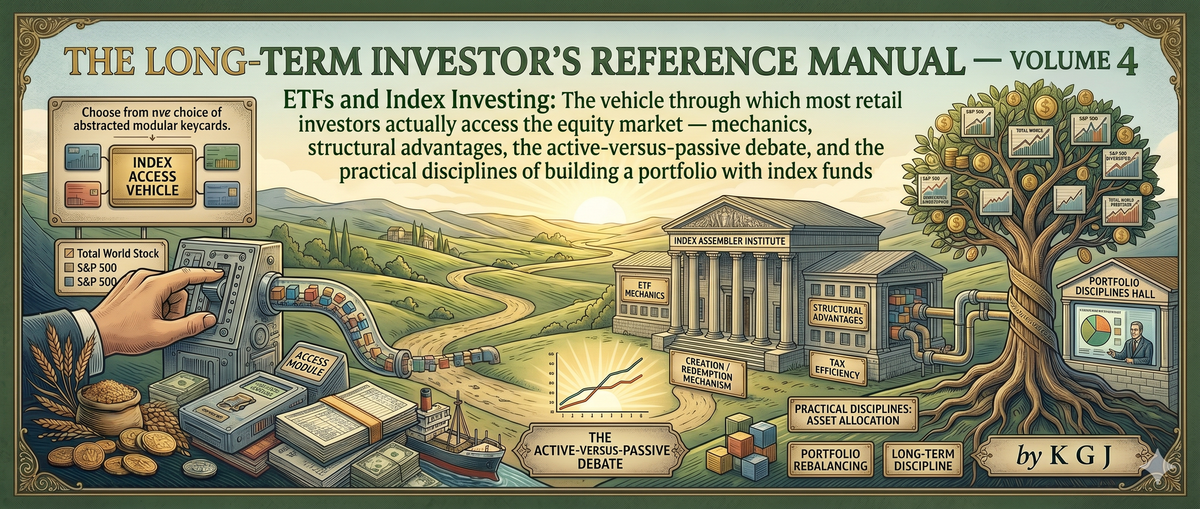
The Long-Term Investor's Reference Manual — Volume 4
ETFs and Index Investing The vehicle through which most retail investors actually access the equity market — mechanics, structural advantages, the active-versus-passive debate, and the practical disciplines of building a portfolio with index funds

Preface to Volume 4
Volume 3 covered the analytical framework for evaluating individual businesses as investments. That framework is necessary for any serious investor, but it is not how most investors actually deploy capital. The substantial majority of retail investment in equities now flows through index funds and exchange-traded funds (ETFs) — vehicles that hold diversified baskets of securities at very low cost, typically tracking specified market indices.
This volume addresses these vehicles directly. It covers the intellectual foundations of indexing (which are stronger than most retail investors realise), the mechanics of how indices are constructed and how ETFs actually function, the empirical record of active versus passive investing, the major index families and fund providers, the specific structures available within passive investing (broad-market, factor, sector, international), the practical disciplines of building a portfolio using these vehicles, and the Australia-specific considerations that affect domestic investors.
The relationship between this volume and Volume 3 is not adversarial. Index investing and individual stock analysis are complementary disciplines. Most investors should hold the bulk of their equity exposure through broad-market index funds; the framework in Volume 3 supports understanding what those funds hold and evaluating any specific positions held outside the index core. The few investors who genuinely have the time, skill, and temperament for substantial individual stock investing can use the framework directly; the much larger group for whom this is unrealistic can use index funds as the structural backbone of their long-term investment plan.
A note on Buffett's view. The man whose Berkshire Hathaway is the most successful actively-managed investment vehicle in modern history has, paradoxically, been one of the most consistent advocates of passive index investing for ordinary retail investors. His 2007 ten-year wager with Protégé Partners — that the S&P 500 index would outperform a basket of fund-of-funds hedge funds over the subsequent decade, with the proceeds going to charity — was won decisively by the index. His instructions to the trustee for his wife's eventual inheritance specify that 90% should be invested in a low-cost S&P 500 index fund and 10% in short-term government bonds. His annual letters have repeatedly emphasised that "for most investors, low-cost index funds are the most sensible equity investment." This is not a reluctant concession. It is a considered conclusion based on six decades of observing investor behaviour and market dynamics, and it represents one of the strongest endorsements of passive investing from anyone in the active-investing world.
The volume is shorter than Volume 3 because the underlying material is more uniform. Where Volume 3 covered the dimensions on which individual companies vary (margins, capital structure, moats, management), this volume covers a more standardised landscape — the variations within passive investing exist but operate within a relatively narrow range. The depth required is therefore less, but the practical importance for retail investors is at least as great.
Section 1 — The Index Investing Revolution
The growth of index investing from a fringe academic concept in the 1970s to the dominant approach in retail investing today is one of the most significant structural changes in modern finance. Understanding how this happened — and why it happened — provides essential context for evaluating the current landscape.
1.1 The pre-index era
Before the 1970s, retail equity investing was almost entirely an active-management proposition. Investors who wished to participate in the stock market had three main options: select individual stocks themselves (which most retail investors lacked the capability to do well), pay a stockbroker for advice and execution (with high commissions and uncertain quality of recommendations), or invest in actively-managed mutual funds (which were widely marketed but rarely produced returns that justified their substantial fees and loads).
The cost structure of this era was extraordinary by current standards. Mutual fund expense ratios commonly ran 1.5-3% annually. Front-end loads (sales commissions paid when buying a fund) of 5-8% were standard. Stock commissions were similarly high — until the May Day deregulation of 1975, fixed commissions on the New York Stock Exchange of around 1% on each side were the norm, meaning a 2% round-trip cost for any stock trade. Active management was expensive, and the costs accumulated heavily over multi-decade horizons.
The intellectual foundation of active investing was the implicit assumption that skilled professionals could identify mispriced securities and produce returns above what the market collectively delivered. The assumption was rarely tested rigorously. Performance comparisons were generally made against arbitrary benchmarks chosen by the fund itself, often without proper adjustment for risk, and the entire industry operated within a framework that took its own value-added for granted.
1.2 The academic foundations
Academic research from the 1950s through the 1970s gradually undermined the assumption that active management produced consistently superior returns.
Harry Markowitz's portfolio theory work (1952, eventually leading to the 1990 Nobel Prize) established that diversification across uncorrelated assets reduces risk without proportionally reducing return — implying that broad market exposure was structurally efficient.
William Sharpe's capital asset pricing model (developed in the 1960s) provided a framework for thinking about market returns and the efficient frontier of risk and return.
Eugene Fama's efficient market hypothesis work (developed across the 1960s and 1970s, also eventually leading to a Nobel Prize) argued that publicly-available information is rapidly incorporated into market prices, making it structurally difficult for active managers to consistently identify mispriced securities.
Michael Jensen's 1968 paper "The Performance of Mutual Funds in the Period 1945-1964" was particularly influential. Jensen evaluated 115 mutual funds over 20 years and found that, on a risk-adjusted basis, the average fund actually underperformed a passive market portfolio after fees. The result was striking: not only did active funds fail to add value collectively, they subtracted value relative to a simple passive alternative.
Subsequent research has consistently reinforced Jensen's finding across different time periods, asset classes, and methodologies. The Standard & Poor's Indices Versus Active (SPIVA) reports, published semi-annually since 2002, consistently show that the substantial majority of actively-managed funds underperform their relevant benchmarks over five, ten, and fifteen-year periods. The percentages vary across asset classes and time periods but typically run in the 70-90% range — that is, 70-90% of active funds fail to beat their benchmark over long periods.
1.3 The Bogle revolution
The translation of academic research into practical investment vehicles required a different kind of insight — one that combined the theoretical case for indexing with the operational and commercial work of building actual products. John Bogle, founder of Vanguard, was the central figure in this translation.
Bogle's path was distinctive. He had written his Princeton senior thesis in 1951 on the mutual fund industry, including critical observations about costs that would inform his later thinking. He had risen through Wellington Management to become its CEO before being fired in 1974 after a contentious merger. The dismissal led him to found Vanguard in 1975 with an unusual structure — the fund company was owned by the funds themselves, meaning that profits flowed back to fund shareholders rather than to external owners. This mutualised structure removed the conflict of interest between fund management and fund shareholders that pervaded the rest of the industry.
In 1976, Vanguard launched the First Index Investment Trust (later renamed the Vanguard 500 Index Fund), the first retail index fund available to ordinary investors. The product was widely criticised at launch — competitors derisively called it "Bogle's Folly" and questioned why investors would settle for "average" returns. The initial offering raised only $11 million against a $150 million target. Sales were modest for the first decade.
The reasons for the slow start were several. The intellectual case for indexing was not yet widely understood outside academia. The financial industry, whose business model depended on selling actively-managed products, had no incentive to promote passive alternatives. Many investors instinctively rejected the idea that they should accept "average" market returns when active managers were promising "above-average" outcomes. Brokers, who earned commissions on actively-managed products with sales loads, had every reason to recommend against the no-load index alternative.
Several factors gradually shifted the dynamics. The empirical evidence accumulated against active management as more long-term studies became available. The 1980s and 1990s bull markets, in which broad index returns were strong, made the cost of underperformance through active management more visible. Vanguard's mutualised structure allowed it to consistently lower fees as scale grew, with savings flowing to fund shareholders rather than external owners. The launch of Vanguard's Total Stock Market Index Fund (1992) and Total International Stock Index Fund (1996) extended the indexing approach to broader exposures. By the early 2000s, indexing had moved from a fringe approach to a mainstream choice.
The growth accelerated dramatically over the past 15 years. Total assets in passive equity vehicles in the United States now exceed those in active vehicles for the first time in history — a milestone reached around 2019. Globally, passive vehicles continue to gain share at the expense of active alternatives. The structural shift, once underway, has proven extraordinarily durable.
1.4 The arrival of ETFs
Index investing originated in the mutual fund structure, but the arrival of exchange-traded funds in the 1990s and 2000s accelerated its growth substantially.
The first United States ETF was the SPDR S&P 500 ETF (ticker SPY), launched by State Street Global Advisors in January 1993. The product offered an index-tracking exposure to the S&P 500 with several novel features compared to mutual funds: continuous intraday trading on a stock exchange, lower expense ratios, greater tax efficiency, and the ability to short, use options on, and otherwise apply standard equity-trading mechanics to the fund itself.
The growth of ETFs has been explosive. From a single product in 1993, the global ETF market now exceeds 12,000 listed products with combined assets of over $13 trillion. In Australia, the first ETFs launched in 2001 (SPDR S&P/ASX 200 Fund, the Australian equivalent of SPY); the local market now has over 350 listed ETFs with combined assets exceeding $250 billion. The growth rates in both jurisdictions have consistently exceeded 20% annually for many years, with no clear sign of slowing.
The ETF structure has several advantages over the traditional open-end mutual fund structure for index-tracking purposes:
Lower operational costs. ETFs do not need to maintain full-time customer service for individual purchases and redemptions, do not need to process daily cash flows from many small investors, and do not need to maintain cash buffers to handle redemptions. The structural cost savings flow through to lower expense ratios.
Better tax efficiency in many jurisdictions. The ETF in-kind creation and redemption process (covered in detail in Section 4) allows the fund to push appreciated securities out without realising taxable gains within the fund. This is particularly valuable in the United States, where mutual fund capital gains distributions can produce surprise tax liabilities for shareholders.
Continuous trading and price discovery. ETFs trade like stocks during market hours, allowing investors to buy and sell at any time at known prices. Mutual funds price once per day at net asset value (NAV) calculated after market close.
Flexibility for trading strategies. ETFs can be shorted, bought on margin, used in options strategies, and otherwise treated as standard equity instruments. This is rarely relevant for long-term retail investors but expands the use cases for the structure.
Transparency. Most ETFs disclose their holdings daily, allowing investors to know precisely what they own. Mutual funds typically disclose holdings monthly or quarterly with a delay.
There are some disadvantages too — bid-ask spreads on illiquid ETFs can be a meaningful cost, the convenience of automatic dollar-cost averaging is harder to replicate (though increasingly available), and some ETF structures introduce complexity that traditional mutual funds avoid. But for most retail investors, the ETF advantages substantially exceed the disadvantages.
1.5 Why indexing won
The transition from active-dominated retail investing to passive-dominated retail investing reflects the cumulative effect of several reinforcing factors.
The cost arithmetic is decisive over long horizons. A 1% annual cost difference between active and passive investing, compounded over 30 years, reduces terminal wealth by roughly 25%. Over 40 years, the reduction is approximately 33%. This compounding cost penalty is unforgiving and largely independent of investment skill.
The empirical record is consistently against active management. Multiple studies across decades and asset classes show that the substantial majority of active managers fail to beat their benchmarks, and the persistence of skill (the question of whether yesterday's winners are tomorrow's winners) is weak. The active management approach is not merely expensive; it is consistently unsuccessful.
The structural mathematics make active management collectively impossible. Investing is, in aggregate, a zero-sum game (before costs). The market return is the weighted average return of all investors. If half of investors hold the market portfolio passively, they receive the market return. The other half collectively also receive the market return — but they pay much higher costs to do so. The active half therefore underperforms the passive half by approximately the cost differential. This is not a contingent empirical observation; it is mathematically necessary, given the structure of markets.
Tax efficiency favours indexing. Passive vehicles trade infrequently, producing minimal portfolio turnover. The resulting tax efficiency adds another layer of advantage over active vehicles that constantly buy and sell positions, generating taxable events.
Regulatory and disclosure changes have made costs more transparent. Investors who once knew only headline expense ratios now have access to detailed disclosures of total costs of ownership, including transaction costs and tax drag. The increased transparency has made the cost penalty of active management more visible and therefore more avoidable.
Behavioural research has documented the pattern of investor self-defeat in active strategies. Investors who switch between active funds chasing recent performance, or who attempt to time entries and exits from individual stocks, consistently underperform what their own funds achieve. The simpler discipline of holding passive vehicles for extended periods avoids this behavioural drag.
Default options in retirement plans have shifted toward indexing. Major employers and retirement plan providers have increasingly defaulted to low-cost index-based target-date funds, creating a structural pull toward passive investing for the retirement assets that dominate household balance sheets in many developed countries.
The cumulative effect is that indexing has won the arguments and the empirical record, with sustained financial momentum that shows no signs of reversing. Active management retains a meaningful share of the market, but its dominance is gone.
1.6 What active management still does well
Acknowledging the structural superiority of indexing for the substantial majority of retail investors does not require dismissing all forms of active management as worthless. Several specific areas merit acknowledgement.
Less efficient markets. Indexing works best in markets where many participants are actively analysing securities and prices reflect available information accurately. In markets where this is less true — small-cap stocks, certain emerging markets, distressed debt, certain real estate categories — skilled active managers may have more opportunity to identify mispricings.
Specific specialist strategies. Some active strategies operate in spaces where passive vehicles cannot easily compete. Distressed credit, certain hedge fund strategies, private equity, and various specialised approaches address opportunities that broad passive products cannot capture. The aggregate returns of these strategies are mixed, and the gross-of-fee returns rarely justify the high fees, but the activities themselves are real.
Concentrated long-term equity investing in specific situations. Berkshire Hathaway itself is the most prominent example. The strategy of identifying a small number of high-quality businesses and holding them for very long periods has produced superior returns at Berkshire and at certain other long-horizon active managers. The number of investors who can execute this strategy successfully is small, however, and the persistence of skill across decades is rare.
Tax management. Active managers focused specifically on after-tax returns can sometimes add value through tax-loss harvesting, asset location, and similar strategies. ETFs increasingly offer some of these benefits as well, and for retail investors, the marginal value of active tax management is modest compared to the structural cost of active management.
Capital allocation in specific corporate situations. Certain forms of activist investing, special situations investing, and arbitrage-style strategies represent legitimate active approaches that operate outside the broad market context. These are typically institutional rather than retail strategies.
The honest summary is that active management has its place but in narrower domains than its proponents claim. For most retail investors holding most of their portfolio for long-term wealth-building, broad-market passive vehicles are the appropriate default. Active strategies, where used, should be approached selectively and with realistic expectations about their long-term returns relative to passive alternatives.
Section 2 — Index Construction: The Mechanics
An index is a calculated value representing the performance of a defined group of securities. Index funds and ETFs aim to replicate the return of specified indices. Understanding how indices are actually constructed — what is included, how the constituents are weighted, and how the index changes over time — is essential for understanding what passive investors actually own.
Volume 2, Section 10 introduced the major equity indices and their basic weighting methodologies. This section goes deeper into the construction mechanics, with attention to the specific design choices that affect index behaviour and the practical implications for index funds tracking these indices.
2.1 The five elements of index construction
Every index construction methodology must address five fundamental questions:
Universe definition: which securities are eligible for inclusion. The universe might be defined geographically (United States, developed Europe, Australia), by size (large-cap, small-cap), by sector (technology, financials), by characteristic (high dividend yield, low volatility), or by combinations of these criteria.
Selection rules: which specific securities from the eligible universe are actually included. Some indices include all eligible securities; others select a subset based on additional criteria (committee discretion, ranking by specific metrics, sampling methodology).
Weighting methodology: how the included securities are combined into the index. The major approaches were introduced in Volume 2 (cap-weighted, equal-weighted, fundamentally weighted, factor-weighted) and are extended in this section.
Rebalancing rules: how the index handles ongoing changes — additions of newly-eligible securities, removals of newly-ineligible securities, weight adjustments as security values change, treatment of corporate actions.
Calculation methodology: how the actual index value is computed at each moment, including handling of dividends, splits, mergers, and other events that affect underlying securities.
These choices, made in different combinations, produce different indices even for nominally similar exposures. The S&P 500 and the Russell 1000 both represent "large-cap United States stocks" but use different selection rules (S&P 500 uses a committee with subjective judgment; Russell 1000 uses a strictly mechanical methodology based on size ranking) and different rebalancing approaches (S&P 500 makes additions and deletions on an ongoing basis as warranted; Russell 1000 reconstitutes annually). The resulting indices are correlated but not identical.
2.2 Universe definition in detail
The universe definition determines what is eligible for index inclusion. For a typical "United States large-cap" index, the universe might be defined by:
Listing requirement: securities listed on major United States exchanges (NYSE, NASDAQ, Cboe BZX). OTC pink sheet securities and ADRs of foreign companies may or may not be eligible, depending on the index.
Domicile requirement: the issuer must be domiciled in the United States. The interpretation of this requirement varies — some indices use legal domicile, others use the location of operations or the country of incorporation. Multinational companies present complications that different indices resolve differently.
Size requirement: the security must exceed minimum market capitalisation thresholds. The S&P 500 uses an approximate $20 billion minimum (with periodic adjustments); the Russell 1000 uses ranking by market cap with the top 1,000 included.
Liquidity requirement: the security must trade with sufficient volume to be practically tradable by index funds. Specific requirements typically address minimum daily volume, public float, and similar measures.
Financial requirements: many indices require positive earnings (the S&P 500 requires four consecutive quarters of positive earnings for new additions, though existing constituents that fall into losses are not automatically removed), minimum profitability, or similar tests.
Other criteria: governance requirements (voting structure restrictions for some indices), sector representation considerations, and idiosyncratic rules.
The universe definition matters because it determines what kinds of companies the index can include. The S&P 500's profitability requirement, for example, has historically excluded fast-growing technology companies that were unprofitable for extended periods (Tesla was excluded for years before joining in December 2020 after meeting the criteria). The Russell 1000's purely mechanical approach has been more inclusive of unprofitable growth companies during their accumulation phases.
For international indices, additional universe questions arise:
Country classification: which countries are "developed" versus "emerging" versus "frontier." MSCI maintains formal country classifications updated periodically, with significant index changes when classifications shift. South Korea has been a long-running borderline case (still classified as emerging by MSCI but as developed by FTSE).
Currency exposure: whether the index represents securities in their local currency or converted to a reference currency. Most international indices are calculated in both local-currency and major-reserve-currency versions.
Inclusion of multiple share classes: how to handle companies with multiple share classes trading in different markets. Some indices include all classes; others include only the primary class.
Cross-border listings: how to handle companies whose primary listing is in one country but which also trade as American Depositary Receipts or in similar cross-listed forms.
These details rarely matter for the casual index investor, but they affect what the index actually contains and can produce surprising differences between superficially similar products.
2.3 Selection rules and committee versus mechanical approaches
Once the universe is defined, the selection rules determine which specific securities from the eligible universe are included.
Mechanical selection rules apply objective criteria automatically. The Russell 1000 includes the top 1,000 United States stocks by market capitalisation as of a specific reconstitution date. The criteria are explicit and produce a deterministic result given the underlying data. There is no discretion in selection.
Committee-based selection rules involve human judgment by an index committee. The S&P 500 is the most prominent example. The S&P Index Committee meets periodically to consider additions and deletions based on their assessment of which companies best represent the United States large-cap equity universe. The criteria are stated but not strictly mechanical — companies meeting all explicit criteria can still be excluded, and companies not technically qualifying can sometimes be added through interpretation.
The trade-offs:
Mechanical approaches are predictable and transparent. Investors can know in advance what the index will include based on observable data. Index funds can prepare for additions and deletions with reasonable certainty. There is no committee bias or political pressure on selections.
Committee-based approaches allow flexibility to address situations that mechanical rules handle poorly. A merger that would mechanically remove a stock from the index but produce a similar new entity can be handled through committee judgment to maintain continuity. Companies that technically qualify but have specific concerns (governance issues, financial irregularities) can be excluded by the committee. The S&P committee's judgment that the Tesla 2020 inclusion be made when the company's profitability had stabilised, rather than mechanically as soon as criteria were met, illustrates how committee discretion can address specific concerns.
The drawbacks of committee approaches include the introduction of subjective judgment that may not always be optimal, the timing uncertainty around index changes (the announcement of a new addition can move the stock's price significantly), and the lack of full transparency about decision criteria.
For investors, the practical implication is that the same nominal exposure (United States large-cap equity) can be obtained through mechanically-constructed indices (Russell 1000, CRSP US Large Cap) or committee-constructed indices (S&P 500). The differences in returns over time are typically modest but real.
2.4 Cap-weighted methodology in detail
Cap-weighted indices, the dominant methodology for major market indices, weight each constituent by its market capitalisation (price × shares outstanding). The total index value is the sum of the weighted values, scaled by a divisor to produce a meaningful number.
The mathematical structure:
For each constituent i with market cap MC_i, the weight is:
w_i = MC_i / Σ(MC_j) for all constituents j
The index value at time t is then:
Index_t = Σ(P_it × Shares_i × Free Float_i) / Divisor
Where the divisor is adjusted over time to maintain index continuity through corporate actions, additions, and deletions.
Several refinements appear in modern cap-weighted indices:
Free float adjustment: only the shares actually available for public trading are counted, excluding shares held by founders, governments, strategic holders, or otherwise restricted. This adjustment matters substantially for some companies — a founder-controlled company might have only 20% of its shares freely traded, with the other 80% held by the founder. The free-float-adjusted weight is much smaller than the total-market-cap weight would be.
Caps and constraints: some indices impose limits on individual constituent weights to prevent excessive concentration. The Russell 1000 does not cap weights, allowing single companies to grow to very large positions if their market caps grow large. Some other indices cap weights at 5%, 10%, or other levels, with the excess redistributed across other constituents.
Sector caps: similar caps may apply at the sector level to prevent excessive concentration in any single sector.
Country caps: in international indices, weights may be constrained at the country level for similar reasons.
The arguments for cap-weighting:
It is the most efficient implementation of indexing. By weighting in proportion to actual market values, the cap-weighted index automatically reflects the aggregate ownership preferences of all investors. Every dollar invested in the index is allocated in the same proportion as the average dollar in the broader market.
It is automatically self-rebalancing. As prices change, the weights of the constituents change proportionally, without requiring active rebalancing trades. This minimises trading costs and tax events for the index fund.
It produces broad exposure to the entire universe being indexed. No constituent can be excluded simply because of style preferences (value versus growth, large versus small within the size category).
The arguments against cap-weighting:
It can produce excessive concentration in the largest stocks. The current S&P 500 has approximately 30% of its weight in the top ten stocks, with the largest single constituents at 6-7% each. A diversified-sounding "500 stock" exposure is in fact substantially concentrated in a handful of names.
It is systematically biased toward overpriced stocks. By construction, a stock that has appreciated has gained weight in the index, and the cap-weighted approach allocates new capital in proportion to current weights — meaning more capital flows to recently-appreciated stocks. Critics argue this produces structural overweighting of stocks at expensive valuations.
It can produce bubble-following behaviour. During the late 1990s technology bubble, technology stocks grew to dominate the cap-weighted indices, with cap-weighted index investors increasingly concentrated in the most overvalued segment. The subsequent collapse hit cap-weighted indices harder than equal-weighted alternatives would have been hit. The same dynamic repeated to some degree in 2021-2022.
For most investors, the cap-weighted approach remains the appropriate default — its advantages outweigh its drawbacks for typical retail use. But the drawbacks are real, and they motivate the various alternative weighting approaches discussed in Section 7.
2.5 Equal-weighted methodology in detail
Equal-weighted indices assign the same weight to every constituent, regardless of market capitalisation. The S&P 500 Equal Weight Index, which equal-weights the same 500 stocks as the standard S&P 500, is the prominent example.
The mathematical structure is straightforward:
For each constituent i in an N-constituent index, the weight is:
w_i = 1/N
The index value is calculated by averaging the returns of all constituents (or by maintaining a portfolio with equal dollar amounts in each constituent, with periodic rebalancing).
Equal-weighting produces several differences from cap-weighting:
Smaller stocks have larger relative weight. In the S&P 500 cap-weighted index, the largest stock has approximately 7% weight while the smallest has approximately 0.01% — a 700-fold difference. In the equal-weighted version, every stock has 0.2% — a 1-fold "difference" that produces dramatically different portfolio composition.
Higher portfolio turnover from rebalancing. As prices change, the equal-weighted portfolio drifts away from equal weights and must be rebalanced periodically to restore the target weights. This produces ongoing trading that the cap-weighted approach does not require.
Different return patterns over time. Equal-weighted indices have historically produced higher long-term returns than their cap-weighted counterparts, partly through a small-cap and value tilt (the stocks that gain weight in equal-weighting tend to be smaller and cheaper than the cap-weighted average) and partly through the rebalancing effect of selling winners and buying losers.
Higher volatility, particularly during stress periods. Equal-weighted indices typically experience larger drawdowns during market stress because the smaller stocks they overweight tend to be more volatile.
For investors, equal-weighting is a legitimate alternative to cap-weighting but with specific characteristics that should be understood. It is not strictly better or strictly worse; it embodies different choices about how to define market exposure, with corresponding trade-offs.
2.6 Fundamental weighting
Fundamental weighting uses fundamental measures of company size — revenue, book value, dividends, earnings — rather than market values. The argument for fundamental weighting is that it avoids the bias toward overpriced stocks that cap-weighting produces.
The most prominent fundamental indices are based on Research Affiliates' RAFI methodology, which uses a composite of book value, cash flow, sales, and dividends to determine weights. Fundamental indices also include various other approaches, including those weighted by single fundamentals (revenue-weighted, book-value-weighted) and various proprietary methodologies.
The empirical evidence on fundamental weighting is mixed. Some studies show modest outperformance over cap-weighted alternatives over long periods, attributed to the value tilt that fundamental weighting produces (companies trading at low multiples of fundamentals get higher weights than they would in cap-weighting). Other studies suggest the outperformance is modest after costs, particularly the higher turnover that fundamental weighting produces.
For typical retail investors, fundamental weighting is a minor alternative rather than a primary approach. The marginal benefit over cap-weighting is small and uncertain; the additional complexity and cost may not be justified. For investors specifically attracted to a value tilt, dedicated value-oriented index products (covered in Section 7) often provide cleaner exposure than fundamental weighting.
2.7 Rebalancing rules
Indices change over time as the underlying universe changes. The rebalancing rules govern how these changes are implemented.
Reconstitution is the periodic full review of the index, with comprehensive additions and deletions based on the current state of the universe. The Russell indices reconstitute annually in late June, with all constituents reviewed against the size-ranking criteria. The CRSP indices reconstitute quarterly. The S&P 500 does not have a fixed reconstitution schedule; changes are made on an as-needed basis throughout the year.
Ongoing maintenance addresses changes between major reconstitutions. New IPOs may be added to the universe and become eligible for index inclusion. Companies that have been acquired or that fall out of the eligible universe (delisting, merger, bankruptcy) must be removed. Cap changes from acquisitions or major share issuances may require weight adjustments.
The rebalancing rules affect index funds in several ways:
Trading costs from index changes. When a security is added to a major index, all index funds tracking that index must buy the security to maintain their tracking. Conversely, deletions require selling. The cumulative trading costs from these changes — broker commissions, market impact, bid-ask spreads — are real costs that reduce index fund returns relative to the pure index calculation.
Front-running by other market participants. The known timing of index changes creates opportunities for traders to anticipate the index funds' required trades. Buying a stock in advance of its addition to a major index, then selling to the index funds during the inclusion period, has been a profitable strategy for some sophisticated traders. The effect on index fund performance is small but real.
The "index inclusion effect". Stocks added to major indices have historically experienced positive returns around the announcement and effective dates, partly from the buying pressure of index funds. Stocks removed from indices have experienced corresponding negative returns. These effects have diminished over time as markets have become more efficient at anticipating changes, but they persist in some form.
For investors, the rebalancing details matter mostly through their cumulative effect on tracking error and total returns. Well-constructed indices with reasonable rebalancing rules, tracked by efficient index funds, capture the index return with very small drag (often just a few basis points annually). Poorly-constructed indices or inefficient tracking can produce meaningfully larger drags.
2.8 Float-adjusted versus full-cap weighting
A specific element of cap-weighting that deserves attention is float adjustment. The two main approaches:
Full-market-cap weighting uses total shares outstanding for each constituent, regardless of whether those shares are publicly available for trading.
Free-float-adjusted weighting uses only the shares actually available for public trading, excluding shares held by founders, governments, strategic shareholders, and other restricted holders.
The float adjustment can be substantial. A company with 1 billion total shares but only 200 million in public float would have its weight reduced by 80% in a float-adjusted index versus a full-cap index. Companies controlled by founders (many recent technology IPOs), majority-state-owned enterprises (some emerging market companies), or with substantial cross-shareholdings (some Japanese companies) all have large differences between full cap and free float.
The arguments for float adjustment:
It reflects what is actually available for index funds to buy. A company with restricted shares that cannot be acquired by index funds should not be weighted as if those shares were available.
It avoids the "phantom weight" problem of including non-tradable shares in the index calculation.
It produces more accurate weighting in the sense of reflecting the actual investable opportunity set.
The arguments for full-cap weighting:
It captures the full economic significance of the company.
It provides a "purer" measure of company size that is not dependent on share registration patterns.
It avoids the awkward situation in which a company's index weight changes substantially because of changes in which shareholders hold shares (rather than changes in the company itself).
Most major indices use float-adjusted weighting today, and this is generally the better approach for index funds. But the underlying methodology should be understood, particularly when comparing similar-sounding indices that may use different conventions.
2.9 Total return versus price return indices
A final element of index construction concerns the treatment of dividends.
Price return indices track only the price changes of constituent securities, ignoring dividends. The Dow Jones Industrial Average, in its commonly-cited form, is a price return index. The S&P 500 in its commonly-cited form is also a price return index.
Total return indices include the reinvestment of dividends. The S&P 500 Total Return Index is the dividend-reinvested version of the S&P 500.
Net total return indices include dividends but assume tax withholding on dividends (typically at a specified rate that approximates withholding for foreign investors). This is sometimes used for international indices where withholding tax considerations are material.
For long-term investors, total return is the relevant measure. A stock that pays substantial dividends produces meaningful return through the dividends, and ignoring this return understates the actual investment outcome. The S&P 500 has historically produced approximately 10% nominal annual total returns versus approximately 8% nominal price-only returns over very long periods — a 2-percentage-point difference that compounds enormously over decades.
When comparing index returns to fund returns, ensure that comparison is on the same total-return basis. Index funds that reinvest dividends should be compared to total return indices, not to price return indices.
For most retail investors, this distinction is automatically handled by the major data sources, but it is worth knowing about — particularly when reading older financial commentary that often referenced price return figures.
2.10 Practical implications for index investors
Drawing this section to its practical implications:
The specific index a fund tracks matters. Two funds that both claim to provide "United States large-cap exposure" may track different indices with different methodologies and produce different returns. The decision of which fund to use should consider the specific index methodology, not just the headline category.
Major established indices are generally better than newer or proprietary alternatives. The S&P 500, Russell 1000, MSCI USA, CRSP US Large Cap, and similar major indices have been thoroughly studied, are tracked by many efficient funds, and operate with transparent and stable methodologies. Newer or more exotic indices may have specific intended characteristics but introduce additional uncertainty and tracking costs.
Cap-weighted indices remain the appropriate default for most investors. Their advantages outweigh their drawbacks for typical retail use. Alternative weighting schemes (equal-weight, fundamental, factor-based) have their place but should be approached as deliberate deviations from the default rather than as casual choices.
Float adjustment, total return treatment, and similar technical elements are worth understanding. They affect what is actually being tracked and what returns will be realised.
The mechanics of rebalancing matter for fund efficiency. Funds that track well-designed indices through efficient implementation produce minimal drag versus the underlying index calculation. Funds tracking poorly-designed indices or operating with inefficient implementation can produce meaningfully larger drag.
The next section turns to the specific structures — mutual funds and ETFs — through which retail investors actually access these indices.
Section 3 — Mutual Funds and ETFs Compared
Index investing reaches retail investors primarily through two structures: open-end mutual funds and exchange-traded funds. The structures share fundamental similarities — both pool investor capital to hold portfolios of securities — but differ in important mechanical and operational details. Understanding these differences allows investors to choose appropriately between them.
3.1 The mutual fund structure
A traditional open-end mutual fund operates through a specific structural pattern:
The fund is established as a corporation or trust, with the fund itself owning a portfolio of securities. Investors buy and sell shares in the fund through transactions with the fund itself, not with other investors. When an investor wants to buy shares, the fund issues new shares and accepts cash from the investor. When an investor wants to sell shares, the fund redeems the shares and returns cash to the investor. The investor's transactions are with the fund, intermediated by the fund's transfer agent or distribution platform.
The fund calculates its net asset value (NAV) once per day, after the close of trading in the underlying markets. The NAV equals the total value of the fund's assets, less liabilities, divided by the number of shares outstanding. All purchases and redemptions on a given day are executed at that day's NAV — a system called forward pricing.
The fund manager invests the assets according to the fund's stated investment objective. For an index fund, this means tracking the specified index by holding the constituent securities in approximately the index weights. For an active fund, this means making active investment decisions within the fund's mandate.
Several structural features follow from this design:
Cash drag. The fund must maintain cash reserves to handle redemptions. When investors collectively redeem more than they purchase, the fund must sell securities to raise cash; when they purchase more than they redeem, the fund must invest the new cash. Either direction can produce trading costs and tax events. The fund typically holds 1-3% of assets in cash to handle ordinary flows, which produces small but real drag on returns relative to a fully-invested portfolio.
Tax inefficiency in some jurisdictions. When the fund must sell securities to handle redemptions or to rebalance, the realised gains are passed through to all remaining shareholders as taxable distributions. In the United States, this can produce a particularly painful pattern in which shareholders who joined a fund relatively recently can owe taxes on gains accumulated by the fund over many years. The pattern is especially problematic in years when net redemptions force the fund to sell appreciated holdings.
End-of-day pricing only. Investors can only buy or sell at the day's NAV, with no intraday pricing transparency. Orders submitted during the day are queued for execution at the close.
Operational costs of handling many small accounts. Mutual funds must maintain customer service infrastructure to handle small individual purchases and redemptions, which adds to the cost structure even in efficiently-run funds.
The mutual fund structure has been the dominant retail investment vehicle for decades and remains the structure for the substantial majority of retirement-plan investments. Index mutual funds (Vanguard's funds being the canonical examples) operate efficiently within this structure and have produced excellent long-term outcomes for shareholders.
3.2 The ETF structure
An exchange-traded fund operates through a meaningfully different mechanical pattern:
The fund is established as a corporation or trust similar to a mutual fund, with the fund owning a portfolio of securities. But ETF shares trade on stock exchanges throughout the day at market-determined prices, and individual investors transact with each other (or with market makers) on these exchanges rather than with the fund itself.
The link between the ETF's market price and the value of its underlying portfolio is maintained through a process involving authorised participants (APs) — large financial institutions (typically major investment banks and market makers) that have agreements with the fund to create and redeem shares in large blocks called creation units. When the ETF trades at a premium to its underlying value, APs can buy the underlying securities, deliver them to the fund in exchange for new ETF shares (creation), and sell those shares on the exchange — earning the spread between the premium price and the underlying value. When the ETF trades at a discount, APs can buy ETF shares on the exchange, deliver them to the fund in exchange for the underlying securities (redemption), and sell the securities — earning the discount spread.
This arbitrage mechanism (covered in detail in Section 4) keeps the ETF's market price closely aligned with the value of its underlying portfolio. For most ETFs in normal market conditions, the difference between price and underlying value is very small (often a few basis points). During market stress or for less liquid ETFs, the gap can widen, but it generally remains within a manageable range for long-term investors.
Several structural features follow from this design:
Continuous trading and pricing. ETFs trade throughout market hours at market-determined prices, allowing investors to know exactly what price they will pay or receive for any transaction. The price may differ from underlying NAV by a small amount (the premium or discount), but it is observable in real time.
No cash drag. Because investor transactions occur on the exchange rather than with the fund directly, the fund does not need to hold cash to handle ordinary flows. The fund can remain fully invested in its target portfolio.
Tax efficiency through in-kind transfers. The creation and redemption process happens "in kind" — APs deliver actual securities to the fund (in creation) or receive actual securities from the fund (in redemption), rather than cash. This means that the fund can transfer appreciated securities out of the portfolio without realising taxable gains. This structural advantage has substantial benefits for long-term US-based shareholders, although the magnitude depends on the underlying portfolio and the specific tax regime.
Lower operational costs. The fund does not need to maintain customer service for individual investors (who deal with their brokers instead) or process daily flows from many small purchases and redemptions. The structural cost savings flow through to lower expense ratios.
Bid-ask spreads as a cost. ETF transactions incur bid-ask spreads similar to those for stock transactions. For highly liquid major-market ETFs, spreads are typically very narrow (often 1 cent or less). For less liquid ETFs, spreads can be meaningful.
3.3 The cost structure comparison
Costs are the most important difference between most index investments, and the comparison between mutual funds and ETFs deserves specific attention.
Expense ratios. Both mutual funds and ETFs charge ongoing expense ratios — the percentage of assets paid annually for fund operations, including management, administration, custody, and other costs. Among the major providers:
For United States large-cap exposure (S&P 500 or total market):
- Vanguard 500 Index Fund (Admiral shares VFIAX, mutual fund): 0.04%
- Vanguard S&P 500 ETF (VOO): 0.03%
- iShares Core S&P 500 ETF (IVV): 0.03%
- SPDR S&P 500 ETF (SPY): 0.0945%
- Schwab US Large-Cap ETF (SCHX): 0.03%
- Fidelity ZERO Large Cap Index Fund (FNILX): 0.00% (mutual fund)
For Australian equity exposure:
- Vanguard Australian Shares Index ETF (VAS): 0.07%
- iShares Core S&P/ASX 200 ETF (IOZ): 0.05%
- SPDR S&P/ASX 200 Fund (STW): 0.05%
- BetaShares Australia 200 ETF (A200): 0.04%
For international (developed markets) exposure:
- Vanguard FTSE Developed Markets ex-US ETF (VEA): 0.06%
- iShares Core MSCI EAFE ETF (IEFA): 0.07%
- Vanguard MSCI Index International Shares ETF (VGS, ASX-listed): 0.18%
The expense ratio differences between competing products are typically small (a few basis points), but they compound over decades. A 0.05 percentage point difference, sustained over 30 years, reduces terminal wealth by approximately 1.5%. This is meaningful but not enormous.
Total cost of ownership extends beyond expense ratios to include:
- Trading costs (commissions for ETFs, sales loads or short-term redemption fees for mutual funds)
- Bid-ask spreads (for ETFs)
- Tax efficiency differences (potentially substantial)
- Tracking error costs (the fund's performance versus the index)
For a long-term investor making infrequent trades, the relevant total cost calculation typically favours ETFs slightly in the United States (better tax efficiency, lower expense ratios, generally tight spreads) and is roughly even in Australia (where the tax differences are smaller and ETF trading commissions are often offset by mutual fund minimum investment levels). The differences are not usually decisive, however, and either structure can produce excellent long-term outcomes for the disciplined investor.
3.4 Tax efficiency in detail
The tax treatment of mutual funds versus ETFs varies significantly by jurisdiction.
United States: ETFs have a substantial structural tax advantage. The in-kind creation and redemption process allows the fund to transfer appreciated securities out without realising taxable gains, dramatically reducing the capital gains distributions that flow through to shareholders. Mutual funds, which must transact in cash, regularly produce capital gains distributions even when individual investors have not sold any shares. Over multi-decade horizons, this difference can amount to 0.5-1.5% per year of after-tax return advantage for ETFs in taxable accounts.
For tax-advantaged accounts (401(k)s, IRAs, similar), this advantage is irrelevant — there are no taxable distributions either way. For taxable accounts, the ETF advantage is substantial and is one of the strongest reasons to prefer ETFs over equivalent mutual funds in the United States.
Australia: the tax treatment is more similar between structures, although some differences exist. Both Australian ETFs and Australian managed funds typically distribute their income, dividends (including franking credits), and realised gains to investors annually. The pass-through structure of both vehicles means that investors pay tax on the fund's realised gains regardless of whether they personally sold any shares.
ETFs in Australia have generally achieved somewhat better tax efficiency than equivalent active funds (because their lower portfolio turnover produces less realised gains), but the difference between Australian index ETFs and Australian index mutual funds is more modest than the equivalent United States comparison.
The franking credit treatment is identical for both structures — Australian dividends with franking credits flow through to investors who can use the credits to offset their own tax liability. This is one of the structural attractions of Australian-domiciled vehicles for Australian residents (covered in detail in Section 10).
Other jurisdictions: tax treatment varies widely. The United Kingdom, Canada, and continental Europe have their own tax conventions that affect the relative attractiveness of mutual funds versus ETFs. Investors in these jurisdictions should evaluate the specific local tax treatment rather than assuming the United States patterns apply.
3.5 Liquidity and trading characteristics
The ability to trade efficiently is a structural difference between mutual funds and ETFs.
Mutual fund liquidity is uniform across the trading day — all transactions execute at the closing NAV, regardless of when the order was placed. This eliminates timing decisions but also eliminates the ability to react to intraday market movements.
ETF liquidity varies by product. The largest ETFs (SPY, VOO, IVV, QQQ in the United States; VAS, A200 in Australia) trade with extremely tight bid-ask spreads (often 1 cent or less on prices of $100-$500) and substantial volume. Trades of any reasonable retail size execute at near-mid-market prices with minimal market impact.
Smaller and less actively traded ETFs have wider spreads and less depth. Some specialist ETFs may have spreads of 0.5% or more, with limited volume that can produce market impact for larger trades. The quality of trading varies dramatically across the ETF universe.
For long-term investors, the liquidity considerations are:
For broad-market ETFs (large-cap US, large-cap Australian, broad international, total bond market), trading liquidity is excellent and not a meaningful concern.
For specialist or thematic ETFs (specific sectors, factor strategies, niche international exposures), trading liquidity should be evaluated. Wider spreads add to the cost of ownership.
For larger trades, even broad-market ETFs may benefit from order management — using limit orders rather than market orders, breaking large orders into smaller pieces, avoiding the first and last 30 minutes of trading when spreads are typically wider.
For systematic accumulation through regular contributions, ETFs may produce slight friction relative to mutual funds with automatic investment plans. Some brokers now support fractional ETF shares and recurring purchases, mitigating this difference, but the operational integration of regular contributions is sometimes still cleaner with mutual funds.
3.6 Practical guidance for choosing between structures
For most retail investors, the practical decision rules are:
In retirement accounts and similar tax-advantaged vehicles: either structure works well. The choice depends primarily on platform support and personal preference. Some retirement plans offer only mutual funds; the mutual fund choice is then dictated. Where both are available, the small expense ratio advantages of ETFs are largely offset by the operational simplicity of mutual funds, particularly for ongoing contributions.
In taxable accounts in the United States: ETFs generally have the advantage. The tax efficiency gap is substantial enough to matter over long horizons, and the operational differences are minor for buy-and-hold investors.
In taxable accounts in Australia: the choice is more balanced. Australian-domiciled ETFs and Australian-domiciled mutual funds have similar tax treatment. ETFs offer slightly lower expense ratios and slightly better tax efficiency through lower turnover. Mutual funds may offer simpler regular contribution plans. Either choice can be made successfully.
For specialist or factor exposures: ETFs typically offer broader and more specific options than mutual funds. The active mutual fund universe is large, but the index/factor mutual fund universe is narrower than the ETF equivalent.
For large lump-sum investments: the trading costs of ETFs (bid-ask spread once, no ongoing commissions for most major brokers) compare favourably to the spread of mutual fund expenses over time. ETFs generally win on this dimension.
For systematic small contributions: mutual funds have traditionally been more convenient, but the gap has narrowed substantially with broker-provided fractional ETF features. Either approach is workable.
Most investors will benefit from holding some mix of both structures, depending on account type and specific exposure. The structural differences are real but should not be over-emphasised. Both mutual funds and ETFs, used through low-cost broad-market vehicles, can provide excellent long-term equity exposure.
Section 4 — How ETFs Actually Work
The ETF structure is mechanically more complex than the mutual fund structure, but the complexity is largely invisible to retail investors most of the time. When markets are functioning normally, ETFs simply trade like stocks at prices that closely track the value of their underlying holdings. But understanding the actual mechanics — particularly the creation and redemption process — is important for evaluating ETFs in unusual conditions and for understanding the structural advantages that make ETFs work.
4.1 The basic mechanism
An ETF holds a portfolio of underlying securities (or, for some ETFs, derivative contracts that produce equivalent economic exposure). The fund's net asset value (NAV) at any moment equals the total value of the holdings, less liabilities, divided by the number of ETF shares outstanding. NAV is calculated continuously throughout the trading day, with most ETF providers publishing intraday indicative values (IIV or iNAV) typically every 15 seconds.
ETF shares trade on stock exchanges — primarily NYSE Arca, NASDAQ, and Cboe BZX in the United States; ASX in Australia; LSE and continental European exchanges in Europe. The trading occurs between market participants (other ETF holders, market makers, institutional investors) rather than directly with the fund.
The market price of the ETF can differ from the underlying NAV. When the price exceeds NAV, the ETF trades at a premium; when the price is below NAV, the ETF trades at a discount. In normal conditions for liquid ETFs, premiums and discounts are very small — typically a few basis points (0.01-0.05% of NAV).
The mechanism that keeps ETF prices closely aligned with NAV is the creation and redemption process operated by authorised participants.
4.2 Authorised participants and creation units
Authorised participants (APs) are the small group of large financial institutions — primarily major market makers and investment banks — that have agreements with the ETF sponsor to create and redeem ETF shares in large blocks. The major APs in United States markets include Citadel Securities, Virtu Financial, Goldman Sachs, JPMorgan, Bank of America, and several others. In Australia, the AP role is filled by similar institutions.
The number of APs varies by ETF, with the most heavily traded ETFs having dozens of APs and smaller ETFs having only a few. The presence of multiple APs supports liquidity by ensuring that arbitrage activity can occur from multiple counterparties. ETFs with very few APs may experience wider premiums and discounts, particularly during stress periods.
APs do not pay any direct fees to maintain their AP status, but they accept obligations to participate in the creation/redemption process and they earn profits through the arbitrage opportunities the role provides.
Creation units are the standardised blocks in which ETF shares are created and redeemed. For most ETFs, a creation unit equals 25,000-100,000 ETF shares, though specific sizes vary across products. At typical ETF prices, this represents transactions in the millions of dollars per creation unit — far above retail-scale activity but small relative to typical institutional activity.
The creation unit structure is what makes the ETF mechanism work. Direct creation and redemption with the fund occurs only at this institutional scale; retail investors transact on the exchange and never interact directly with the fund.
4.3 The creation process
The creation process — adding new ETF shares to the supply — works as follows:
An AP determines that creating new ETF shares will be profitable. This typically occurs when the ETF is trading at a premium to NAV (price above value of underlying holdings), making it possible for the AP to acquire underlying holdings at fair value, deliver them to the fund, and receive ETF shares that can be sold at a premium.
The AP acquires the basket of securities that constitutes one creation unit. The composition of this basket is published daily by the ETF sponsor (the Portfolio Composition File or PCF) and typically matches the ETF's underlying holdings on a per-share basis. For an S&P 500 ETF, the creation basket is the same 500 stocks held by the fund, in the same weights, scaled to match the creation unit value.
The AP delivers this basket of securities to the ETF, which credits the AP's account with new ETF shares (one creation unit's worth). The transaction is in kind — securities for shares, with no cash changing hands except for any small amount needed to balance precise weights.
The AP can then sell these ETF shares on the exchange. If the ETF was trading at a premium, the AP captures that premium as profit (less transaction costs).
The mechanism has several effects:
It increases the ETF's share count (matching the increased holdings). The fund's NAV per share remains unchanged because both holdings and shares increase proportionally.
It reduces the premium by adding supply to the market. The arbitrage activity continues until the premium narrows enough that further creation is no longer profitable.
It transfers ownership of underlying securities from the AP to the fund (and indirectly to the fund's shareholders). The fund's holdings increase by the value of the creation basket.
The cumulative effect of many AP creation activities, conducted by multiple competing firms, keeps the ETF's market price closely aligned with NAV.
4.4 The redemption process
The redemption process — removing ETF shares from the supply — works in the reverse direction:
An AP determines that redeeming ETF shares will be profitable. This typically occurs when the ETF is trading at a discount to NAV (price below value of underlying holdings), making it possible for the AP to acquire ETF shares at a discount, deliver them to the fund, and receive underlying securities at fair value.
The AP acquires one creation unit's worth of ETF shares from the open market.
The AP delivers these ETF shares to the fund, which credits the AP's account with the basket of underlying securities. Again, the transaction is in kind.
The AP can sell these underlying securities. If the ETF was trading at a discount, the AP captures that discount as profit (less transaction costs).
The mechanism has several effects:
It reduces the ETF's share count (matching the reduced holdings). The fund's NAV per share remains unchanged.
It reduces the discount by removing supply from the market. The arbitrage activity continues until the discount narrows enough that further redemption is no longer profitable.
It transfers ownership of underlying securities from the fund to the AP. The fund's holdings decrease by the value of the redemption basket.
4.5 The tax efficiency advantage
The in-kind creation and redemption process produces a structural tax advantage that is particularly valuable for United States investors holding ETFs in taxable accounts.
When an ETF needs to dispose of an appreciated security (for example, because the security has been removed from the underlying index), the fund can deliver that security to an AP through the redemption mechanism rather than selling it in the market. The transfer to the AP is "in kind" and does not produce a taxable event for the fund. The AP receives the security at its current market value and may subsequently sell it, but those tax consequences accrue to the AP, not to the fund or its shareholders.
Compare this to a mutual fund needing to dispose of the same appreciated security. The mutual fund sells the security in the market, realising the gain. The realised gain is then distributed to all fund shareholders (typically annually), creating a taxable event for each shareholder regardless of whether they personally sold any fund shares.
The cumulative effect over decades is substantial. Studies of large-cap United States equity funds suggest that ETFs in this category typically distribute capital gains representing 0.0-0.3% of NAV per year, while equivalent mutual funds typically distribute 1-3% per year (with the highest distributions occurring in years of high market activity or net redemptions). The 1-2 percentage point annual difference in taxable distributions, applied over 30+ years for a high-income investor in a high-tax jurisdiction, can produce a 10-20% difference in terminal after-tax wealth.
The tax efficiency advantage applies to:
United States large-cap equity ETFs: substantial advantage. The combination of relatively long holding periods (low base turnover), ability to transfer specific lots through in-kind redemption, and absence of forced cash sales produces minimal capital gains distributions. The advantage is largest for index ETFs with naturally low turnover.
Other equity ETFs: meaningful but smaller advantage. The mechanism works similarly but the magnitude depends on how active the underlying strategy is. Sector ETFs and broad international ETFs typically achieve good tax efficiency; some specialist or thematic ETFs with high turnover may achieve less.
Bond ETFs: smaller advantage. The in-kind mechanism still works, but the tax characteristics of fixed income (income distributions taxed annually as ordinary income) reduce the relative importance of capital gains efficiency. Bond ETFs still have some tax advantages over equivalent bond mutual funds, but the gap is narrower than for equities.
Australian ETFs: as discussed in Section 3, the Australian tax structure produces less differentiation between ETFs and managed funds than the United States structure does. The in-kind mechanism still operates, but the advantage versus equivalent active managed funds is more about the underlying strategy's turnover than about the ETF wrapper itself.
4.6 When the mechanism fails: ETF stress
The ETF arbitrage mechanism works extraordinarily well in normal market conditions, keeping prices closely aligned with NAV. But the mechanism can fail or struggle in specific circumstances. Understanding the failure modes helps investors evaluate ETFs in unusual conditions.
Market stress periods. During severe market stress, several things can happen. The underlying securities may become illiquid, with wide bid-ask spreads and uncertain mid-market prices. APs may be reluctant to commit capital to creation/redemption activity when their own balance sheets are stressed. Trading in the underlying securities may be halted while the ETF continues to trade. All of these can cause the ETF price to deviate substantially from the (uncertain) NAV.
The prominent recent example is March 2020, when COVID-19 stress produced unusual conditions. Investment-grade corporate bond ETFs, which had been trading at small premiums or near NAV, briefly traded at discounts of 5% or more during the worst days. The discount reflected the uncertainty about the underlying corporate bond market, where trading had become difficult. The ETF prices were arguably more accurate than the stale NAV calculations during this period; the discount was a real-time price discovery mechanism rather than a malfunction.
Illiquid or specialist ETFs. ETFs holding less liquid underlying securities — small-cap, emerging market, niche thematic — generally have wider premiums and discounts even in normal conditions. The arbitrage mechanism is less efficient when the underlying securities themselves trade in less liquid markets.
Closed exchange situations. When the underlying securities trade in markets that are closed (international ETFs traded in US markets after London close, for example), the ETF price reflects expectations about where the underlying would open, while the NAV calculation uses stale prices from the closed market. Premiums and discounts during these periods are not market malfunctions but reflections of the price discovery occurring continuously in the ETF market.
Halted underlying securities. If a major holding of the ETF is halted from trading, the NAV calculation for the fund becomes uncertain. The ETF can continue to trade, but the arbitrage mechanism is disrupted because APs cannot easily value or transact in the halted security.
Mass redemption stress. In theory, if many investors simultaneously sell ETF shares, the arbitrage mechanism should produce orderly redemptions and stable prices. In practice, very large simultaneous outflows can stress the system, particularly for less liquid products. The rare extreme cases have historically resolved within days, but the experience can be unsettling for shareholders during the event.
For long-term investors, the practical implication is that ETFs work extremely well in normal conditions and acceptably well in moderately stressed conditions, but can experience temporary dysfunction in extreme stress. Long-term investors who do not need to transact during these periods experience the dysfunction primarily as paper price movement that resolves as conditions normalise. Investors who must transact during stress periods may experience real costs.
4.7 Indicative NAV and price transparency
ETFs publish several pieces of information that retail investors can use to evaluate transactions:
Net Asset Value (NAV): calculated and published once per day, typically after market close. NAV reflects the precise value of the fund's holdings as of the calculation point.
Indicative Intraday Value (IIV) or iNAV: a real-time estimate of NAV calculated and published every 15 seconds during the trading day. IIV is calculated by applying current prices of the underlying holdings to the most recent published portfolio composition. It provides a near-real-time estimate of the fund's underlying value.
Premium or discount to NAV: the percentage difference between the ETF's current trading price and either the closing NAV or the current IIV. Major data sources (Morningstar, fund websites, broker platforms) typically display recent premium/discount data.
For most large, liquid ETFs in normal conditions, the premium or discount is in the range of 0.0-0.1% — small enough to be a non-issue for most retail trades. For smaller or less liquid ETFs, or in stressed conditions, the gap can be larger and worth checking before transacting.
The practical guidance:
For routine transactions in major liquid ETFs, the premium/discount can usually be ignored.
For transactions during stress periods or in less liquid ETFs, checking the IIV before transacting is prudent. Limit orders set near IIV provide protection against unexpectedly wide spreads.
For very large transactions, working with the broker to evaluate execution options (block trading desks, request-for-quote systems) may produce better execution than placing market orders.
4.8 Synthetic ETFs
A specific structural variant deserves attention. Synthetic ETFs do not hold the underlying securities they track. Instead, they hold a basket of unrelated securities (collateral) and enter into a swap agreement with a counterparty (typically a major bank) that delivers the return of the target index in exchange for the return of the collateral basket plus a fee.
The structure has several characteristics:
Tracking precision. Synthetic ETFs typically achieve tighter tracking of their target index than physical ETFs, because they receive the index return directly through the swap rather than approximating it through holdings.
Counterparty risk. The fund's exposure depends on the swap counterparty's continued ability to meet the swap obligations. If the counterparty fails, the fund is left with the collateral basket and a claim against the failed counterparty. UCITS regulations in Europe limit counterparty exposure to 10% of NAV; United States rules vary by structure.
Lower expense ratios in some cases. Synthetic ETFs can sometimes operate with lower expense ratios than physical equivalents, particularly for difficult-to-replicate exposures (some commodities, certain emerging markets).
Structural complexity. The synthetic structure introduces operational complexity that physical ETFs avoid.
Synthetic ETFs are common in Europe (where UCITS regulations support the structure) and uncommon in the United States and Australia (where regulatory frameworks have favoured physical replication). For investors in markets where both structures are available, the choice depends on the specific product. For most major exposures, physical ETFs are preferable because they avoid the counterparty risk; synthetic structures may be appropriate for specific exposures where physical replication is genuinely difficult or expensive.
4.9 Fund of funds ETFs and complex structures
Some ETFs are themselves portfolios of other ETFs — "fund of funds" structures. An example is the iShares Core Conservative Allocation ETF, which holds a basket of other iShares ETFs to provide a single-ticket diversified portfolio.
The structures have several characteristics:
Layered fees. The fund of funds charges its own expense ratio in addition to the expense ratios of the underlying ETFs. The total cost is the sum (sometimes called the "weighted average expense ratio").
Operational simplicity. A single ETF holding provides multi-asset diversification without requiring the investor to hold and rebalance multiple positions.
Automatic rebalancing. The fund manager handles rebalancing among the underlying components, eliminating that operational burden for the investor.
For investors looking for simple diversified portfolios, fund of funds ETFs (particularly the all-in-one ETFs covered in Section 11) can be excellent choices. The cost is usually reasonable relative to the operational benefit.
4.10 Summary of the ETF mechanism
Drawing this section together:
The basic structure: ETFs hold portfolios of securities and trade on exchanges. The arbitrage mechanism between authorised participants and the fund keeps prices closely aligned with underlying values.
The advantages: continuous trading, tax efficiency through in-kind transfers, lower operational costs, no cash drag, high transparency.
The mechanics that produce these advantages: creation units, AP arbitrage, in-kind delivery, real-time pricing.
The failure modes: market stress, illiquid underlying, halted securities, very large flows. These are real but typically resolve quickly and primarily affect investors who must transact during stress periods.
The transparency tools: NAV, IIV, published premium/discount data — all available through major data sources.
For long-term investors, the ETF mechanism is invisible most of the time and works extremely well. The structural advantages produce real benefits over decades. The failure modes are worth understanding but should not deter use of ETFs for appropriate purposes. The same disciplines that apply to all investing — patience, diversification, low costs, long horizons — apply to ETF investing as well.
Section 5 — Active versus Passive: The Empirical Debate
The question of whether active management produces returns sufficient to justify its costs has been one of the most extensively studied topics in modern finance. The answer is largely settled, but the nuances matter for investors. This section presents the empirical evidence, the structural mathematics that underlie it, and the specific contexts where active management still has a defensible role.
5.1 The structural mathematics
Before examining empirical evidence, the structural mathematics of investing deserves attention because they constrain what is even theoretically possible.
In aggregate, all investors collectively hold the entire market. The aggregate return of all investors equals the market return, by construction. There is no way for the average investor to outperform the market — the average investor IS the market.
This observation, due originally to William Sharpe in his 1991 paper "The Arithmetic of Active Management," has profound implications. If we partition all investors into "active" and "passive" groups:
- Passive investors hold portfolios approximately matching the market and earn approximately the market return (less small fees and tracking costs).
- Active investors collectively hold the rest of the market — and since their holdings sum to the non-passive portion of the market, their aggregate return must equal the market return (less the differential cost between passive and active).
The implication: active investors collectively underperform passive investors by approximately the difference in their costs. This is not contingent on the skill of any individual active manager; it is a mathematical necessity given how markets work.
For some active investors to outperform, others must underperform. The total of all active results minus the total of passive results must equal zero (before costs). Active management is a zero-sum game (before costs) and a negative-sum game (after costs) for participants as a group.
This argument has several important features:
It is independent of efficient markets. The argument does not require markets to be efficient. Even if some securities are mispriced, the active investors who buy them must be balanced by active investors who sell them. The mispricing creates winners and losers among active investors, but the average active investor still earns the market return less costs.
It is independent of skill. The existence of skilled active managers does not change the aggregate. Skilled managers outperform; unskilled managers underperform; the average is the market.
It produces a specific empirical prediction: the average actively-managed fund should underperform the market by approximately the cost of active management. This prediction has been tested extensively and is consistently confirmed.
The mathematics do not preclude individual active investors from outperforming. They do imply that the substantial majority of active investors, holding all the same securities collectively, must collectively underperform after costs. The question is which specific active managers will be in the minority that outperforms. The empirical record on this question is poor — past outperformance does not reliably predict future outperformance.
5.2 The SPIVA studies
S&P Dow Jones Indices publishes the SPIVA (Standard & Poor's Indices Versus Active) reports semi-annually, providing the most extensive ongoing comparison of actively-managed funds versus their benchmarks. The reports cover multiple asset classes across multiple geographies.
The consistent findings across these reports:
Domestic large-cap equity (S&P 500 in the United States, S&P/ASX 200 in Australia, similar benchmarks elsewhere): typically 80-95% of actively-managed large-cap funds underperform their benchmark over fifteen-year periods. The outperformance percentage is similar across major developed markets and persistent across different time periods.
Mid-cap and small-cap equity: results are similar but somewhat less stark. Active managers in less efficient markets have somewhat better records, with perhaps 70-85% underperforming their benchmarks over fifteen-year periods. The gap between active and passive is smaller in these segments.
International equity: active managers in international markets have generally underperformed their benchmarks at similar rates to domestic managers, though with more variation across specific regions and time periods. Emerging markets active managers have somewhat better records than developed-international active managers.
Fixed income: results vary more significantly by category. Investment-grade bond active managers have underperformed their benchmarks at typical rates. High-yield and emerging market debt active managers have shown more competitive results, though still with majority underperformance.
Survivorship bias: the SPIVA studies adjust for survivorship bias by including the performance of funds that have closed during the measurement period. Without this adjustment, the active management record would look better, because failed funds are typically merged or liquidated and disappear from the data. The adjusted figures are the relevant ones for evaluating active management as a discipline.
Style consistency: active managers who change style during their fund's lifetime (drift toward different market caps, value/growth orientations) often appear to perform better against their original benchmark than they would against a benchmark matching their current holdings. SPIVA addresses this through style box analysis.
The cumulative effect of these reports is overwhelming evidence that the substantial majority of active managers cannot produce returns sufficient to justify their costs over long periods. The minority that does outperform is small, and identifying members of that minority in advance has proven nearly impossible.
5.3 The persistence of skill question
If most active managers underperform, perhaps the small minority that outperforms can be identified and used? The empirical evidence here is also discouraging.
The persistence question asks: if a manager has outperformed in the past, are they more likely than average to outperform in the future? Multiple studies have examined this question:
The S&P Dow Jones Persistence Scorecard, published quarterly, examines whether top-performing active managers in one period continue to outperform in subsequent periods. The consistent finding is that persistence is weak — top-quartile managers in one period are no more likely than chance to be top-quartile in subsequent periods. The pattern that emerges from the data is essentially random.
Other academic studies have examined longer-term persistence, looking for evidence that some managers have skill that produces sustained outperformance over very long periods. The results are mixed. A small number of managers — perhaps 1-2% of the total — have outperformed by enough over long enough periods that random chance can be largely ruled out as the explanation. But identifying these managers in advance, before their long track record has accumulated, is essentially impossible. By the time a manager has demonstrated 30 years of outperformance, much of the lifetime opportunity has passed.
The implications for investors:
Past performance is not a reliable predictor of future performance — a fact required to be disclosed in fund marketing but often ignored in practice. The fund that outperformed last year, last three years, or last five years is roughly as likely as any other to outperform in the next period.
Manager turnover compounds the problem. Even if a specific manager has skill, their tenure at any fund is finite. The fund that has outperformed under one manager may not continue under their successor. The track record of an organisation is partly the track record of specific people, and people change.
Strategy capacity matters. Strategies that work well at small scale often degrade at large scale. A manager who outperformed when managing $100 million may not produce similar results when managing $50 billion. As successful funds attract capital, their ability to continue the strategies that produced their success often declines.
The lottery winner problem. With thousands of active funds, some will outperform by chance alone over any given period. The funds that have won the multi-year lottery are visible after the fact and naturally attract attention; the funds that have lost are forgotten. This creates the impression that outperformance is more achievable than it actually is.
The honest synthesis is that selecting active managers in advance is extremely difficult. Even sophisticated institutional investors with substantial resources have generally failed to consistently identify outperforming active managers. For retail investors with much more limited resources, the task is essentially impossible.
5.4 The Buffett bet
A famous demonstration of the active versus passive question was Warren Buffett's 2007 wager with Protégé Partners.
The terms: Buffett would bet $1 million that an unmanaged S&P 500 index fund would outperform an actively-managed basket of hedge funds, selected by Protégé Partners, over the ten-year period from 2008 through 2017. The proceeds would go to charity.
The bet was structured as a Long Bets entry, a public commitment platform. Buffett selected Vanguard's S&P 500 Admiral Class Index Fund. Protégé Partners selected five actively-managed hedge funds-of-funds, each comprising multiple underlying hedge funds, providing exposure to perhaps 100+ active managers in total.
The active selection was reasonable — Protégé argued that hedge funds, with their flexibility to use leverage, short selling, and various strategies, should be able to outperform a simple index over a ten-year period. The selection covered multiple strategies and was diversified across managers.
The result, after ten years:
- Vanguard's S&P 500 Index Fund returned approximately 7.1% annually.
- Protégé's basket of hedge funds returned approximately 2.2% annually.
The gap was substantial: approximately 5 percentage points per year, compounded over a decade. The index fund's cumulative return was approximately 125%; the hedge fund basket's return was approximately 24%.
Several factors contributed to the gap. The decade included a strong recovery from the 2008-2009 crisis, which favoured beta exposure. Hedge fund fees (typically 2% management plus 20% of profits, plus underlying fund-of-funds fees) consumed a substantial portion of the gross returns. Short positions and various hedge strategies that hedge funds use to reduce risk also reduced returns during the strong bull market.
The wider lesson Buffett drew from the bet: for most investors, low-cost index funds are the appropriate vehicle for equity exposure. The performance of even sophisticated, well-resourced active strategies, after fees, has been consistently disappointing relative to simple passive alternatives.
The bet's outcome is sometimes dismissed as specific to a particular decade or particular hedge fund selection. But the broader empirical record (the SPIVA studies, the persistence research, the various comparisons of active versus passive returns over long periods) consistently supports the bet's outcome as representative rather than exceptional.
5.5 Where active management can still work
The structural and empirical case against active management does not eliminate every possible role for active strategies. Several specific areas merit acknowledgement.
Genuinely inefficient markets. Indexing works best where markets are reasonably efficient. In markets where many participants are actively analysing securities and prices reflect available information, the marginal mispricing that active managers can exploit is small. In less efficient markets — micro-cap stocks, certain emerging markets, distressed securities, complex special situations — the opportunity for active managers may be larger. Even here, the costs of active management often consume the gross alpha, but the gap is narrower.
Specialised strategies. Some investment activities cannot be easily indexed. Distressed credit strategies, certain hedge fund strategies, private equity, venture capital, real estate development — these require active decision-making and operational involvement that no index can replicate. The aggregate returns of these strategies are mixed and the high fees consume most of the gross returns, but specific managers in specific niches can produce genuine value.
Concentrated long-term equity investing. Berkshire Hathaway is the most prominent example, but a small number of other long-horizon concentrated active managers have produced strong long-term records. The strategy involves identifying a small number of high-quality businesses and holding them for very long periods, with patience and discipline that most institutional structures cannot easily accommodate. The number of investors successfully executing this strategy is small, and the persistence across generations of management is rare.
Tax management. Active strategies focused specifically on after-tax returns can sometimes add value through tax-loss harvesting, asset location optimisation, and similar techniques. ETFs increasingly offer some of these benefits passively, narrowing the gap. For high-net-worth investors with complex tax situations, dedicated tax-aware active management can produce meaningful incremental after-tax returns.
Customisation and constraint accommodation. Some investors have specific requirements that index funds cannot easily satisfy — exclusion of specific securities for personal or institutional reasons, alignment with specific values (ESG considerations, religious requirements), accommodation of unusual concentration risks elsewhere in the portfolio. Custom active management can address these requirements at a cost.
Capital allocation in specific corporate situations. Certain forms of activist investing, special situations investing, merger arbitrage, and similar strategies represent legitimate active approaches. These typically require institutional scale and infrastructure rather than retail accessibility.
The honest summary: active management has its place, but in much narrower domains than its proponents claim. For retail investors holding most of their portfolio for long-term wealth-building, broad passive vehicles are the appropriate default. Active strategies, where used, should be approached selectively, with realistic expectations, and with attention to total costs.
5.6 The semi-passive middle ground
Between fully passive index funds and traditional active management lies a middle ground sometimes called "smart beta," "factor investing," or "rules-based active management." These strategies use systematic rules to select and weight securities, aiming to produce returns above pure market-cap weighting through identified factors.
The major factors that have been empirically associated with long-term return premiums:
Value: securities trading at low multiples of fundamentals (book value, earnings, cash flow) have historically produced returns above the broad market. The Fama-French research on the value premium is extensive.
Size: small-cap stocks have historically produced returns above large-cap stocks over very long periods. The size premium has been less consistent in recent decades.
Momentum: securities that have outperformed recently tend to continue outperforming over short to medium horizons (typically 3-12 months). The momentum effect is one of the most robust empirical patterns in markets.
Quality: companies with high profitability, stable earnings, and low debt have historically produced returns above the broad market. Quality factors became prominent in academic research and product offerings during the past decade.
Low volatility: stocks with lower historical volatility have produced returns approximately equal to or above higher-volatility stocks, a finding that contradicts standard CAPM predictions. The "low volatility anomaly" has been studied extensively.
Profitability: companies with high gross profitability (gross profit divided by total assets) have produced returns above the broad market.
Smart beta ETFs and factor funds aim to capture these factor premiums systematically. The major providers offer products tracking single factors (value-only, momentum-only, quality-only) and multi-factor combinations.
The arguments for factor investing:
The factor premiums are well-documented over long periods, with theoretical explanations that suggest they may persist (compensation for risk, reward for behavioural biases of other investors).
The systematic implementation through index-like rules avoids the high costs and lack of persistence associated with traditional active management.
The diversification across factors can produce returns competitive with or above broad cap-weighted indices over long periods.
The arguments against:
Factor premiums vary dramatically over time. Value underperformed for an extended period (roughly 2007-2020) before resuming. Investors who tried to capture the value premium during that period experienced sustained underperformance versus the broad market.
Factor capacity is limited. As capital flows into factor strategies, the prices of factor-favoured securities are bid up, reducing the future premium. The factor that worked when capital was small may not work as well when capital has grown.
Factor implementation involves real costs — turnover from rebalancing, market impact from concentrated buying, etc. The gross factor premium documented in academic research is generally larger than the net premium achievable in practice.
Factor selection itself becomes a form of active management. The investor who decides to overweight value factors versus growth factors versus quality factors is making an active decision. The merits of any particular factor exposure are debatable, and the "right" factor mix is unclear.
For most retail investors, broad cap-weighted indices remain the appropriate primary exposure. Factor strategies can be appropriate for portions of the portfolio, particularly for investors who genuinely understand the factor exposure they are taking and who can maintain the discipline through long periods of underperformance. They should not be approached as a casual upgrade to passive investing — they introduce specific decisions that investors should be prepared to defend.
5.7 Active share and closet indexing
A specific concern within active management is the practice of "closet indexing" — funds that nominally engage in active management but actually maintain holdings very similar to their benchmark, charging active fees for essentially passive performance.
Active share is a measure introduced by Cremers and Petajisto (2009) that quantifies how different a fund's portfolio is from its benchmark. A fund with 100% active share holds a completely different portfolio from its benchmark; a fund with 0% active share holds the benchmark exactly.
Their research found that funds with low active share (50% or below) consistently underperformed their benchmarks after fees. Funds with high active share (70% or above) had more variable performance — including more outperformers but also more underperformers. The relationship suggested that genuinely active management could potentially produce value, but closet indexing was a clearly losing proposition for investors.
The practical implication: an investor paying for active management should ensure they are getting active management. A fund charging 1% in fees while holding portfolios essentially identical to the benchmark is likely to underperform that benchmark by approximately 1% per year. Such a fund is structurally inferior to either a low-cost index fund (matches benchmark at low cost) or a genuinely active fund (potentially produces alpha to justify cost).
Active share analysis is increasingly available through third-party tools (Morningstar publishes active share for many funds) and provides a useful sanity check on whether stated "active management" is actually delivering the activity it claims.
5.8 Cost as the dominant variable
Across all of the active versus passive analysis, one variable emerges as dominant: cost. The empirical evidence consistently shows that low-cost funds outperform high-cost funds over long periods, with the cost differential largely explaining the performance gap.
Morningstar's research has consistently found that the expense ratio is the strongest single predictor of mutual fund performance. Funds in the lowest-cost quintile have consistently outperformed funds in the highest-cost quintile across multiple time periods and asset classes.
Bogle's repeated framing — "you get what you don't pay for" — captures the dynamic. Every dollar paid in fees is a dollar that is no longer compounding for the investor. Over multi-decade horizons, the compounding cost penalty is severe.
A simple comparison illustrates the magnitude:
| Annual return before costs | Annual cost | Net annual return | $10,000 grown over 30 years |
|---|---|---|---|
| 8% | 0.05% (typical index fund) | 7.95% | $98,996 |
| 8% | 0.30% (low-cost active) | 7.70% | $92,373 |
| 8% | 1.00% (typical actively-managed mutual fund) | 7.00% | $76,123 |
| 8% | 2.00% (typical hedge fund or wrap account) | 6.00% | $57,435 |
The differences are stark. Across 30 years, the typical actively-managed mutual fund produces approximately 23% less terminal wealth than the typical index fund — and this comparison assumes no underperformance from active management, only the cost differential. In practice, active management's underperformance compounds the cost penalty.
Across 40-year horizons (a working lifetime of investing), the differences become even more dramatic. The case for low costs is essentially the case for indexing, and the case is overwhelming.
Section 6 — The Major Index Families and Providers
The index landscape includes several major families of indices, each with distinct methodologies, coverage, and characteristics. Understanding the major providers helps investors evaluate which specific indices to track and why differences between superficially similar products exist.
6.1 S&P Dow Jones Indices
S&P Dow Jones Indices, jointly owned by S&P Global, CME Group, and News Corporation (through Dow Jones), is one of the largest index providers globally. Its major equity indices include:
S&P 500: 500 large-cap United States stocks selected by a committee. The dominant institutional benchmark for United States large-cap equity. Approximately $7 trillion of assets are directly indexed to the S&P 500, with vastly more benchmarked against it.
S&P MidCap 400 and S&P SmallCap 600: mid-cap and small-cap United States equity indices, also committee-selected. Together with the S&P 500, they form the S&P Composite 1500.
S&P Total Market Index: comprehensive United States market index covering essentially all listed United States stocks above minimum size thresholds.
S&P 500 sectors: eleven sector indices covering subsets of the S&P 500 by Global Industry Classification Standard (GICS) sector. Each is tracked by sector ETFs.
S&P 500 styles: growth and value subsets of the S&P 500, with Pure Growth and Pure Value variants that select non-overlapping subsets.
S&P 500 Equal Weight: the same 500 stocks as the S&P 500 but with equal weights, rebalanced quarterly.
S&P/ASX series: Australian indices including the S&P/ASX 200 (the dominant Australian benchmark), S&P/ASX 300 (broader coverage), and various sub-indices. These are calculated by S&P in cooperation with the ASX.
Dow Jones Industrial Average: the famous 30-stock price-weighted index. Now anachronistic methodologically but historically and culturally important.
S&P Global indices: international and global indices covering various regions and segments.
The S&P methodology is committee-based for the major indices, allowing flexibility but introducing some unpredictability. The committee meetings, additions, and deletions are well-publicised events that index funds must accommodate.
6.2 MSCI
MSCI (Morgan Stanley Capital International, now an independent company) is the dominant provider of international equity indices. Its major products:
MSCI ACWI (All Country World Index): the most comprehensive global equity index, covering large- and mid-cap stocks across 23 developed and 24 emerging markets. Approximately 2,500 constituents.
MSCI World: large- and mid-cap stocks across 23 developed markets. Approximately 1,500 constituents. The dominant institutional benchmark for global developed-market equity.
MSCI EAFE (Europe, Australasia, Far East): developed-market equity excluding North America. Approximately 800 constituents. Widely used as the international developed component in United States investor portfolios.
MSCI Emerging Markets: large- and mid-cap stocks across 24 emerging markets. Approximately 1,400 constituents.
MSCI USA, MSCI Australia, MSCI Japan, etc.: country-specific indices using consistent MSCI methodology across markets.
MSCI factor indices: a comprehensive suite of factor-tilted indices including value, momentum, quality, size, and combinations.
MSCI ESG indices: indices applying environmental, social, and governance criteria to underlying universes. The ESG indices have grown substantially in assets and influence over the past decade.
The MSCI methodology is strictly rules-based (no committee discretion in selection, although the country classification framework involves committee judgment). The rules are well-documented and produce predictable results given the underlying data.
MSCI's country classification framework is particularly important for international investors. Countries are classified as developed, emerging, or frontier based on a combination of economic development, market accessibility, and quality of regulation. The classification is reviewed annually, and reclassifications can produce substantial index changes (when South Korea or Taiwan have been considered for promotion to developed market status, for example, the implications for emerging market versus developed market funds have been substantial).
6.3 FTSE Russell
FTSE Russell, owned by London Stock Exchange Group, is the third major global index provider. Its major products:
Russell 1000: top 1,000 United States stocks by market cap. Mechanical methodology with annual reconstitution. The Russell 1000 is similar to the S&P 500 in coverage but uses different selection rules.
Russell 2000: the next 2,000 United States stocks (positions 1,001-3,000). The dominant United States small-cap benchmark.
Russell 3000: the combined Russell 1000 and Russell 2000, covering the largest 3,000 United States stocks.
Russell Top 200: the largest 200 United States stocks. A mega-cap benchmark.
Russell Microcap Index: smaller stocks beyond the Russell 3000.
Russell style indices: growth and value subsets of the size-based indices.
FTSE 100, FTSE 250, FTSE All-Share: United Kingdom equity indices. The FTSE 100 is the dominant UK benchmark, similar in role to the S&P 500.
FTSE All-World, FTSE Developed, FTSE Emerging: global indices similar in coverage to MSCI's equivalents.
The FTSE Russell methodology is mechanical (rules-based with no committee discretion in selection), with the major United States indices reconstituting annually in late June. The reconstitution creates a substantial trading event each year, with index funds tracking these indices producing concentrated buying and selling on the reconstitution date.
The Russell 1000 versus S&P 500 comparison is worth noting. Both indices represent United States large-cap exposure, but the S&P 500 has 500 constituents (committee-selected) while the Russell 1000 has 1,000 constituents (mechanically selected as the top 1,000 by market cap). The Russell 1000 includes smaller companies that the S&P 500 excludes, producing slightly different return profiles. The differences are typically small but real over time.
6.4 Bloomberg Indices
Bloomberg, having acquired Barclays' index business in 2016, is the dominant fixed income index provider. Its major products:
Bloomberg US Aggregate Bond Index (the "Agg"): broad investment-grade United States fixed income benchmark, including Treasuries, agency MBS, investment-grade corporates, and various other categories. The dominant United States bond market benchmark.
Bloomberg Global Aggregate: similar approach but global in scope.
Bloomberg US Treasury Index: United States Treasury securities only.
Bloomberg US Treasury Inflation-Linked Index: TIPS only.
Bloomberg US High Yield Corporate Bond Index: below-investment-grade corporate bonds.
Bloomberg AusBond Composite: Australian bond market benchmark.
The Bloomberg fixed income indices use issuance-weighting, meaning that securities are weighted by the amount of debt issued. This produces over-weighting of the most-indebted issuers — a feature that has been criticised but is consistent with how the broader bond market actually operates.
The fixed income indexing space is structurally different from equity indexing. Bonds trade in less liquid markets than stocks, with less standardisation across securities. Index providers must address questions about how to handle individual security liquidity, how to deal with the fact that individual bonds are often only available in specific lot sizes, and how to balance pure replication against practical implementation.
6.5 CRSP
The Center for Research in Security Prices (CRSP), affiliated with the University of Chicago Booth School of Business, provides indices used primarily by Vanguard. Vanguard's transition from following S&P and Russell indices to CRSP indices for many of its largest funds began in 2013, motivated partly by lower licensing fees.
The CRSP indices include:
CRSP US Large Cap Index: approximately 600 of the largest United States stocks, representing approximately 85% of total US market cap.
CRSP US Mid Cap Index: approximately 360 mid-cap stocks.
CRSP US Small Cap Index: approximately 1,750 small-cap stocks.
CRSP US Total Market Index: comprehensive United States market coverage.
CRSP Mega Cap, Multi-Cap, etc.: various size segmentations.
The CRSP methodology uses smooth migration between size bands (companies move gradually rather than abruptly between size categories), which reduces turnover and trading costs for tracking funds. The indices are float-adjusted cap-weighted with rules-based selection.
For Vanguard fund investors, the CRSP indices are operationally invisible — the funds track these indices, but most investors do not even know which index underlies the funds they hold. The indices have produced returns very similar to the S&P and Russell equivalents over time.
6.6 Other index providers
Several other index providers operate in specific niches:
SOLACTIVE is a German-based index provider that has grown substantially in recent years, providing custom and white-label indices for ETF sponsors. Many specialised and thematic ETFs track SOLACTIVE indices.
WisdomTree maintains its own indices for its proprietary fundamentally-weighted ETFs.
Indxx, ICE Data Indices, S-Network, and various others provide more specialised indices for specific exposures.
Stoxx Limited, owned by Deutsche Börse, provides European indices including the Euro Stoxx 50.
Tokyo Stock Exchange: maintains the TOPIX index for Japanese equities.
Hang Seng Indexes Company: maintains the Hang Seng Index for Hong Kong.
The proliferation of index providers has produced substantial choice but also confusion. Investors should focus on the major established providers (S&P, MSCI, FTSE Russell, Bloomberg, CRSP) for core exposures, with caution about more specialised or proprietary indices that may have shorter track records and less rigorous methodology review.
6.7 Methodology differences in practice
The differences between major index providers, while well-documented in their respective methodology documents, can be surprisingly material in practice. Several specific examples illustrate:
S&P 500 versus Russell 1000: although both nominally provide "United States large-cap" exposure, the differences include:
- S&P 500 has 500 stocks, committee-selected with profitability requirements.
- Russell 1000 has approximately 1,000 stocks, mechanically selected by size.
- Russell 1000 reconstitutes annually in late June; S&P 500 changes throughout the year.
- Russell 1000 includes some smaller companies that S&P 500 excludes.
- Cumulative return differences over multi-decade periods have been small (less than 1% per year) but real.
MSCI EAFE versus FTSE Developed ex-US: both provide international developed market exposure but with different country definitions:
- MSCI EAFE excludes North America (no Canada).
- FTSE Developed ex-US includes Canada.
- This produces different country weights and somewhat different return profiles.
- Vanguard's international developed funds historically tracked MSCI EAFE before switching to FTSE Developed ex-US in 2013, which meaningfully changed the exposures investors received.
Total US Market: CRSP, S&P, Russell: Vanguard's Total Stock Market funds track CRSP US Total Market Index. Schwab's equivalent track S&P Total Market. iShares' equivalent track Russell 3000. These produce very similar but not identical returns. The specific choice typically does not matter much for long-term investors, but the funds are not perfect substitutes.
Emerging markets: MSCI versus FTSE: the two major emerging markets indices use different country classifications:
- MSCI classifies South Korea as emerging.
- FTSE classifies South Korea as developed.
- This produces different exposure profiles and returns.
- Funds tracking the two indices can have somewhat different performance characteristics.
6.8 Index licensing and costs
Behind the scenes, index providers earn revenue through licensing fees from fund providers that track their indices. The revenue model:
Licensing fees are paid by fund providers (Vanguard, BlackRock, State Street, etc.) to index providers (S&P, MSCI, FTSE, etc.) for the right to track and brand funds against the index.
Asset-based fees are typical, with the fund paying a percentage of assets to the index provider. The percentages are confidential but are believed to range from 1-10 basis points (0.01-0.10%) of fund assets.
Per-fund fees also apply in some structures, with flat fees regardless of asset size.
Specific calculation and data fees for ongoing index calculation, distribution, and methodology maintenance.
The licensing costs are passed through to investors in the form of higher fund expense ratios. A fund tracking an expensive-to-license index (like S&P 500 or MSCI World) will typically have a slightly higher expense ratio than a fund tracking a cheaper-to-license index (like CRSP or proprietary indices). Vanguard's switch from S&P/MSCI/Russell to CRSP for many funds in 2013 was motivated partly by these cost considerations, with savings flowing through to lower expense ratios.
For investors, the practical implication is that small expense ratio differences between similar-sounding funds may reflect index licensing costs rather than operational efficiency differences. This is a reasonable basis for choosing one fund over another, although the differences are typically small (a few basis points).
6.9 The rise of self-indexing
A more recent development is "self-indexing" — fund providers creating their own indices in-house to avoid paying licensing fees to external index providers. The motivation:
Cost savings: by maintaining indices in-house, the fund provider avoids licensing fees, reducing total fund costs.
Methodology control: the fund provider can tailor the index methodology to their specific needs.
Strategic flexibility: changes can be made more easily than when negotiating with external index providers.
The drawbacks:
Potential conflicts of interest: the fund provider that both creates the index and tracks it has potential conflicts that external providers do not. Independent third-party indices have been a structural protection against various forms of manipulation.
Less transparency: external indices are subject to detailed methodology disclosure and review by neutral third parties. Self-indexing arrangements vary in transparency.
Methodology stability: external index providers have institutional incentives to maintain stable methodologies. Self-indexing arrangements may be more susceptible to changes that benefit the fund provider at the expense of fund shareholders.
For investors, self-indexed products require additional scrutiny. The cost savings can be real and meaningful, but the structural protections are weaker than with external indices. Major established providers using transparent methodologies with strong governance have produced excellent outcomes for investors over decades. Newer self-indexed products should be evaluated more carefully before being chosen as core holdings.
6.10 Practical guidance on index selection
Drawing this section together for practical investment decisions:
For United States large-cap exposure: S&P 500, Russell 1000, CRSP US Large Cap, MSCI USA all produce essentially equivalent long-term outcomes. The choice depends primarily on the specific fund's expense ratio, tracking error, and other features rather than on the underlying index. Personal preferences about committee versus mechanical selection methodologies can influence the choice but are unlikely to materially affect results.
For United States total market exposure: CRSP US Total Market, S&P Total Market, Russell 3000 all provide comprehensive coverage. Differences are minor.
For international developed market exposure: MSCI EAFE/World ex-US versus FTSE Developed ex-US (Canada inclusion) is a meaningful difference. Investors should choose based on whether they want Canadian exposure included in their international developed exposure or held separately.
For emerging markets exposure: MSCI EM versus FTSE EM (South Korea classification) is a meaningful difference. Either approach is defensible, but understanding which is being used affects what is actually owned.
For broad bond exposure: Bloomberg US Aggregate is the dominant benchmark in the United States. Bloomberg AusBond Composite is the equivalent in Australia. Other indices exist but are less commonly tracked.
For factor exposures: MSCI factor indices are the most extensively documented. S&P factor indices are also widely used. Specific factor exposures should match the investor's intended exposure.
For sector exposures: S&P GICS sector indices are widely tracked through ETFs. The sector definitions are consistent across major providers using GICS.
The major index providers have each spent decades refining their methodologies. The differences between major established indices are real but typically modest. Most retail investors would benefit from choosing index funds based on the fund's overall quality, expense ratio, and operational efficiency rather than agonising over which index methodology is theoretically superior.
Section 7 — Equity Index Funds and ETFs in Detail
The equity ETF universe has grown to include products spanning the full spectrum of possible equity exposures. This section covers the major categories and the practical considerations for choosing among them.
7.1 Broad-market equity ETFs
The most important category for long-term investors is broad-market equity ETFs — funds providing diversified exposure to large segments of equity markets at very low cost.
United States total market ETFs hold thousands of US-listed stocks across all market capitalisations. The major products:
- Vanguard Total Stock Market ETF (VTI): tracks CRSP US Total Market Index. Approximately 4,000 holdings. Expense ratio 0.03%.
- Schwab US Broad Market ETF (SCHB): tracks Dow Jones US Broad Stock Market Index. Similar coverage. Expense ratio 0.03%.
- iShares Core S&P Total US Stock Market ETF (ITOT): tracks S&P Total Market Index. Expense ratio 0.03%.
United States large-cap ETFs hold the largest US stocks:
- Vanguard S&P 500 ETF (VOO): tracks S&P 500. Expense ratio 0.03%.
- iShares Core S&P 500 ETF (IVV): tracks S&P 500. Expense ratio 0.03%.
- SPDR S&P 500 ETF (SPY): the original ETF, still the most heavily traded. Expense ratio 0.0945%.
- Schwab US Large-Cap ETF (SCHX): tracks Dow Jones US Large-Cap Total Stock Market Index. Expense ratio 0.03%.
International developed markets ETFs hold stocks of large companies in developed economies outside the United States:
- Vanguard FTSE Developed Markets ETF (VEA): tracks FTSE Developed All Cap ex-US Index. Includes Canada. Expense ratio 0.06%.
- iShares Core MSCI EAFE ETF (IEFA): tracks MSCI EAFE IMI Index. Excludes Canada. Expense ratio 0.07%.
- Schwab International Equity ETF (SCHF): tracks FTSE Developed ex-US Index. Includes Canada. Expense ratio 0.06%.
Emerging markets ETFs hold stocks of companies in emerging economies:
- Vanguard FTSE Emerging Markets ETF (VWO): tracks FTSE Emerging Markets All Cap China A Inclusion Index. Includes mainland Chinese A-shares. Expense ratio 0.07%.
- iShares Core MSCI Emerging Markets ETF (IEMG): tracks MSCI Emerging Markets IMI Index. Expense ratio 0.09%.
- Schwab Emerging Markets Equity ETF (SCHE): tracks FTSE Emerging Index. Expense ratio 0.11%.
Total world equity ETFs combine US, international developed, and emerging market exposure in a single product:
- Vanguard Total World Stock ETF (VT): tracks FTSE Global All Cap Index. Approximately 9,500 holdings globally. Expense ratio 0.07%.
- iShares MSCI ACWI ETF (ACWI): tracks MSCI ACWI Index. Expense ratio 0.32% (notably higher than alternatives).
For most retail investors, broad-market ETFs covering US, international developed, and emerging markets — either through three separate products or through a single total-world product — provide excellent core equity exposure at very low cost. The choice between specific providers within each category is usually a minor consideration; the major providers all offer high-quality products with similar long-term performance.
7.2 Australian equity ETFs
For Australian investors, several Australian-domiciled ETFs provide domestic equity exposure with full franking credit pass-through:
- Vanguard Australian Shares Index ETF (VAS): tracks S&P/ASX 300 Index. The most popular Australian equity ETF by assets. Expense ratio 0.07%.
- iShares Core S&P/ASX 200 ETF (IOZ): tracks S&P/ASX 200 Index. Slightly narrower coverage than VAS. Expense ratio 0.05%.
- SPDR S&P/ASX 200 Fund (STW): tracks S&P/ASX 200 Index. Expense ratio 0.05%.
- BetaShares Australia 200 ETF (A200): tracks Solactive Australia 200 Index. Expense ratio 0.04%.
The S&P/ASX 200 versus S&P/ASX 300 choice involves slightly different coverage. The ASX 200 covers approximately 200 of the largest Australian companies (about 80% of total market cap). The ASX 300 extends to approximately 300 companies (about 81-82% of market cap). The additional 100 smaller companies in the ASX 300 add modest diversification but with their lower individual weights produce minimal impact on overall returns.
Australian equity ETFs are heavily weighted toward financials and resources, reflecting the structure of the Australian market. The four major banks (CBA, Westpac, ANZ, NAB) and the major resources companies (BHP, Rio Tinto, Fortescue, Newcrest before its acquisition) typically account for 30-40% of the index weight. This concentration is structural and unavoidable when investing in the broad Australian market — it reflects what the Australian market actually is, not a defect of the ETFs.
The practical implication is that Australian investors holding only Australian equity exposure are heavily concentrated in financials and resources. International diversification (through US, international developed, and emerging market ETFs) becomes important not just for general diversification but specifically to balance the sector concentration of Australian equities.
7.3 Sector ETFs
Sector ETFs provide focused exposure to specific industries within an underlying index. The major US sector ETF families:
SPDR Select Sector ETFs track the GICS sectors of the S&P 500:
- Technology Select Sector SPDR (XLK)
- Health Care Select Sector SPDR (XLV)
- Financial Select Sector SPDR (XLF)
- Consumer Discretionary Select Sector SPDR (XLY)
- Communication Services Select Sector SPDR (XLC)
- Industrials Select Sector SPDR (XLI)
- Consumer Staples Select Sector SPDR (XLP)
- Energy Select Sector SPDR (XLE)
- Utilities Select Sector SPDR (XLU)
- Materials Select Sector SPDR (XLB)
- Real Estate Select Sector SPDR (XLRE)
Expense ratios approximately 0.10%.
Vanguard sector ETFs track MSCI US Investable Market Index sectors with broader coverage. Expense ratios approximately 0.10%.
iShares sector ETFs track Dow Jones US Sector Indexes. Expense ratios approximately 0.40% (notably higher than competitors).
For Australian sector exposure, options are more limited. SPDR S&P/ASX 200 sector ETFs and various BetaShares sector ETFs cover the major Australian sectors (financials, resources, materials).
For most long-term investors, sector ETFs introduce more risk than they reduce. Concentrating exposure in a single sector — even a sector that has performed well historically — eliminates the diversification benefit that broad-market exposure provides. The successful sector tilts of the past have typically been recognised after the fact rather than identified prospectively, and the persistent rotation across sector leadership makes sector timing extremely difficult.
The legitimate uses of sector ETFs are narrower:
Specific tax-loss harvesting. An investor wishing to harvest tax losses in a specific sector while maintaining similar economic exposure might briefly use a sector ETF as a substitute.
Targeted hedging. An investor concentrated in one sector through other holdings (employer stock, family business, specific positions) might want to deliberately hedge by underweighting or shorting that sector through ETFs.
Tactical allocation views. Investors who genuinely have sector views and want to express them might use sector ETFs, although this is generally a poor strategy for retail investors over long periods.
For most retail investors holding diversified portfolios, the broad-market exposure already provides appropriate sector weights. Adding sector ETFs typically introduces risk without expected return improvement.
7.4 Factor and smart beta ETFs
Factor ETFs aim to capture identified return premiums by systematically tilting toward securities with specific characteristics. Section 5.6 introduced the major factors. The corresponding ETF products:
Value ETFs overweight securities trading at low multiples of fundamentals:
- iShares Russell 1000 Value ETF (IWD)
- Vanguard Value ETF (VTV) tracking CRSP US Large Cap Value Index
- Avantis US Value ETF (AVUV) for small-cap value
- Vanguard FTSE All-World ex-US Value Factor ETF (VVAL) for international value
Quality ETFs overweight securities with strong profitability and stable earnings:
- iShares MSCI USA Quality Factor ETF (QUAL)
- Vanguard US Quality Factor ETF (VFQY)
Momentum ETFs overweight securities with strong recent price performance:
- iShares MSCI USA Momentum Factor ETF (MTUM)
- Vanguard US Momentum Factor ETF (VFMO)
Low volatility ETFs overweight securities with lower historical volatility:
- iShares MSCI USA Min Vol Factor ETF (USMV)
- Invesco S&P 500 Low Volatility ETF (SPLV)
Multi-factor ETFs combine multiple factor exposures in a single product:
- iShares MSCI USA Multifactor ETF (LRGF)
- Goldman Sachs ActiveBeta US Large Cap Equity ETF (GSLC)
Equal-weighted indices are sometimes considered factor approaches:
- Invesco S&P 500 Equal Weight ETF (RSP) tracks S&P 500 Equal Weight Index
- iShares MSCI USA Equal Weighted ETF (EUSA)
Factor ETFs typically charge slightly higher expense ratios than broad-market ETFs (often 0.15-0.40% versus 0.03-0.07% for broad-market alternatives). The cost premium is meaningful but not enormous.
The argument for factor investing in retail portfolios:
The factor premiums have been documented over very long periods, with theoretical justifications for their persistence (compensation for risk, reward for behavioural biases of other market participants). Capturing these premiums systematically through low-cost rules-based products avoids the high costs and lack of persistence associated with traditional active management.
The argument against:
Factor premiums vary dramatically over time. Value underperformed for an extended period (roughly 2007-2020) before resuming. Investors who tried to capture the value premium during that period experienced sustained underperformance. The behavioural challenge of holding through these periods is substantial.
Factor capacity is limited. As capital flows into factor strategies, the prices of factor-favoured securities are bid up, reducing the future premium.
Factor selection itself becomes a form of active management. The decision to overweight value versus quality versus momentum involves judgments that the investor must make and defend.
For most retail investors, broad cap-weighted indices remain the appropriate primary exposure. Factor strategies can be appropriate for specific portions of the portfolio, particularly for investors who genuinely understand the factor exposure and can maintain the discipline through long periods of underperformance. They should not be approached as a casual upgrade to passive investing.
7.5 Thematic ETFs
Thematic ETFs target specific investment themes — clean energy, artificial intelligence, robotics, cybersecurity, blockchain, genomics, water, and many others. The major characteristics:
Narrow exposure. Thematic ETFs typically hold 30-100 securities focused on the specific theme. The concentration produces both potential outperformance (if the theme delivers) and substantial risk (if it does not).
Higher expense ratios. Thematic ETFs typically charge 0.40-0.80% in expenses, several times higher than broad-market alternatives.
Variable methodology rigor. Some thematic ETFs use carefully constructed indices with clear inclusion criteria; others use proprietary methodologies with less transparent rules.
Performance volatility. Thematic ETFs tend to be highly volatile, with periods of strong performance often followed by periods of severe underperformance.
The empirical record of thematic ETFs is generally poor. They tend to launch at peaks of investor enthusiasm for specific themes (when the underlying stocks have already appreciated significantly), produce substantial early flows from retail investors chasing the theme, and then experience sustained underperformance as the theme's momentum reverses.
Recent examples include:
- Cannabis ETFs launched at the peak of cannabis enthusiasm in 2018-2019, which subsequently lost 70-90% of their value over the next several years.
- Disruptive technology ETFs launched during the 2020-2021 rally, which subsequently lost 50-70% of their value during the 2022 market correction.
- Various crypto-related ETFs launched at peaks of crypto enthusiasm, with similar patterns.
The launch timing pattern is structural — ETF sponsors create products in response to investor demand, which peaks when themes are hot. The post-launch performance typically reflects the high entry valuations rather than ongoing fundamentals.
For long-term retail investors, thematic ETFs are generally inappropriate. The combination of high costs, narrow exposure, volatile performance, and unfortunate timing patterns produces structural disadvantages that thematic enthusiasm rarely overcomes.
If thematic exposure is genuinely desired, the better approach is usually to identify the relevant theme and then access it through broader exposure that includes theme-relevant companies among other holdings. For example, an investor wanting exposure to artificial intelligence growth might be better served by holding broad technology exposure (which includes the major AI players among other technology companies) than by a narrow AI-focused thematic ETF.
7.6 ESG and sustainable ETFs
Environmental, social, and governance (ESG) considerations have produced a substantial category of ETFs that apply ESG criteria to underlying universes. The major variations:
ESG screened indices exclude companies that fail specific ESG criteria — typically excluding tobacco, weapons, gambling, fossil fuels, or companies with serious controversies. The remainder of the universe is held with weights similar to the broad market.
ESG tilted indices apply ESG criteria as continuous variables, overweighting companies with strong ESG scores and underweighting those with weaker scores.
ESG best-in-class indices select the highest-rated ESG companies within each industry, providing sector-balanced ESG exposure.
Climate-focused indices specifically address climate exposure through carbon footprint reduction, clean energy emphasis, or alignment with specific temperature targets.
The ESG ETF space has grown substantially in assets — global ESG fund assets exceeded $2 trillion by 2024. The ETF products track various ESG indices from MSCI, S&P, and other providers.
For investors considering ESG ETFs, several considerations:
Defining ESG is genuinely difficult. Different ESG rating providers can produce dramatically different ESG scores for the same company, reflecting different methodologies and weightings. The resulting ESG indices can have substantially different compositions despite all claiming to address ESG.
ESG screening produces sector and style tilts. Excluding fossil fuel companies, for example, produces a structural underweight to energy and a structural overweight to growth-oriented technology and healthcare. These tilts affect returns in ways that may or may not be visible to the investor.
Performance varies. Some ESG strategies have outperformed broad market over recent periods; others have underperformed. The empirical record is mixed and depends substantially on the period chosen.
The values question is personal. The decision to apply ESG criteria reflects personal values. Investors who genuinely care about ESG considerations should choose products that align with their specific values, recognising that different ESG approaches reflect different value frameworks.
For investors not deeply committed to specific ESG values, the general advice is to use broad-market exposure rather than ESG-specific products. The cost premium of ESG products (typically 5-20 basis points above equivalent broad-market alternatives), combined with the structural sector tilts, generally produces inferior risk-adjusted returns for investors who do not have specific reasons to prefer the ESG approach.
For investors who do have strong ESG values, the products provide a way to align investments with values at a manageable cost. The key disciplines are choosing products whose specific ESG approach matches the investor's values and being prepared to accept the structural performance differences that ESG screening produces.
7.7 Dividend-focused ETFs
A specific category of equity ETFs focuses on dividend-paying stocks, with several variations:
High-yield dividend ETFs select stocks with the highest dividend yields. Examples include the Vanguard High Dividend Yield ETF (VYM) and the iShares Core High Dividend ETF (HDV).
Dividend growth ETFs select stocks with histories of consistently growing dividends, regardless of current yield. Examples include the Vanguard Dividend Appreciation ETF (VIG) and the SPDR S&P Dividend ETF (SDY).
Dividend aristocrats ETFs select stocks with very long histories of consecutive annual dividend increases (typically 25+ years). Examples include the ProShares S&P 500 Dividend Aristocrats ETF (NOBL).
For Australian investors, dividend ETFs include:
- Vanguard Australian Shares High Yield ETF (VHY): Australian high-dividend stocks with franking credits.
- BetaShares Australian Dividend Harvester Fund (HVST): focuses on Australian dividend yield with active dividend harvesting strategy.
- SPDR MSCI Australia Select High Dividend Yield Fund (SYI): Australian high-dividend exposure.
The arguments for dividend-focused ETFs:
Income-oriented investors receive regular cash distributions that can fund living expenses or be reinvested.
Quality bias in dividend strategies often produces exposure to mature, profitable businesses with disciplined capital allocation. Companies that have grown dividends consistently over decades tend to be high-quality businesses.
Behavioural support can come from focusing on dividend income rather than market price. Investors who track their dividend income may maintain better holding discipline through volatile periods than those focused on market values.
The arguments against:
Dividend yield is a poor signal of quality. The highest-yield stocks are often those whose prices have declined due to fundamental concerns. "Yield-chasing" can produce concentration in deteriorating businesses.
Tax inefficiency in some structures. In jurisdictions where dividends are taxed less favourably than capital gains (parts of the United States for some investors, some other jurisdictions), focusing on dividends can produce inferior after-tax returns. In Australia, the franking credit system substantially mitigates this concern for Australian dividends.
Sector and style concentration. Dividend strategies typically overweight financial services, utilities, energy, and consumer staples while underweighting technology and healthcare. The resulting portfolio may have substantial structural deviations from broad market exposure.
Reduced flexibility. Companies committed to high dividend payouts have less retained capital available for reinvestment in attractive opportunities. The dividend strategy may favour mature companies with limited growth prospects.
For most long-term investors, broad-market exposure is preferable to dividend-focused exposure. The total return approach (capital gains plus dividends, with reinvestment) typically produces superior outcomes to a dividend-focused approach over long periods. Dividend ETFs can be appropriate for specific income-oriented purposes, but they should be approached as a deliberate deviation from broad-market exposure rather than as a strict upgrade.
7.8 The choice problem in equity ETFs
The proliferation of equity ETF categories — broad-market, sector, factor, thematic, ESG, dividend — creates a choice problem for investors. The general guidance:
Start with broad-market exposure as the default. For most of the equity allocation, broad-market ETFs covering US, international developed, and emerging markets provide diversified exposure at very low cost. This should be the starting point for most retail portfolios.
Add specialised exposures only with specific purpose. Sector ETFs, factor ETFs, thematic ETFs, ESG ETFs, and dividend ETFs all introduce specific tilts away from broad-market exposure. These tilts should be deliberate rather than casual, with the investor understanding what is being targeted and why.
Limit specialised exposures to a portion of the portfolio. For most investors, broad-market exposure should constitute 70-90% of equity allocation, with specialised exposures (where chosen) limited to 10-30%. This preserves the diversification of broad exposure while allowing some expression of specific views.
Maintain the long-term perspective. Specialised exposures often go through extended periods of underperformance. Investors who chose factor or thematic exposures must be prepared to hold through these periods rather than abandoning the strategy at the worst times.
Watch costs carefully. The cumulative cost of specialised exposures can be substantial. A factor ETF charging 0.25% versus a broad-market ETF at 0.05% represents 20 basis points of additional cost annually. Over 30 years, this compounds to several percent of terminal wealth — meaningful, even if individually modest.
For most investors, a portfolio composed of three to five broad-market ETFs (US large-cap or total market, international developed, emerging markets, perhaps with sector or factor tilts of modest size) provides excellent equity exposure at very low cost. The complexity beyond this is typically not worth its cost in additional management burden and reduced diversification.
Section 8 — Bond ETFs and Other Asset Classes
While equity ETFs dominate the index investing landscape, the ETF universe extends across most asset classes. This section covers fixed income ETFs (the second-largest category by assets) and the smaller but meaningful categories covering commodities, REITs, currency, and alternative strategies.
8.1 The structure of bond ETFs
Bond ETFs operate on the same basic mechanism as equity ETFs — exchange-traded shares with arbitrage between authorised participants and the fund maintaining alignment between price and underlying value. But the underlying market differs substantially from equities, producing some structural complications.
The bond market is decentralised. Unlike stocks, which trade on exchanges with continuous central order books, bonds trade primarily over-the-counter through dealer networks. There is no equivalent of a "best bid" and "best offer" continuously updated for most bonds; trades occur through bilateral negotiations between dealers and clients.
Individual bonds are heterogeneous. A given issuer may have dozens or hundreds of outstanding bonds with different maturities, coupon rates, structures, and trading characteristics. This contrasts with stocks, where each company typically has one or a few share classes that trade together.
Many bonds trade infrequently. Even very large bond issues may go days or weeks without trading. The "last traded price" for many bonds may not reflect current market conditions.
Settlement is more complex. Bond settlement typically takes T+1 or T+2 (similar to stocks), but the actual mechanics involve dealer-to-dealer transactions that are operationally more complex than stock settlement.
These features create challenges for bond index tracking that equity index tracking does not face. Bond index funds typically cannot hold every constituent of the underlying index (because some bonds are not available for purchase in reasonable quantities). They use sampling techniques — holding a subset of bonds that approximates the index's overall characteristics (duration, credit quality, sector, maturity distribution).
8.2 Major bond ETF categories
The major categories of bond ETFs:
Total bond market ETFs aim to track the broad investment-grade bond market:
- Vanguard Total Bond Market ETF (BND): tracks Bloomberg US Aggregate Float Adjusted Index. Approximately 10,000+ holdings via sampling. Expense ratio 0.03%.
- iShares Core US Aggregate Bond ETF (AGG): tracks Bloomberg US Aggregate Bond Index. Expense ratio 0.03%.
- Schwab US Aggregate Bond ETF (SCHZ): tracks Bloomberg US Aggregate Bond Index. Expense ratio 0.03%.
US Treasury ETFs hold US government bonds, providing essentially no credit risk but full interest rate exposure:
- iShares 1-3 Year Treasury Bond ETF (SHY): short-duration Treasury exposure.
- iShares 7-10 Year Treasury Bond ETF (IEF): intermediate-duration Treasury exposure.
- iShares 20+ Year Treasury Bond ETF (TLT): long-duration Treasury exposure.
- Vanguard Intermediate-Term Treasury ETF (VGIT): 5-10 year Treasuries. Expense ratio 0.04%.
TIPS (Treasury Inflation-Protected Securities) ETFs hold inflation-linked Treasuries:
- Schwab US TIPS ETF (SCHP): broad TIPS exposure. Expense ratio 0.03%.
- iShares TIPS Bond ETF (TIP): similar exposure. Expense ratio 0.19%.
- Vanguard Short-Term Inflation-Protected Securities ETF (VTIP): short-duration TIPS. Expense ratio 0.04%.
Investment-grade corporate ETFs hold corporate bonds rated BBB- or above:
- Vanguard Intermediate-Term Corporate Bond ETF (VCIT): 5-10 year corporate bonds. Expense ratio 0.04%.
- iShares iBoxx $ Investment Grade Corporate Bond ETF (LQD): broad investment-grade corporate exposure. Expense ratio 0.14%.
High-yield corporate ETFs hold below-investment-grade corporate bonds:
- iShares iBoxx $ High Yield Corporate Bond ETF (HYG): broad high-yield exposure. Expense ratio 0.49%.
- SPDR Bloomberg High Yield Bond ETF (JNK): similar exposure. Expense ratio 0.40%.
Municipal bond ETFs hold tax-exempt municipal bonds (relevant primarily for US investors):
- Vanguard Tax-Exempt Bond ETF (VTEB): broad municipal exposure. Expense ratio 0.05%.
- iShares National Muni Bond ETF (MUB): similar exposure. Expense ratio 0.05%.
International bond ETFs hold foreign government and corporate bonds:
- Vanguard Total International Bond ETF (BNDX): hedged international developed-market bonds. Expense ratio 0.07%.
- iShares Core International Aggregate Bond ETF (IAGG): similar exposure. Expense ratio 0.07%.
Australian bond ETFs for Australian investors:
- Vanguard Australian Fixed Interest Index ETF (VAF): tracks Bloomberg AusBond Composite 0+ Yr Index. Expense ratio 0.20%.
- iShares Core Composite Bond ETF (IAF): similar exposure. Expense ratio 0.15%.
- BetaShares Australian Government Bond ETF (AGVT): Australian government bonds specifically. Expense ratio 0.22%.
The broad pattern is that bond ETFs offer access to fixed income exposure with the operational advantages of ETFs — continuous trading, intraday pricing, lower minimums than direct bond purchases, low expense ratios (typically 0.03-0.20% versus often higher for active bond funds).
8.3 Bond ETFs versus individual bonds
For some bond exposures, the choice between bond ETFs and individual bond holdings deserves consideration.
Individual bond holdings offer several specific advantages:
- Defined maturity: an individual bond returns principal at a known date, allowing matching of investments to specific future obligations.
- Defined yield: holding to maturity locks in the yield-to-maturity at purchase, providing certainty about return.
- No ongoing management fees: once purchased, no fund manager fees apply.
- Tax control: individual bond holders control timing of any sales and resulting tax events.
Bond ETF advantages:
- Diversification: a single ETF holding provides exposure to thousands of bonds, reducing single-issuer risk.
- Operational simplicity: no need to manage individual bond purchases, sales, and reinvestment of maturities and coupons.
- Liquidity: ETFs trade more easily than individual bonds, particularly for smaller transaction sizes.
- Lower minimums: most retail investors cannot economically purchase individual bonds in sufficient diversity to achieve meaningful exposure.
For most retail investors, bond ETFs are the more practical choice. The minimums and operational complexity of individual bond holdings are difficult to manage at retail scale, and the diversification benefits of ETFs are substantial. Individual bonds make sense primarily for larger portfolios with specific requirements (matching liabilities at specific future dates, accessing very specific exposures, managing tax positions in detailed ways).
8.4 The duration question
Bond ETFs have a specific duration that affects their behaviour differently from how stocks behave. Duration is the weighted average time to receive the bond's cash flows, in years, weighted by the present value of each cash flow. It is also approximately the percentage price change for a 1% change in interest rates — a 7-year duration bond will fall approximately 7% when rates rise 1% and rise approximately 7% when rates fall 1%.
The duration considerations for bond ETF investors:
Match duration to investment horizon. An investor with a 5-year investment horizon should generally hold bond ETFs with duration around 5 years. Holding longer duration introduces interest rate risk; holding shorter duration sacrifices yield.
Recognise rate environment. The 2022-2023 episode demonstrated dramatically what duration risk means in practice. As the Federal Reserve raised rates from near zero to over 5%, long-duration bond ETFs (TLT, etc.) fell more than 20%. The "safe" income asset became the source of severe portfolio losses for investors holding long duration.
Consider duration as a portfolio variable. The choice of duration is one of the most important asset allocation decisions for the bond portion of a portfolio. Different durations have different risk and return characteristics, and the decision should reflect the investor's overall portfolio context.
Total bond market funds have intermediate duration. Vanguard Total Bond Market ETF (BND) has a duration of approximately 6 years — a moderate exposure that combines short, intermediate, and long-term bonds. This is a reasonable default for many investors but is not always optimal.
The mathematics of bond pricing and duration is covered in detail in Volume 5. For Volume 4 purposes, the practical implication is that bond ETFs are not all equivalent — duration matters substantially, and investors should choose products with duration appropriate to their circumstances.
8.5 Commodity ETFs
Commodity ETFs provide exposure to physical commodities or to commodity futures markets. The structures vary substantially.
Physical commodity ETFs hold the actual commodity in storage. Examples include:
- SPDR Gold Shares (GLD): holds physical gold in London vaults. The largest physical gold ETF. Expense ratio 0.40%.
- iShares Gold Trust (IAU): similar to GLD but with lower fees. Expense ratio 0.25%.
- iShares Silver Trust (SLV): physical silver. Expense ratio 0.50%.
Physical commodity ETFs work well for storable commodities where physical holding is practical. They typically track spot prices closely with minimal tracking error.
Futures-based commodity ETFs hold futures contracts rather than physical commodities. This is necessary for commodities that cannot be practically stored in retail-investor-relevant quantities (oil, natural gas, agricultural products):
- United States Oil Fund (USO): tracks oil prices through futures. Has experienced substantial tracking error and structural decay.
- Invesco DB Agriculture Fund (DBA): agricultural commodities through futures.
- Invesco DB Commodity Index Tracking Fund (DBC): broad commodity exposure through futures.
Futures-based commodity ETFs face the contango problem. When the futures curve is upward-sloping (longer-dated futures cost more than near-dated futures), rolling futures positions forward each month produces consistent losses. The 2020 oil ETF episode, in which USO was forced to liquidate as oil futures collapsed, dramatically illustrated the structural risks of futures-based commodity ETFs.
For most retail investors, commodity ETFs introduce more complexity than benefit. Gold ETFs specifically can serve specific portfolio diversification purposes (covered in Volume 6). Other commodities are typically better avoided as separate allocations, with their economic exposures already captured indirectly through equity holdings (energy companies, agricultural companies, mining companies).
8.6 REIT ETFs
Real Estate Investment Trusts (REITs) are companies that own income-producing real estate. REIT ETFs provide diversified exposure to the REIT sector:
- Vanguard Real Estate ETF (VNQ): tracks MSCI US Investable Market Real Estate 25/50 Index. Largest REIT ETF. Expense ratio 0.12%.
- Schwab US REIT ETF (SCHH): tracks Dow Jones US REIT Capped Select Index. Expense ratio 0.07%.
- iShares Core US REIT ETF (USRT): similar exposure. Expense ratio 0.08%.
International REIT ETFs:
- Vanguard Global ex-US Real Estate ETF (VNQI): international REITs. Expense ratio 0.12%.
- iShares International Developed Real Estate ETF (IFGL): developed-market international REITs.
Australian REIT ETFs:
- Vanguard Australian Property Securities Index ETF (VAP): tracks S&P/ASX 300 A-REIT Index. Expense ratio 0.23%.
- SPDR S&P/ASX 200 Listed Property Fund (SLF): similar exposure. Expense ratio 0.40%.
REIT ETFs provide:
Income exposure: REITs are required to distribute 90% of taxable income, producing typically high dividend yields.
Real estate exposure without direct property ownership: avoiding the operational, transactional, and concentration risks of direct property ownership.
Inflation hedging: real estate has historically performed reasonably well during inflationary periods, partly because rents and property values tend to rise with inflation.
Diversification benefits: REITs have correlations with equities lower than 1.0, providing some diversification benefit at the portfolio level.
REIT ETFs are covered in more detail in Volume 6. For Volume 4 purposes, the practical guidance is that REIT ETFs can be a useful component of a diversified portfolio, typically representing 5-15% of total equity allocation for investors who want explicit real estate exposure.
8.7 Currency ETFs
Currency ETFs provide exposure to specific currencies or currency strategies. Examples:
- Invesco DB US Dollar Index Bullish Fund (UUP): long US dollar versus a basket of major currencies.
- CurrencyShares Euro Trust (FXE): exposure to the euro against the US dollar.
- CurrencyShares Japanese Yen Trust (FXY): exposure to the Japanese yen.
For most retail investors, currency ETFs are inappropriate. Pure currency speculation has very poor expected returns over time, and currency exposure is more appropriately managed at the portfolio level through international equity and fixed income holdings rather than through dedicated currency products.
The legitimate uses of currency ETFs are narrow:
- Specific hedging of known foreign currency exposures: an investor with a known future foreign currency obligation might hedge through currency products.
- Tactical currency views in specific situations: rare circumstances where the investor genuinely has insight into currency movements.
For most investors, these situations do not arise, and currency ETFs should be avoided.
8.8 Volatility and inverse ETFs
The ETF universe includes products designed to provide leveraged exposure to indices, inverse exposure (rising when the underlying falls), or exposure to volatility itself. These products are generally inappropriate for retail investors but deserve mention so investors understand what to avoid.
Leveraged ETFs aim to produce 2x or 3x the daily return of an underlying index. Examples:
- ProShares Ultra S&P500 (SSO): 2x daily return of S&P 500.
- ProShares UltraPro QQQ (TQQQ): 3x daily return of NASDAQ-100.
The structural problem with leveraged ETFs is volatility decay. The 2x or 3x daily targeting means that after periods of volatility, the cumulative return diverges substantially from the levered cumulative return of the underlying. Over multi-year periods, leveraged ETFs typically underperform their nominal multiple of the underlying — sometimes by very large amounts.
Inverse ETFs aim to produce the negative of an underlying index's return. Examples:
- ProShares Short S&P500 (SH): -1x daily return of S&P 500.
- ProShares UltraShort S&P500 (SDS): -2x daily return.
Inverse ETFs face similar volatility decay and additional structural issues.
Volatility ETFs track volatility indices like the VIX. Examples:
- iPath Series B S&P 500 VIX Short-Term Futures ETN (VXX): short-term VIX futures exposure.
Volatility ETFs face structural decay even more severe than leveraged or inverse ETFs because of the persistent contango in VIX futures.
For long-term retail investors, all of these products should be avoided. They are designed for short-term tactical trading by sophisticated participants and structurally lose value over time when held for extended periods. The ETF format obscures this structural disadvantage; investors who do not understand the underlying mechanics often hold these products through extended periods of decay.
8.9 Active ETFs
The ETF universe has expanded to include actively-managed ETFs, in which the manager makes investment decisions rather than tracking an index. The growth has accelerated since the SEC's 2019 ETF Rule made it easier to launch active ETFs.
Active ETFs combine some advantages of the ETF structure (tax efficiency, intraday trading) with active management decisions. Examples:
- ARK Innovation ETF (ARKK): focused on disruptive innovation themes. Cathie Wood-managed, with extreme volatility — substantial gains 2020 followed by substantial losses 2021-2022.
- JPMorgan Equity Premium Income ETF (JEPI): covered call writing on US equity exposure for enhanced yield.
- Dimensional ETFs: factor-based equity strategies from Dimensional Fund Advisors, formerly available only as mutual funds.
For investors considering active ETFs:
The same active management critique applies. The structural mathematics and empirical evidence against active management in mutual funds apply equally to active management in ETFs. The wrapper does not change the underlying activity.
Lower fees than traditional active mutual funds. Active ETFs typically charge 0.40-0.80% versus 0.80-1.50% for traditional active mutual funds. The cost differential is meaningful but does not eliminate the active management disadvantage.
Increased transparency. Most active ETFs disclose holdings daily, providing more transparency than traditional active mutual funds (which typically disclose monthly or quarterly with lags).
Dimensional and similar systematic active managers. Some active ETFs use rules-based systematic strategies similar to factor investing. These represent a hybrid between pure passive and traditional discretionary active management. The empirical evidence on these strategies is mixed but generally more favourable than for purely discretionary active management.
For most retail investors, active ETFs do not change the fundamental analysis. Broad-market passive ETFs remain the appropriate primary exposure. Active ETFs may be considered for specific portions of the portfolio, but they should be approached with the same skepticism applied to traditional active management.
8.10 Bond and alternative asset class summary
Drawing this section together:
Bond ETFs are the appropriate vehicle for most fixed income exposure for retail investors. The diversification, low cost, and operational simplicity make them superior to individual bonds for most purposes. The choice between specific products depends primarily on duration and credit quality preferences.
Commodity ETFs are appropriate for specific limited purposes (gold for inflation hedging, perhaps) but are generally over-used. Most investors do not benefit from substantial commodity allocations.
REIT ETFs can provide useful real estate exposure as part of a diversified portfolio, typically 5-15% of equity allocation for investors who want explicit real estate exposure.
Currency ETFs are inappropriate for most retail investors. Currency exposure should be managed at the portfolio level rather than through dedicated products.
Leveraged, inverse, and volatility ETFs should be avoided for long-term investing. Their structural decay produces poor outcomes over multi-year holding periods.
Active ETFs do not change the fundamental active versus passive analysis. The ETF wrapper improves some operational features but does not address the structural disadvantages of active management.
For most retail investors, a portfolio composed of broad-market equity ETFs (across US, international developed, emerging markets) and broad-market bond ETFs (with duration matched to investment horizon), perhaps with REIT exposure for explicit real estate allocation, provides comprehensive multi-asset exposure at very low cost. The complexity beyond this is generally not worth its cost.
Section 9 — Cost Analysis: What Index Investors Actually Pay
The decisive long-term advantage of indexing is the cost differential against active alternatives. But the cost picture is more complex than the headline expense ratio suggests, and understanding the full cost structure is essential for choosing among the increasingly broad menu of low-cost options.
9.1 The expense ratio and what it includes
The expense ratio is the headline cost figure, expressed as an annual percentage of fund assets. A fund with a 0.05% expense ratio charges five basis points per year — $5 per $10,000 invested.
The expense ratio includes:
Management fees: the compensation paid to the fund's investment manager for portfolio management services.
Administrative costs: custody, fund accounting, transfer agent services, legal and audit fees, regulatory compliance, and similar operational costs.
Distribution and marketing fees: in some funds, fees paid to brokers and platforms for distribution. These are sometimes called "12b-1 fees" in the United States and are more common in retail mutual fund share classes than in ETFs.
Other operating expenses: various smaller costs including index licensing fees, board of directors compensation, and miscellaneous administrative items.
The expense ratio is calculated daily and deducted from the fund's net asset value continuously. An investor never receives a bill for the expense ratio; it is simply subtracted from returns. This makes it easy to overlook compared to explicit fees, but the cumulative effect over multi-decade horizons is enormous.
A simple compounding illustration. Two investors each invest $100,000 and earn gross returns of 7% per year for 40 years. Investor A holds funds with a 0.05% expense ratio; Investor B holds funds with a 1.00% expense ratio.
| Year | Investor A (0.05% ER) | Investor B (1.00% ER) | Difference |
|---|---|---|---|
| 0 | $100,000 | $100,000 | $0 |
| 10 | $194,800 | $179,100 | $15,700 |
| 20 | $379,400 | $320,700 | $58,700 |
| 30 | $738,800 | $574,300 | $164,500 |
| 40 | $1,438,800 | $1,028,200 | $410,600 |
The 95-basis-point cost differential, applied for 40 years, produces a $410,000 difference in terminal wealth — Investor B has 28% less wealth despite identical gross returns and identical contributions. Stated differently, the cost differential consumed 28% of the wealth that would otherwise have accumulated.
This is the structural reason why low-cost passive investing produces durable advantages. The cost is small in any single year and easy to dismiss; over decades, it compounds dramatically.
9.2 The expense ratio race to zero
Competitive pressure has driven expense ratios for major index ETFs down dramatically over the past decade. As of 2024, the lowest-cost broad-market index ETFs charge expense ratios of 0.03% or even less:
In the United States:
- Vanguard Total Stock Market ETF (VTI): 0.03%
- iShares Core S&P 500 ETF (IVV): 0.03%
- Schwab US Broad Market ETF (SCHB): 0.03%
- Fidelity ZERO Total Market Index Fund (FZROX): 0.00% (mutual fund, no expense ratio)
In Australia:
- Vanguard US Total Market Shares Index ETF (VTS): 0.03% (passes through to underlying US ETF)
- Vanguard MSCI International Shares ETF (VGS): 0.18%
- Vanguard Australian Shares Index ETF (VAS): 0.07%
- BetaShares Australia 200 ETF (A200): 0.04%
- iShares Core S&P/ASX 200 ETF (IOZ): 0.05%
For typical broad-market exposures, the cost of holding has fallen to nearly zero. The competitive pressure has been driven by Vanguard's structural cost advantages (its mutual ownership structure, where customers are owners), iShares' scale advantages, and Charles Schwab's strategic decision to use very low-cost ETFs as customer acquisition tools.
A subtle observation: the difference between a 0.03% expense ratio and a 0.10% expense ratio is real but small in absolute terms. Over 40 years at 7% gross returns, the $100,000 investment grows to $1,438,800 at 0.03% versus $1,401,200 at 0.10% — a $37,600 difference, or about 2.6% less wealth. The difference matters, but it is dwarfed by the difference between either of these and a 1.00% expense ratio fund. Once an investor has reached the very-low-cost tier, further optimisation produces small benefits at the margin.
The implication: pay close attention to expense ratios, choose funds with very low expense ratios for core holdings, but do not obsess about distinguishing between 0.03% and 0.07% options. The decision should rest on other factors (index quality, fund liquidity, sponsor reliability, tax efficiency) once funds are within the very-low-cost tier.
9.3 The hidden costs
Beyond the published expense ratio, several additional costs affect the total cost of ETF ownership.
Bid-ask spreads on transactions were covered in Section 3. For broad-market ETFs trading actively, spreads are typically very narrow (1-2 basis points). For specialised ETFs or international ETFs in less-liquid markets, spreads can be wider. The spread is paid each time the investor transacts, so frequent trading multiplies the cost.
Securities lending revenue is income earned by the fund from lending its underlying holdings to short sellers. The income is typically retained partially by the fund sponsor and partially returned to fund investors through reduced effective expense ratios. Different sponsors have different revenue-sharing arrangements; Vanguard's arrangement returns essentially all securities lending revenue to investors, while some other sponsors retain larger shares.
Transaction costs within the fund are the costs incurred by the fund itself when it must trade — to handle inflows and outflows, to rebalance to track index changes, or to manage corporate actions. These costs do not appear in the expense ratio but reduce returns. For broad-market index ETFs with low turnover and efficient creation/redemption mechanisms, internal transaction costs are typically small. For more specialised funds or those with higher turnover, they can be material.
Cash drag is the small return loss from holding cash balances rather than fully invested positions. Most well-run index ETFs minimise cash holdings, but some level of cash is operationally necessary, and it produces a small drag in normal markets (and a benefit during market declines).
Tracking error captures the cumulative effect of all these factors plus various operational issues. A well-run broad-market index ETF typically has tracking error of less than 5 basis points per year, including the expense ratio. The published "tracking difference" — the actual gap between fund returns and index returns — is the relevant metric for evaluating real costs.
For most retail investors, these hidden costs are small enough that the published expense ratio is a reasonable approximation of total cost. For very large positions or very specialised funds, more detailed analysis can be worthwhile.
9.4 Tax costs
In taxable accounts, taxes on distributions can be substantially larger than the expense ratio for some funds. The relevant considerations:
Dividend distributions flow through to investors as taxable income each year. ETFs holding dividend-paying stocks generate dividend distributions that are taxable in the year received. The investor cannot avoid these by simply holding the ETF; the distributions occur whether or not the investor sells.
Capital gains distributions occur when the fund itself sells appreciated securities and distributes the resulting gains. ETFs with in-kind creation/redemption mechanisms typically minimise these, but they are not always zero. Mutual funds (including index mutual funds) generally have less efficient mechanisms and may produce larger capital gains distributions.
Cost basis tracking matters because eventual sale of the ETF triggers capital gains tax on the difference between sale price and adjusted cost basis. For investors making regular contributions, the cost basis includes multiple lots at different prices, and the choice of which lots to sell (FIFO, LIFO, specific identification) affects tax outcomes.
Foreign tax considerations apply to ETFs holding international securities. Withholding taxes on foreign dividends are typically partially recoverable through foreign tax credit mechanisms but require proper reporting. The differences between US-domiciled and Australian-domiciled ETFs holding international securities (covered in Section 3.6) can produce material tax differences.
For Australian investors specifically:
Franking credits on Australian shares held within ETFs flow through to investors. ETFs holding Australian shares with significant franked dividend payments effectively reduce after-tax cost for investors in lower tax brackets and can produce refunds for those with sufficient franking credits relative to tax liability.
The 50% capital gains discount for assets held longer than 12 months by individuals applies to ETF holdings, providing significant tax benefits for long-term holders.
Distribution timing in Australian ETFs typically occurs annually at end of June (financial year end). Investors should be aware of these distribution dates when buying or selling near year-end, as they can affect taxable income for the year.
The cumulative effect of tax considerations means that the after-tax cost of fund ownership can differ substantially from the published expense ratio. For investors with substantial taxable accounts, the tax efficiency of the fund structure is often more important than small differences in expense ratio.
9.5 Total cost framework
Putting the various costs together, the total annual cost of holding an ETF position can be approximated as:
Total Annual Cost = Expense Ratio + Bid-Ask Spread × Trading Frequency + Tax Drag + Tracking Error
For a long-term investor holding a major broad-market ETF in a tax-advantaged account:
- Expense ratio: ~0.05%
- Bid-ask spread: ~0.01% × infrequent trading = negligible
- Tax drag: 0% in tax-advantaged account
- Tracking error beyond expense ratio: ~0.02%
Total: approximately 0.07% per year
For the same investor in a taxable account with international holdings:
- Expense ratio: ~0.10%
- Bid-ask spread: ~0.02% × infrequent trading = negligible
- Tax drag from distributions: 0.30-0.80% depending on yield and tax bracket
- Tracking error: ~0.05%
Total: approximately 0.45-0.95% per year
For an active mutual fund in the same taxable account:
- Expense ratio: ~0.80%
- Trading costs within fund: ~0.30%
- Tax drag from turnover: 0.50-1.00%
- Tracking error/performance gap: variable
Total: approximately 1.60-2.10% per year
The differences are substantial. Over multi-decade horizons, the total cost differential typically exceeds 1 percentage point per year between well-chosen low-cost passive vehicles and typical active alternatives. Compounded, this difference produces dramatically different terminal wealth outcomes.
9.6 Cost-conscious construction
The practical implications for cost-conscious portfolio construction:
Use the lowest-cost vehicle available for each desired exposure, subject to other quality considerations. The marginal benefit of a slightly more expensive option must be substantial to justify the cost.
Minimise turnover within the portfolio. Each transaction generates costs (spreads, taxes); a buy-and-hold approach with periodic rebalancing minimises these.
Hold tax-inefficient assets in tax-advantaged accounts where possible. Bonds and high-dividend stocks generate ongoing taxable income; growth stocks defer taxes. The asset location decision (which assets to hold in which account types) can produce meaningful tax savings.
Avoid excessive complexity. Each additional fund, each layer of strategy, each additional rebalancing trigger introduces costs. A simple portfolio of three to five broad-market ETFs typically captures most of the available diversification benefit at very low cost.
Be patient with rebalancing. Frequent rebalancing generates costs without producing meaningful improvement in expected returns. Annual rebalancing is generally sufficient; even less frequent rebalancing (every two to three years, or only when allocations drift substantially from targets) is often appropriate.
Reconsider expensive holdings periodically. Funds with relatively high expense ratios that have been held for many years may have appreciated substantially, making the tax cost of switching prohibitive. New contributions can be directed to lower-cost alternatives even if existing holdings remain.
The cost discipline is one of the few areas in investing where small advantages compound into large ones with high reliability. Unlike investment skill, which is uncertain and may not persist, cost differentials are mechanical and certain. Choosing low-cost vehicles is the closest thing to a "free lunch" in investing.
9.7 The free funds question
In recent years, several fund sponsors have launched ETFs and mutual funds with zero or near-zero expense ratios. Fidelity's ZERO funds (FZROX, FZILX, FNILX, FZIPX) charge no expense ratio. Various smaller sponsors have launched promotional zero-fee products.
The economics work because:
The sponsor earns revenue through securities lending, payment for order flow on transactions in the fund, and similar ancillary income.
The sponsor benefits from the customer relationship and cross-selling opportunities, even if the specific fund generates no direct fee revenue.
The sponsor uses the zero-fee fund as a marketing tool to attract assets that ultimately produce revenue through other relationships.
Are these zero-fee funds genuinely free? Approximately, yes — though some hidden costs (less favourable execution on fund transactions, less revenue from securities lending returned to investors, less efficient handling of corporate actions) may exist at the margins. For practical purposes, the zero-fee funds are excellent low-cost options.
The caveats:
Zero-fee funds are typically only available within specific sponsor platforms. Fidelity's ZERO funds, for example, are only available through Fidelity brokerage accounts. Investors who want to hold these funds must use the sponsor's platform.
The sponsor lock-in creates switching costs. An investor who has built up significant positions in a sponsor-specific fund faces tax costs if they want to move to a different platform. The "stickiness" can be a feature for the sponsor and a constraint for the investor.
For many investors, the specific zero-fee fund is comparable to a 0.03% Vanguard or iShares fund in practical terms. The difference is small enough that other considerations (platform features, broader fund selection, customer service) often dominate the choice.
9.8 The cost as competitive moat
A subtle observation about the indexing industry: the cost competition has produced consolidation around a few major sponsors with structural advantages.
Vanguard's mutual ownership structure (technically owned by its funds, which are owned by their investors) means that profits flow back to investors through lower fees rather than to outside shareholders. This produces a structural cost advantage that competitors with more conventional ownership structures cannot easily match.
iShares (BlackRock) has scale advantages from being the largest ETF provider globally. The fixed costs of running a fund are spread across enormous asset bases, allowing very low per-asset cost.
State Street's SPDR business has long-established institutional relationships and operational scale.
Charles Schwab has used low-cost ETFs as customer acquisition tools, accepting low margins on the funds themselves in exchange for broader customer relationships.
Fidelity has used zero-fee funds as a competitive weapon, leveraging its broader platform economics.
Smaller sponsors face difficult competitive economics in the core indexing market. To compete on cost, they need scale they cannot easily achieve. To attract assets with higher fees, they need differentiation that is increasingly difficult to provide. The result has been gradual consolidation, with smaller sponsors either being acquired, exiting the market, or focusing on specialised niches where the major sponsors have not chosen to compete.
For investors, this concentration is partly beneficial (lower costs, deeper liquidity, operational reliability) and partly concerning (governance influence, potential systemic risks if a major sponsor failed). The current concentration appears stable and is unlikely to change quickly.
Section 10 — Behavioural Advantages and Disadvantages of Index Investing
The structural advantages of indexing are well-documented. Less appreciated are the behavioural advantages — the ways in which the structure of index investing helps investors avoid behavioural errors that commonly destroy returns. Equally underappreciated are the specific behavioural challenges that indexing creates.
10.1 The behavioural advantages
Reduced engagement reduces opportunities for error. The investor who checks their portfolio daily has 250+ opportunities per year to make decisions. The investor who checks quarterly has 4. Each opportunity is an opportunity for behavioural error — panicking during downturns, chasing performance during rallies, over-trading on news flow. Index investing's natural lower engagement (because there is less to do) reduces the number of opportunities for error.
No stock-picking decisions to second-guess. Active investors face continuous decisions about individual stocks — to buy, to sell, to hold. Each decision is subject to the various behavioural biases. Index investors face many fewer decisions; the broad allocation decision is made once and revisited only periodically.
Automatic discipline through diversification. A diversified index fund cannot become concentrated in a single position through investor inaction. The structural diversification eliminates the risk of unintentional concentration that affects individual stock investors.
Reduced exposure to performance chasing. The active investor who sees a recent winner is tempted to add to it. The index investor's allocation to that same stock is mechanically determined by the index methodology, not by recent performance. The temptation to chase is structurally limited.
Mechanical rebalancing through cap weighting. Cap-weighted indices automatically adjust as prices change. When a stock rises faster than others, its weight increases mechanically. When it falls, its weight decreases. This produces a kind of automatic rebalancing without requiring investor decisions.
Cost discipline through structure. Low-cost ETFs make cost discipline structural rather than behavioural. The investor does not need to consciously avoid high-fee products; the fee structure of their default holdings is already favourable.
Long-term orientation through low-friction holding. ETFs trade efficiently with low transaction costs, but the structure does not encourage active trading. Investors who hold broad-market ETFs in tax-advantaged accounts have minimal incentive to trade actively, and the structure naturally supports long-term holding.
These structural features collectively defeat many of the behavioural errors that typically reduce active investor returns. The "behaviour gap" — the difference between fund returns and the returns actual investors in those funds achieve — is typically smaller for index fund investors than for active fund investors. Some studies have shown the behaviour gap to be 1-2% per year for active fund investors and 0.5% per year or less for index fund investors. The structural protection is real and valuable.
10.2 The behavioural disadvantages
Indexing is not free of behavioural challenges. Several specific disadvantages deserve attention.
The temptation to track individual stock performance within the index. An investor holding the S&P 500 may track Apple, Microsoft, or Tesla performance because these are familiar companies. The tracking can lead to second-guessing the index allocation ("why don't I just buy Apple directly?") and to gradual drift away from the disciplined approach.
The temptation to "improve" the basic index strategy. Once an investor has internalised the case for broad diversification, the temptation arises to add specific tilts — small-cap exposure, value tilts, sector overweights, factor strategies. Each addition makes the portfolio more complex and introduces opportunities for the additional decisions to produce errors. The discipline of accepting "the market" as the appropriate exposure is harder than it sounds.
The cognitive challenge of accepting "average". Many investors find it psychologically difficult to accept that they will achieve only market returns rather than market-beating returns. The desire to outperform — even if statistically unlikely — drives behaviour that often reduces actual returns. The discipline of accepting market returns and focusing on saving rate and time horizon (where the investor has actual control) is harder than the case for indexing makes it sound.
Vulnerability to specific market environments. Indexing performs badly in environments where the market index has major structural issues. The Japanese Nikkei in the 1990s lost approximately 80% of its peak value over a decade. An investor holding only Japanese index funds would have suffered severely. Excessive home-country concentration is a specific risk that indexing does not address (unless the investor consciously diversifies internationally).
The temptation to time the market. "Should I sell my index funds because the market seems overvalued?" "Should I buy more after the market drops?" These questions arise for all investors, and the indexing structure does not eliminate them. The investor must still maintain discipline through downturns and avoid trying to time entry and exit.
Cap-weight bias toward overpriced stocks. As discussed in Volume 3, cap-weighted indices implicitly weight more heavily toward stocks whose prices have risen most relative to fundamentals. During market bubbles, this can mean substantial weight in overvalued stocks. The 2000 dot-com peak had an S&P 500 with technology stocks at 30% of the index; many of those stocks subsequently lost 80% or more of their value. Pure cap-weighted indexing participates fully in such bubbles and the subsequent declines.
The complacency risk. Investors who set up automated index contributions and then ignore their portfolios for years can become complacent about other aspects of financial planning — savings rate, insurance coverage, estate planning, asset allocation appropriateness for their life stage. Indexing simplifies investing but does not eliminate the need for ongoing financial discipline.
10.3 Discipline under stress
The most important behavioural test of any investment strategy is performance during stress. Both active and passive strategies are easy to maintain during good times; the test is whether the investor maintains the strategy during severe drawdowns.
For index investors, the test takes specific forms:
Severe broad market declines (2008-2009 was approximately 50%; 2020 was approximately 35%; various smaller bear markets produce 20-30% declines) test whether the investor will continue to hold and ideally to continue contributing. The investors who held and continued contributing through these episodes captured the substantial recoveries. Those who sold during the declines locked in losses.
Extended periods of poor performance test patience. The 2000-2012 period in the United States produced essentially zero real returns over 12 years for broad market indices. Japanese investors have experienced multi-decade periods of poor returns. Holding through such periods requires substantial discipline and is harder than the case studies of recovery from sharper but briefer declines.
Performance dispersion across markets and styles tests whether investors will maintain their chosen exposure. When growth dramatically outperforms value, value-tilted investors face years of relative underperformance against more growth-heavy peers. When international underperforms US (as has been the case for much of the past decade), internationally-diversified investors face questioning of their approach. Maintaining a chosen strategy through these periods requires conviction and discipline.
Innovation in investment products tests whether investors will be lured into new strategies that promise better outcomes. Cryptocurrency, thematic ETFs, leveraged products, alternative strategies — each produces marketing arguments for why traditional indexing is suboptimal. Resisting these temptations and maintaining the discipline of broad diversified indexing requires both intellectual confidence and emotional fortitude.
The investor who has demonstrated discipline through one or more major stress periods has shown the temperament that indexing requires. The investor who has not yet been tested should plan for the test and structure their approach accordingly.
10.4 The investment policy statement
A useful tool for maintaining discipline is the investment policy statement (IPS). The IPS is a written document that records the investor's:
Investment objectives: what the portfolio is intended to achieve (retirement at age X with income of Y, education funding for children, financial independence, etc.).
Asset allocation targets: the percentages of the portfolio in equities, fixed income, and other asset classes, with sub-allocations as appropriate.
Specific holdings: the funds or instruments used to achieve each allocation.
Rebalancing rules: when and how to rebalance the portfolio to maintain target allocations.
Contribution patterns: the planned schedule of contributions during accumulation phase.
Withdrawal patterns: the planned approach to withdrawals during distribution phase.
Behavioural commitments: explicit statements about what the investor will and will not do during various market conditions. "I will not sell during market declines greater than 20%." "I will not change my asset allocation more often than annually." "I will not add new specific positions without 30 days of consideration."
Review process: when the IPS will be reviewed (typically annually) and what circumstances might warrant changes.
The act of writing the IPS forces explicit articulation of what would otherwise be implicit. The document then serves as a reference during stress, providing the investor with their own pre-committed instructions when emotion threatens to override judgment.
The IPS does not need to be elaborate. A two-page document is often sufficient. The discipline is in writing it down and referring back to it, not in producing extensive prose.
For Australian retail investors, an IPS might look something like:
"Investment objectives: Build wealth for retirement at age 65, with target portfolio of $2.5 million in today's dollars by that point.
Asset allocation: 80% growth assets, 20% defensive assets during accumulation phase. Within growth assets, 40% Australian equities, 40% developed international equities, 10% emerging market equities, 10% Australian property/REITs.
Specific holdings: VAS for Australian equities, VGS for international developed, VGE for emerging markets, VAP for property.
Rebalancing rule: Rebalance annually at end of June if any allocation drifts more than 5 percentage points from target.
Contribution pattern: Maximum allowable concessional super contributions, plus $500 per fortnight to non-super investment account.
Behavioural commitments: I will not sell during market declines. I will not change asset allocation more than once every three years except in response to specific life events. I will not add new specific positions without first reviewing this statement."
The simplicity is the point. The investor has committed in writing to a specific approach and to maintain discipline against various behavioural pressures. The IPS is not legally binding, but the psychological anchoring effect is real.
10.5 The role of automation
Automation is a powerful behavioural tool. Several specific automations support disciplined indexing:
Automatic contributions to investment accounts on a scheduled basis (typically monthly or fortnightly) eliminate the decision of when to contribute. The contribution happens whether the market is up, down, or sideways. This produces a form of dollar-cost averaging without requiring active decisions.
Automatic dividend reinvestment within ETFs reinvests distributions in additional shares without requiring investor action. This is particularly valuable for index investors with broad-market exposures.
Automatic rebalancing through services that periodically adjust portfolio allocations to maintain targets. Some platforms offer this as an explicit service; for self-directed investors, calendar-based rebalancing (every June, for example) provides similar discipline.
Automatic statements and review through scheduled portfolio reviews (annually, at year-end, or on specific dates) maintains awareness without requiring constant attention.
The cumulative effect of these automations is that the investor's required ongoing decisions are minimised. The strategy runs largely on autopilot, which structurally reduces opportunities for behavioural errors.
The trade-off is some loss of flexibility. The investor who has automated everything cannot take advantage of perceived opportunities to deploy capital opportunistically (for example, after major market declines). For most investors, this trade-off is favourable — the cost of missed tactical opportunities is small compared to the benefit of structural discipline. For investors with strong analytical conviction and demonstrated tactical skill, more flexibility may be appropriate.
10.6 The simplicity discipline
A theme throughout this volume is that simpler approaches typically outperform more complex ones over multi-decade horizons. The reasons:
Complex strategies introduce more decision points and more opportunities for error. Simple strategies are easier to maintain through various conditions.
Complex strategies typically have higher costs, in the form of more transactions, more fees on specialised products, and more time investment.
Complex strategies are harder to evaluate. The investor pursuing a 12-fund portfolio with various factor tilts has difficulty assessing whether the complexity is producing actual benefits. The investor with a 3-fund portfolio can easily compare against simple benchmarks.
Complex strategies tend to drift over time as the investor's interest, knowledge, and circumstances change. Simple strategies are more likely to be maintained consistently across decades.
The famous "three-fund portfolio" advocated by various financial commentators captures this discipline. The portfolio consists of three holdings:
A total United States stock market fund (or, for non-US investors, the equivalent broad domestic stock fund).
A total international stock fund (covering developed and emerging markets).
A total bond market fund.
The proportions vary by life stage and risk tolerance, but the structure produces broad diversification at very low cost with minimal complexity. Numerous studies have shown that this simple structure performs comparably to or better than far more elaborate portfolios over multi-decade periods.
For Australian investors, the equivalent might be:
VAS or A200 for Australian equities.
VGS or IVV for international developed market equities (covering both US and other developed markets, or US-only with separate international developed exposure).
VAF or similar broad bond fund for fixed income.
The discipline is to resist the temptation to add complexity. Each additional fund must justify its inclusion through specific value-add that cannot be obtained through the basic three-fund structure. Most additions fail this test on honest evaluation.
Section 11 — Practical Portfolio Construction with Index Funds
The frameworks in Sections 1-10 support the actual work of building a portfolio. This section addresses practical construction with attention to both United States and Australian context.
11.1 The asset allocation decision
Before specific fund selection, the broad asset allocation decision must be made. This determines the rough proportions of equities, fixed income, and other asset classes.
The traditional starting framework uses age-based allocation. The "100 minus age" rule suggests holding (100 - age)% in equities and the remainder in bonds. A 30-year-old would hold 70% equities and 30% bonds; a 60-year-old would hold 40% equities and 60% bonds.
This framework has been modified in modern thinking to reflect longer life expectancies and lower bond yields. "110 minus age" or "120 minus age" produces more equity-heavy allocations that better match long retirement horizons. For a 30-year-old, this would suggest 80-90% equities; for a 60-year-old, 50-60% equities.
The actual right allocation depends on multiple factors:
Time horizon. Longer horizons can support higher equity allocations because there is more time for equities to recover from drawdowns and for compound returns to overcome volatility.
Risk tolerance. Some investors have demonstrated capacity to hold through severe drawdowns; others have shown they panic during smaller declines. Honest self-assessment is critical, and the relevant evidence is past behaviour during stress, not aspirational claims about future behaviour.
Income stability. Investors with stable, secure income can take more portfolio risk because their human capital provides cushion. Investors with volatile income or career risk should consider more conservative portfolios.
Other assets. The portfolio decision should consider all assets, not just the investment portfolio. Substantial home equity, defined benefit pension entitlements, or other significant assets affect the appropriate allocation of the investment portfolio.
Liability matching. Specific known future obligations (children's education, planned home purchase, retirement income needs) should inform allocation decisions. Liabilities with shorter time horizons or more certainty argue for more conservative allocations.
For most retail investors during accumulation phase, allocations in the 60-90% equities range are appropriate. The specific point depends on individual factors. For most retail investors approaching or in retirement, allocations in the 40-70% equities range are appropriate, again with individual variation.
The key discipline is to choose an allocation that the investor can maintain through severe drawdowns without panic. An investor whose stated tolerance is 80% equities but who panics and sells during a 30% market decline has effectively a much lower equity tolerance. Better to start with a more conservative allocation that can be maintained than an aggressive one that produces forced sales at market lows.
11.2 The basic three-fund portfolio for United States investors
For United States investors, a basic three-fund portfolio might look like:
60% Total US Stock Market (VTI or equivalent)
30% Total International Stock Market (VXUS or equivalent)
10% Total Bond Market (BND or equivalent)
This produces 90% equity exposure with broad geographic diversification and a defensive bond component. Variations:
For a more aggressive accumulation-phase portfolio: 70% US, 30% international, 0% bonds.
For a more conservative pre-retirement portfolio: 40% US, 20% international, 40% bonds.
For a retirement-phase portfolio: 30% US, 15% international, 55% bonds.
The proportions reflect a home-country bias toward US equities (consistent with the United States representing approximately 60-65% of global equity market capitalisation), broad international diversification, and growing bond allocation with age.
Within these basic categories, several refinements are possible:
Total stock market versus S&P 500: Total stock market funds (like VTI) include small and mid-cap stocks alongside large-caps. S&P 500 funds (like VOO) include only the 500 largest companies. The difference is small in long-term returns but the total stock market is theoretically more diversified.
Developed versus emerging international: international funds typically include both developed (Europe, Japan, Australia, Canada) and emerging markets (China, India, Brazil, etc.). Some investors prefer to separate these exposures with explicit allocations (perhaps 20-25% developed international and 5-10% emerging).
Bond duration choice: total bond market funds include all maturities; intermediate-term bond funds focus on 5-10 year maturities; short-term bond funds focus on 1-5 year maturities. Duration choice affects interest rate sensitivity. For most investors during accumulation phase, total bond market or intermediate-term funds are appropriate.
11.3 The basic portfolio for Australian investors
For Australian investors, the equivalent structure must account for the Australian-specific tax considerations and the smaller size of the Australian market.
A basic portfolio might look like:
30-40% Australian equities (VAS or A200 or IOZ)
40-50% International developed market equities (VGS or IVV or VTS)
5-10% Emerging markets (VGE or IEM)
10-20% Australian fixed income (VAF or similar)
The home-country bias toward Australian equities is more pronounced in Australian portfolios than the equivalent US bias in US portfolios, for several reasons:
Franking credits: Australian shares pay dividends with attached franking credits that effectively reduce tax (or produce refunds for low-bracket investors). This creates a meaningful after-tax return advantage for Australian shares over comparable international shares for Australian residents.
Currency match: Australian liabilities (cost of living, retirement spending) are denominated in Australian dollars. Some currency match between assets and liabilities is appropriate.
Familiarity: Australian investors have natural information advantages in evaluating Australian companies, reducing some of the structural disadvantages of active management within Australian equities.
The trade-offs:
Australian equity market is small (approximately 2% of global market capitalisation) and concentrated (banks and resources represent over 50% of the index). Substantial concentration in Australian equities produces sector concentration that international diversification helps address.
Australian equities have produced strong long-term returns historically, partly driven by the resources and financial sectors. Whether this will continue is uncertain.
For Australian investors with international holdings, the choice between Australian-domiciled and US-domiciled ETFs (covered in Section 3.6) depends on individual circumstances. For most retail investors, Australian-domiciled ETFs (VGS for developed markets, VGE for emerging) are simpler to administer and appropriate. For larger portfolios, US-domiciled ETFs may have small efficiency advantages but introduce administrative complexity.
11.4 Sub-allocations within basic categories
Beyond the basic three or four categories, several sub-allocation decisions are possible:
Small-cap tilt: separating small-cap exposure from broad market exposure to increase weight in smaller companies. The historical evidence for a small-cap premium is debated, and the implementation cost (additional fund, additional rebalancing complexity, higher expense ratios on small-cap funds) often exceeds the benefit. Most retail investors should not bother.
Value tilt: separating value stocks (typically defined by low price-to-book or price-to-earnings ratios) from broad market exposure. The factor literature has documented value premiums historically, but they have been weak or negative for the past 15+ years. Whether the premium will return is debated. Implementation requires additional funds with higher expense ratios.
Quality tilt: focusing on stocks with high return on equity, stable earnings, and strong balance sheets. The empirical case for quality premium is reasonable but not overwhelming. Implementation through specific quality ETFs is possible but adds complexity.
Sector tilts: deliberately overweighting specific sectors (technology, healthcare, consumer staples, etc.). This is essentially active management dressed in passive clothing, and it requires the same justification as any other active bet. Most retail investors should avoid sector tilts.
Country tilts: deliberately overweighting specific countries within international exposure. Again, this is active management. Justifying it requires specific analytical conviction.
Factor combinations: combining multiple factor exposures (small-cap + value, quality + low volatility, etc.). The complexity rises rapidly with each addition, and the benefits become harder to demonstrate empirically.
For most retail investors, the basic three or four-fund portfolio captures the substantial majority of the available diversification and return benefit. Each additional sub-allocation should be justified by specific analytical conviction and the expected benefit must outweigh the added complexity and cost.
11.5 Account placement (asset location)
A subtle but important optimisation is asset location — which assets to hold in which account types.
The general principles in tax-advantaged accounts versus taxable accounts:
Hold tax-inefficient assets in tax-advantaged accounts. Bonds, REITs, and high-dividend stocks generate ongoing taxable income that is fully taxed in taxable accounts. The same assets in tax-advantaged accounts (401(k), IRA, super) shield the income from current taxation.
Hold tax-efficient assets in taxable accounts. Broad-market equity index ETFs generate relatively little taxable income and most appreciation occurs as deferred capital gains. They are well-suited to taxable accounts where they generate minimal current tax liability.
Hold international stocks in taxable accounts where foreign tax credit applies. International ETFs generate foreign tax credits that can offset US (or Australian) tax liability. The credit is only useful in taxable accounts; in tax-advantaged accounts, the credit is wasted.
For US investors, a typical asset location strategy:
Roth IRA: high-growth equities (because withdrawals are tax-free, you want maximum growth here)
Traditional 401(k)/IRA: bonds and tax-inefficient assets (sheltered from current income tax)
Taxable brokerage: broad-market equity ETFs (tax-efficient through deferred gains)
For Australian investors, the framework is different:
Superannuation: tax rate is 15% on contributions and earnings, so the relative advantage of placing high-income assets in super is more limited than the equivalent US framework. Bonds and international shares (which lose franking credit advantages) are typical choices.
Outside super: Australian shares with franking credits (the credits flow to the holder and are most valuable in lower tax brackets, which retirees often achieve through pension phase or simply lower marginal rates).
The asset location decision can produce material benefits — perhaps 0.10-0.30% per year in additional after-tax returns for typical investors. The benefit compounds over decades to meaningful amounts but is small relative to the basic discipline of low-cost broad-market investing.
11.6 Rebalancing in practice
The portfolio drifts away from target allocations as different asset classes produce different returns. Rebalancing returns the portfolio to targets, typically by selling appreciated assets and buying depreciated ones.
Several rebalancing approaches:
Calendar rebalancing: rebalance on a fixed schedule (annually, semi-annually). Simple and disciplined but may miss large moves between rebalancing dates.
Threshold rebalancing: rebalance when any allocation drifts more than a specified amount (typically 5 percentage points) from target. More responsive to market moves but produces more transactions.
Calendar plus threshold: rebalance on schedule unless drift is small, in which case skip the rebalance. Combines simplicity with responsiveness.
New-money rebalancing: direct new contributions to underweighted asset classes rather than buying proportionally across all targets. This rebalances passively without requiring sales of appreciated holdings (and the associated tax consequences).
For most retail investors during accumulation phase, new-money rebalancing combined with annual review is appropriate. The new contributions naturally rebalance the portfolio over time without generating taxable transactions. Annual review checks whether the drift has exceeded reasonable thresholds and explicit rebalancing transactions are needed.
For investors in distribution phase, withdrawals can perform a similar function — drawing from overweighted asset classes preserves the underlying allocation without requiring separate rebalancing transactions.
The frequency of rebalancing matters less than is sometimes claimed. Annual rebalancing produces returns very similar to monthly rebalancing in most simulations, with much lower costs. The structural argument for rebalancing is to maintain risk exposures consistent with the chosen strategy, not to generate excess returns.
11.7 Lifecycle considerations
The appropriate portfolio changes over the investor's lifecycle:
Early accumulation (20s-30s): high equity allocation (80-100%), focus on broad diversification, automated contributions, simplicity. The long horizon supports aggressive equity exposure; the absence of significant capital base means even substantial volatility produces small absolute losses.
Mid-career (40s-50s): continued high equity allocation (70-90%), increased attention to overall financial planning, beginning consideration of retirement income needs. The capital base is larger so volatility produces larger absolute moves; the time horizon is still long enough to support equity-heavy allocations.
Pre-retirement (5-10 years before retirement): gradual transition toward more conservative allocations (60-70% equities), focus on managing sequence-of-returns risk, building cash and short-duration bond positions to fund initial retirement years. Specific attention to retirement income strategy.
Early retirement (first 5-10 years): continued moderate equity exposure (50-70% equities), drawdown strategy implementation, ongoing attention to changing circumstances and longevity expectations. Sequence-of-returns risk is highest in this phase; cash and short-duration bond cushions help.
Mid-to-late retirement: adapting to longevity outcomes, with allocations adjusted based on remaining time horizon and accumulated capital. Some studies suggest that re-rising equity allocations later in retirement may be appropriate, particularly for investors whose portfolios have grown beyond their consumption needs.
The transitions between phases should be gradual rather than abrupt. An investor who shifts from 90% equity to 50% equity overnight at retirement is making a market-timing decision that may produce regret in either direction. Gradual transitions over multiple years smooth the changes.
For most investors, target-date funds provide a packaged approach to this lifecycle transition. A target-date fund with a date matching the investor's expected retirement automatically shifts toward more conservative allocations as the date approaches. The convenience is real, although the specific glide paths embedded in target-date funds vary across providers and may not match every investor's circumstances.
11.8 The practical work of getting started
For an investor starting from zero (or with a portfolio that needs restructuring), the practical steps:
Establish account structure. Determine what account types are appropriate (employer-sponsored retirement, tax-advantaged accounts, taxable brokerage). Open accounts with reputable major brokers or fund sponsors. For many retail investors, holding all accounts at a single institution simplifies management.
Determine asset allocation targets. Based on age, risk tolerance, time horizon, and other factors, decide the target percentages. Document the targets in a simple investment policy statement.
Select specific funds. Choose low-cost broad-market index ETFs or mutual funds for each target allocation. Three to five funds is typically sufficient.
Establish contribution patterns. Automate regular contributions to each account. Maximum tax-advantaged contributions where possible; remaining savings to taxable brokerage.
Set up automatic rebalancing or scheduled review. Plan when and how rebalancing will occur. Most retail investors benefit from annual scheduled review with new-money rebalancing in between.
Document everything. Investment policy statement, account structure, fund selections, rebalancing rules, behavioural commitments. Keep the documentation accessible for reference.
Then leave it alone. The structure does the work over decades. The investor's job is to maintain the savings discipline, ignore market noise, and resist the temptation to constantly tinker.
The simplicity is the point. A well-designed indexing portfolio requires perhaps 5-10 hours per year of active attention — a year-end review, occasional rebalancing decisions, periodic reconsideration of asset allocation as circumstances change. The remainder of the time, the structure runs autonomously, producing market returns at very low cost.
For retail investors who genuinely want to spend more time on investing, the appropriate channel is selective active investing alongside the index core (as described in Volume 3) or deeper engagement with financial planning more broadly (tax optimisation, estate planning, insurance review). Spending more time managing the index core itself produces no incremental benefit and often produces incremental harm through over-trading and behavioural error.
Section 12 — Synthesis and the Path Forward
This volume has covered the theoretical case, mechanical structure, practical implementation, and behavioural dimensions of index investing. The synthesis worth emphasising is that index investing is a mature, well-developed approach that captures most of the benefits available to retail investors with substantially less cost and complexity than active alternatives.
12.1 The integrated framework
The case for indexing rests on several mutually reinforcing arguments:
Mathematical: by arithmetic identity, active investors as a group must underperform passive investors as a group after costs. Sustained outperformance by any specific active investor is possible but increasingly difficult as time horizons lengthen.
Empirical: the long-term record shows that the substantial majority of active funds underperform broad-market indices over 10-15 year horizons across markets and asset classes.
Structural: low-cost index ETFs provide diversified exposure at minimal cost, with the cost advantage compounding dramatically over multi-decade horizons.
Behavioural: indexing's natural lower engagement reduces opportunities for the behavioural errors that destroy active investor returns.
Practical: a simple three-to-five fund portfolio of broad-market indexes can be implemented in any major brokerage account, requires minimal ongoing management, and captures the substantial majority of available diversification benefits.
Together, these arguments support indexing as the appropriate default strategy for the substantial majority of retail investors. Deviations from indexing should be justified by specific analytical conviction and structural advantages, not by general dissatisfaction with the idea of "average" returns or by the marketing of more elaborate alternatives.
12.2 The relationship to other volumes
Volume 4 has covered the appropriate vehicle for most retail investors. The remaining volumes contextualise this:
Volume 5 (Fixed Income) extends to bond markets, including the bond ETFs that complement equity index funds in balanced portfolios. The mathematical tools (duration, convexity, yield curves) and credit analysis frameworks specific to bonds are essential for understanding what bond allocations actually do.
Volume 6 (Real Estate and Alternatives) covers asset classes outside public stocks and bonds. Many of these can be accessed through ETFs (REIT ETFs, commodity ETFs), bringing the indexing framework to additional asset classes.
Volume 7 (Portfolio Construction) addresses the integration of asset classes into coherent portfolios. The basic principles introduced in Section 11 are extended with formal frameworks for asset allocation, diversification, and lifecycle design.
Volume 8 (Risk Management) develops the structural defences that support long-term portfolio survival. Indexing provides the foundation; risk management ensures that the foundation can withstand the unusual events that matter most.
Volume 9 (Behavioural Finance) explores the psychology of investing in greater depth. The behavioural advantages of indexing covered in Section 10 are part of a broader treatment of how investor psychology shapes outcomes.
Volume 10 (Macroeconomics and Cycles) provides the macro framework. Index investors do not need to predict macro outcomes, but understanding the macro environment helps with appropriate asset allocation and behavioural discipline through cycles.
Volume 11 (Practical Execution) covers the operational mechanics of implementation in detail. Account types, broker selection, tax optimisation, and similar practical matters extend the introduction in Section 11.
Volume 12 (Berkshire Case Study and Master Synthesis) revisits the active versus passive question through the most studied case in modern investing history. The Berkshire model is not replicable for most investors, but understanding what produced its outcomes informs the broader question of when active investing makes sense.
12.3 The realistic expectations
A note on what indexing realistically delivers and does not deliver:
Indexing delivers broad-market exposure at very low cost, with structural defences against behavioural errors, with appropriate diversification across companies and (with international holdings) geographies. It captures the long-term compound returns that productive economies generate.
Indexing does not deliver market-beating performance, immunity from severe drawdowns, optimal exposure for every specific situation, or relief from the broader work of financial planning. The S&P 500 fell approximately 50% during the 2008-2009 financial crisis and 35% during March 2020. Index investors held those positions and felt the losses fully. The recovery in subsequent years rewarded those who held; those who panicked and sold experienced permanent capital impairment.
Indexing does not eliminate the need for adequate savings rates, appropriate asset allocation for the investor's situation, ongoing management of life events and financial circumstances, or the broader disciplines of financial planning. Indexing simplifies the investment selection problem; it does not solve all financial problems.
Indexing requires patience, discipline, and faith that compound returns will materialise over multi-decade horizons. Investors who require shorter time horizons or who lack patience for the slow compounding process will not capture the benefits. The behaviours that enable success are not effortless even though the strategy itself is structurally simple.
Indexing assumes that capitalism will continue to function, that productive economies will continue to generate returns, and that broad diversification will continue to be effective. These assumptions have held for decades and are likely to continue holding, but they are not certain. Catastrophic geopolitical, economic, or financial events could disrupt them. Investors should be aware of the assumptions even if they are unlikely to fail.
12.4 The discipline of doing less
A counter-intuitive theme of this volume is that indexing's primary requirement is the discipline of doing less. The active investor must continuously make decisions; the index investor must continuously avoid making decisions.
The decisions to avoid:
Don't try to time the market. The investor who sells when the market seems overvalued and buys when it seems undervalued must be right twice — once when selling and once when buying. The empirical record shows that consistently doing this successfully is essentially impossible for retail investors.
Don't chase recent performance. Funds that have outperformed recently typically do not continue outperforming. The pattern of buying yesterday's winners produces below-average returns over time.
Don't add complexity without specific justification. Each additional fund, each tilt, each strategy variation requires justification. Most additions fail honest scrutiny.
Don't react to market noise. Daily, weekly, and even monthly market movements are largely noise around the long-term trend. Reacting to noise produces transactions without benefit.
Don't exit the strategy during stress. The behavioural test is performance during severe drawdowns. Investors who maintain their indexed positions through downturns capture the recoveries; those who exit lock in losses.
The discipline of inaction is harder than it sounds. The financial industry produces continuous content suggesting reasons to act — market commentary, performance comparisons, new product launches, strategic rebalancing recommendations. The index investor's job is to recognise most of this as noise and to maintain their structure regardless.
This is consistent with Buffett's observation that the stock market is a device for transferring money from the impatient to the patient. The patient indexer, holding broad-market exposure through cycles, captures the compounding that the underlying economies produce. The impatient investor, constantly trading and adjusting, captures dramatically less.
12.5 The path forward
For investors finishing this volume, the path forward varies by current situation:
For new investors starting from zero: open appropriate accounts with major reputable sponsors, choose three to five low-cost broad-market index ETFs aligned with target asset allocation, automate contributions, document the strategy in a simple investment policy statement, and then maintain the discipline.
For investors with existing portfolios that need restructuring: evaluate current holdings against the simplicity and cost discipline described in this volume. High-cost active funds in tax-advantaged accounts can typically be exchanged for index alternatives without immediate tax cost. Holdings in taxable accounts may require gradual transition to manage tax implications.
For investors who are already indexing: the relevant question is whether the current implementation is unnecessarily complex or expensive. Reduction to fewer holdings, optimisation of asset location, and review of cost structures often produces small improvements.
For investors considering selective active investing alongside index core: the framework in Volume 3 supports this approach. The discipline is to maintain the index core for the substantial majority of the portfolio and to allow active positions only where genuine analytical conviction exists.
For investors with substantial existing active portfolios: the question of whether and how to transition requires careful consideration of tax implications and behavioural readiness. The transition need not be immediate; gradual shifts over multiple years often produce better outcomes than sudden restructuring.
In all cases, the structural shift from active to passive is one that has produced remarkably consistent benefits for those who have made it over the past several decades. The mathematical, empirical, and behavioural arguments support indexing as the default strategy. The practical implementation is straightforward. The required discipline is real but available to any investor willing to maintain it.
Closing Note
Volume 4 has covered indexing in detail because it is, for most retail investors, the appropriate default strategy. The volume has not argued that indexing is the only valid approach — Volume 3 covered the analytical framework for individual stock investing for investors who genuinely want to engage with that work, and the remaining volumes will address other approaches and contexts. But the burden of proof is on any deviation from indexing, and most retail investors who make the honest assessment will find that indexing is the appropriate primary strategy.
The intellectual case for indexing is strong but the implementation discipline is weak in most retail investors. Reading this volume does not produce indexing success; maintaining the discipline over decades does. The structural simplicity of indexing — three to five funds, broad-market exposure, very low costs, automated contributions — is a feature, not a bug. The investor who can resist the constant pressure toward complexity, activity, and specialisation captures the benefits that the structure makes available.
Buffett's instruction that his wife's trust be invested 90% in S&P 500 index funds and 10% in short-term government bonds is one of the strongest endorsements of indexing from someone whose own wealth came from active concentrated investing. The endorsement reflects the honest acknowledgement that the substantial majority of investors lack the time, temperament, and capabilities required for active outperformance, and that broad-market indexing produces excellent long-term outcomes for the vast majority.
The mathematics established in Volume 1 — compound returns at reasonable rates over long horizons producing extraordinary terminal wealth — apply directly to indexing investors. The system architecture covered in Volume 2 — exchanges, settlement, custody, regulation — supports indexing implementation. The analytical framework in Volume 3 — understanding what businesses are owned through indices — completes the picture. Volume 4 covers the vehicle through which most readers will actually invest.
The remaining volumes complete the picture: fixed income, alternatives, portfolio construction, risk management, behavioural finance, macroeconomics, practical execution, and the integrative case study. Each builds on the foundations established in Volumes 1 through 4. The investor who has internalised the material through Volume 4 has a substantially complete framework for sound long-term investing; the remaining volumes refine and extend rather than replace it.
That is Volume 4.
End of Volume 4. Volume 5 — Fixed Income — will cover the bond markets that complement equity holdings in balanced portfolios, including the mathematics of bond pricing, the structure of credit markets, the behaviour of bonds across rate cycles, and the appropriate use of bond ETFs and individual bonds in long-term portfolios.